







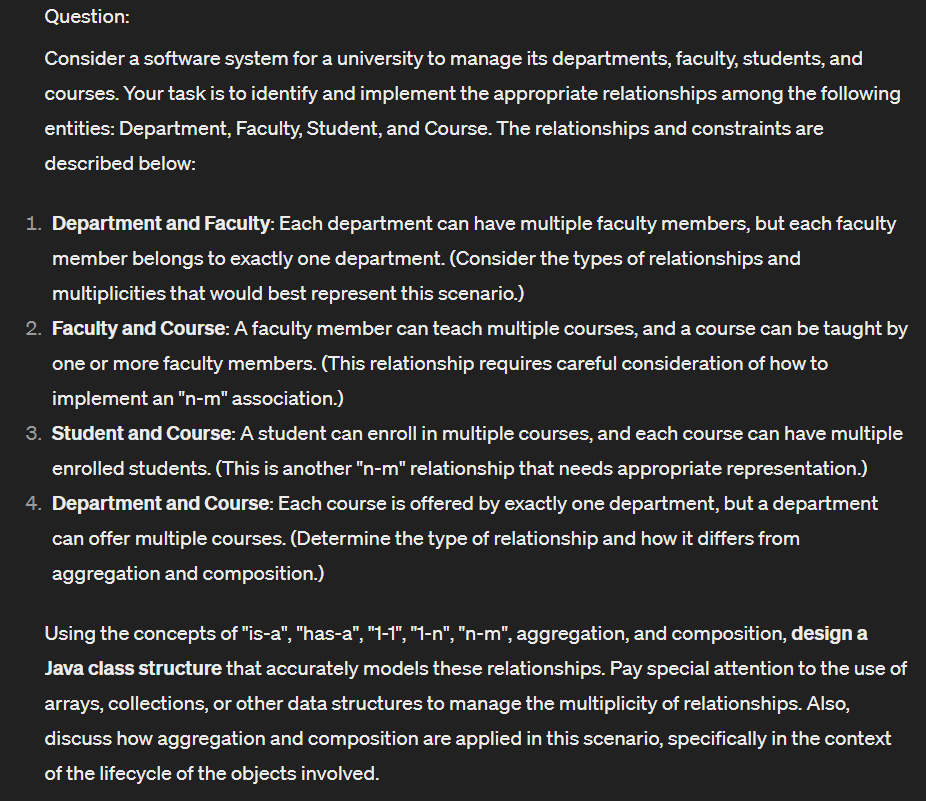
Question: Question: Consider a software system for a university to manage its departments, faculty, students, and courses. Your task is to identify and implement the appropriate
Question:
Consider a software system for a university to manage its departments, faculty, students, and
courses. Your task is to identify and implement the appropriate relationships among the following
entities: Department, Faculty, Student, and Course. The relationships and constraints are
described below:
Department and Faculty: Each department can have multiple faculty members, but each faculty
member belongs to exactly one department. Consider the types of relationships and
multiplicities that would best represent this scenario.
Faculty and Course: A faculty member can teach multiple courses, and a course can be taught by
one or more faculty members. This relationship requires careful consideration of how to
implement an nm association.
Student and Course: A student can enroll in multiple courses, and each course can have multiple
enrolled students. This is another relationship that needs appropriate representation.
Department and Course: Each course is offered by exactly one department, but a department
can offer multiple courses. Determine the type of relationship and how it differs from
aggregation and composition.
Using the concepts of isa "hasannm aggregation, and composition, design a
Java class structure that accurately models these relationships. Pay special attention to the use of
arrays, collections, or other data structures to manage the multiplicity of relationships. Also,
discuss how aggregation and composition are applied in this scenario, specifically in the context
of the lifecycle of the objects involved.
Step by Step Solution
There are 3 Steps involved in it
1 Expert Approved Answer
Step: 1 Unlock

Question Has Been Solved by an Expert!
Get step-by-step solutions from verified subject matter experts
Step: 2 Unlock
Step: 3 Unlock
 Study Help