







Question: Question: For the unit 7 Programming Assignment, we will implement a function grapher. Program that can plot a function that is in the form z
Question:
For the unit 7 Programming Assignment, we will implement a function grapher.
Program that can plot a function that is in the form
z = f(x,y)
Your program must generate input values between -1 and 1 in increments of .1 and use this to plot x, y, and z vertices to be included as part of a mesh that will then be graphically displayed.
If you would like you can implement the functionality to allow both the function to be mapped as expressed as a mathematical formula and the input values to be entered by the user of your program, however, this is optional.
Your program must implement mouse controls such that the function that you have mapped can be rotated and scaled using the mouse.
Your project MUST include a plane and an axis helper to provide a point of reference for your function that indicates the origin which is assumed to be x=0, y=0, and z=0.
The axis helper is an object that can be added to you scene that looks like the following and indicates the direction of x, y, and z within the scene.
Your completed project should look like the following example (you do not need to provide the input box in the upper right hand corner):
In the above example we are graphing the function z = f(x,y) where f(x,y) = x2 + y2. Your function grapher should be able to accommodate any function that can be expressed and evaluated as a mathematical function. In the case of the above example the input values of x and y are evaluated to produce a value of z producing the coordinates for a vertex. Although your program should be able to graph any function in the form z = f(x,y), you should use one of the following to submit as part of the assignment:
- produces a cone shape
- produces a hyperbolic paraboloid
NOTE: that if you implement the functionality to allow the user to enter any function that they want then this is NOT required so long as your program can graph any of them.
The input values can be generated using simple for loops as indicated below or by using one of the other examples that have been identified.
for (x=Min_x; x
{
for(y=Min_y; y
{
z = fun(x,y); // note that fun must evaluate the expression
new Vector3 ( ....);
}
}
Keep in mind that you must capture all of the vertices that you are defining and provide them as input into one of the geometry functions within Three.js. The ParametricGeometry object is perhaps the best one to use, however, if your research identifies another approach feel free to use it so long as you can achieve the same results.
Does the assignment demonstrate the ability to graph a given function? (Yes/No)
Does the assignment include one of the specified formulas or does it allow the user to enter the formula? (Yes/No)
Can the user rotate and scale the graphed function? (Yes/No)
Was an Axis helper included in the scene (the object that indicates the x, y, and z dimensions)? (Yes/No)
Was a plane (either solid or wireframe) perpendicular to the object at the origin included? (Yes/No)
Was the JavaScript / Three.js code well documented (Scale of 1-4 where 1 is no comments and 4 is comprehensive comments)
http://prntscr.com/13g5cjc
https://pastebin.com/fRtP4dCV
I almost have it, but im getting an error
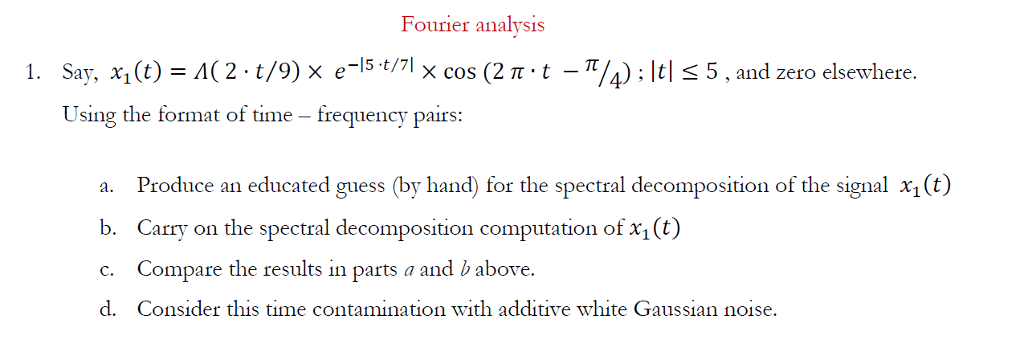
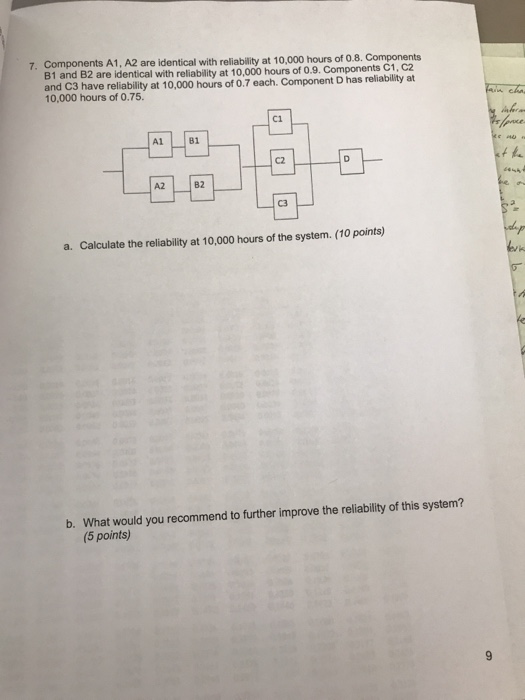


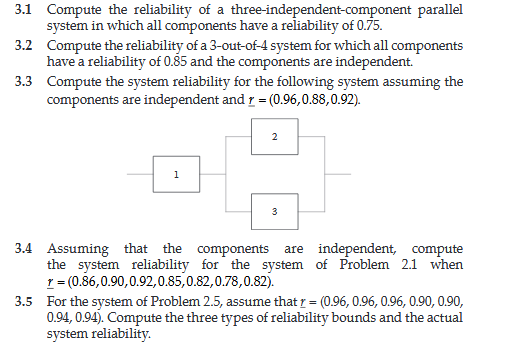
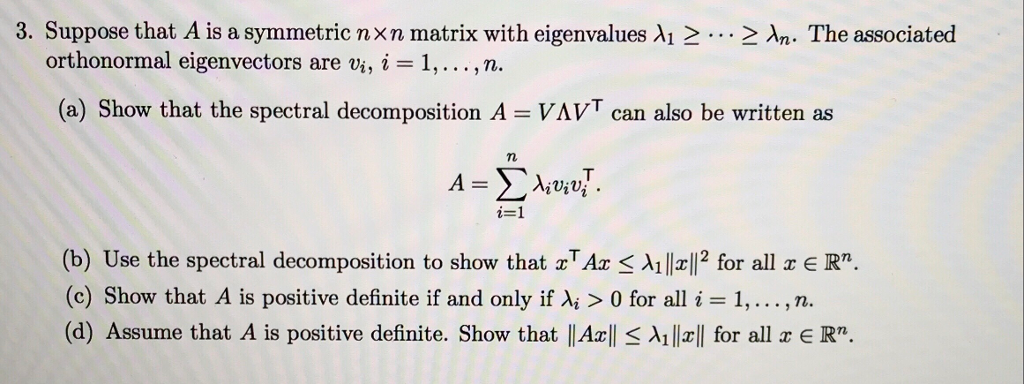
Fourier analysis 1. Say, X1 (t) = A( 2 . t/9) x e-15 .t/71 x cos (2 n . t - Tt/) ; It| $ 5 , and zero elsewhere. Using the format of time - frequency pairs: a. Produce an educated guess (by hand) for the spectral decomposition of the signal X, (t) b. Carry on the spectral decomposition computation of X, (t) c. Compare the results in parts a and b above. d. Consider this time contamination with additive white Gaussian noise.7. Components A1, A2 are identical with reliability at 10,000 hours of 0.8. Components B1 and B2 are identical with reliability at 10,000 hours of 0.9. Components C1, C2 and C3 have reliability at 10,000 hours of 0.7 each. Component D has reliability at 10,000 hours of 0.75. A1 D a. Calculate the reliability at 10,000 hours of the system. (10 points) b. What would you recommend to further improve the reliability of this system? (5 points) 93.1 Compute the reliability of a three-independent-component parallel system in which all components have a reliability of 0.75. 3.2 Compute the reliability of a 3-out-of-4 system for which all components have a reliability of 0.85 and the components are independent. 3.3 Compute the system reliability for the following system assuming the components are independent and r = (0.96,0.88,0.92). 2 1 3 3.4 Assuming that the components are independent, compute the system reliability for the system of Problem 2.1 when r = (0.86, 0.90, 0.92, 0.85, 0.82,0.78,0.82). 3.5 For the system of Problem 2.5, assume that y = (0.96, 0.96, 0.96, 0.90, 0.90, 0.94, 0.94). Compute the three types of reliability bounds and the actual system reliability.3. Suppose that A is a symmetric n xn matrix with eigenvalues A1 2 . . . 2 An. The associated orthonormal eigenvectors are vi, i = 1, ..., n. (a) Show that the spectral decomposition A = VAV can also be written as n A = > i=1 (b) Use the spectral decomposition to show that a Ar 0 for all i = 1, ..., n. (d) Assume that A is positive definite. Show that || Axl|
Step by Step Solution
There are 3 Steps involved in it

Get step-by-step solutions from verified subject matter experts
 Study Help