



Question: QUESTION FOUR As a small and medium-sized enterprise (SME), what are the main KUSATEXs management problems? How do they overcome the problem in the short
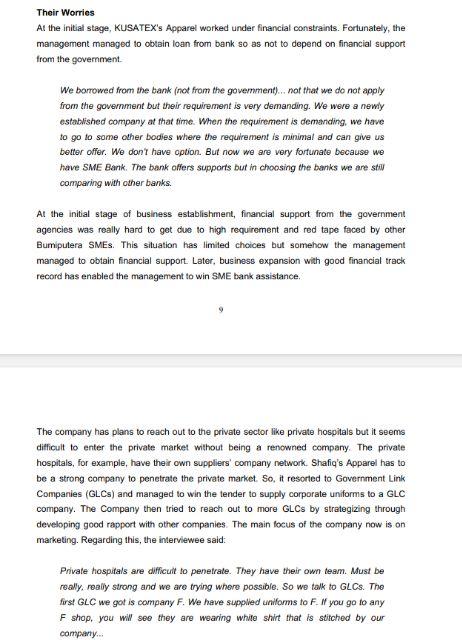
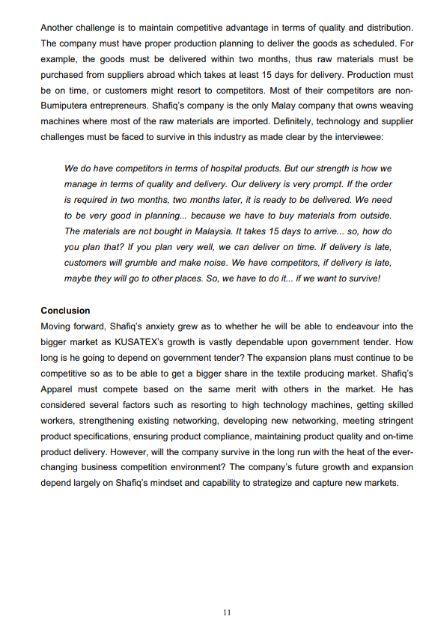
QUESTION FOUR As a small and medium-sized enterprise (SME), what are the main KUSATEXs management problems? How do they overcome the problem in the short run and a long run? (20m) QUESTION FIVE Discuss FIVE (5) suggestions that KUSATEX Group can make to remain competitive. (20m)Their Worries At the initial stage, KUSATEX's Apparel worked under financial constraints. Fortunately, the management managed to obtain loan from bank so as not to depend on financial support from the government. We borrowed from the bank (not from the government)... not that we do not apply from the government but their requirement is very demanding. We were a newly established company at that time. When the requirement is demanding, we have to go to some other bodies where the requirement is minimal and can give us better offer. We don't have option. But now we are very fortunate because we have SME Bank. The bank offers supports but in choosing the banks we are still comparing with other banks. At the initial stage of business establishment, financial support from the government agencies was really hard to get due to high requirement and red tape faced by other Bumiputera SMEs. This situation has limited choices but somehow the management managed to obtain financial support. Later, business expansion with good financial track record has enabled the management to win SME bank assistance. The company has plans to reach out to the private sector like private hospitals but it seems difficult to enter the private market without being a renowned company. The private hospitals, for example, have their own suppliers' company network. Shafiq's Apparel has to be a strong company to penetrate the private market. So, it resorted to Government Link Companies (GLCs) and managed to win the tender to supply corporate uniforms to a GLC company. The Company then tried to reach out to more GLCs by strategizing through developing good rapport with other companies. The main focus of the company now is on marketing. Regarding this, the interviewee said: Private hospitals are difficult to penetrate. They have their own team. Must be really, really strong and we are trying where possible. So we talk to GLCs. The first GLC we got is company F. We have supplied uniforms to F. If you go to any F shop, you will see they are wearing white shirt that is stitched by our company... Another challenge is to maintain competitive advantage in terms of quality and distribution. The company must have proper production planning to deliver the goods as scheduled. For example, the goods must be delivered within two months, thus raw materials must be purchased from suppliers abroad which takes at least 15 days for delivery. Production must be on time, or customers might resort to competitors. Most of their competitors are non- Bumiputera entrepreneurs. Shafiq's company is the only Malay company that owns weaving machines where most of the raw materials are imported. Definitely, technology and supplier challenges must be faced to survive in this industry as made clear by the interviewee: We do have competitors in terms of hospital products. But our strength is how we manage in terms of quality and delivery. Our delivery is very prompt. If the order is required in two months, two months later, it is ready to be delivered. We need to be very good in planning... because we have to buy materials from outside. The materials are not bought in Malaysia. It takes 5 days to amive... so, how do you plan that? If you plan very well, we can deliver on time. If delivery is late, customers will grumble and make noise. We have competitors, if delivery is late, maybe they will go to other places. So, we have to do it... if we want to survive! Conclusion Moving forward, Shafiq's anxiety grew as to whether he will be able to endeavour into the bigger market as KUSATEX's growth is vastly dependable upon government tender. How long is he going to depend on government tender? The expansion plans must continue to be competitive so as to be able to get a bigger share in the textile producing market. Shafiq's Apparel must compete based on the same merit with others in the market. He has considered several factors such as resorting to high technology machines, getting skilled workers, strengthening existing networking, developing new networking, meeting stringent product specifications, ensuring product compliance, maintaining product quality and on-time product delivery. However, will the company survive in the long run with the heat of the ever- changing business competition environment? The company's future growth and expansion depend largely on Shafiq's mindset and capability to strategize and capture new markets. 11
Step by Step Solution
There are 3 Steps involved in it
1 Expert Approved Answer
Step: 1 Unlock

Question Has Been Solved by an Expert!
Get step-by-step solutions from verified subject matter experts
Step: 2 Unlock
Step: 3 Unlock