



Question: Question I (2 Marks) Suggested word limit: 100 - 150 words Based on the case study and your understanding of the ungraded questions, give a
Question I (2 Marks)
Suggested word limit: 100 - 150 words
Based on the case study and your understanding of the ungraded questions, give a summary of the major leadership and team problems at FireArt. (Give the summary in 4-5 points).
| Grading Criteria | Marks |
| Major problems at FineArt (Summary) |
Question II (12 Marks)
Suggested word limit: 200 - 250 words
The FireArt team responsible to plan and execute actions to overhaul the organisation within 6 months is deeply demotivated to work both individually and collectively. List and elaborate on two ways which Eric Holt and CEO Jack Derry can take in order to intrinsically and extrinsically motivate the team.
| Grading Criteria | Marks |
| Listing 2 intrinsic motivators | 2 (1 mark each) |
| Listing 2 extrinsic motivators | 2 (1 mark each) |
| Elaboration for intrinsic motivators | 4 (2 marks each) |
| Elaboration for extrinsic motivators | 4 (2 marks each) |
| Total | 12 |
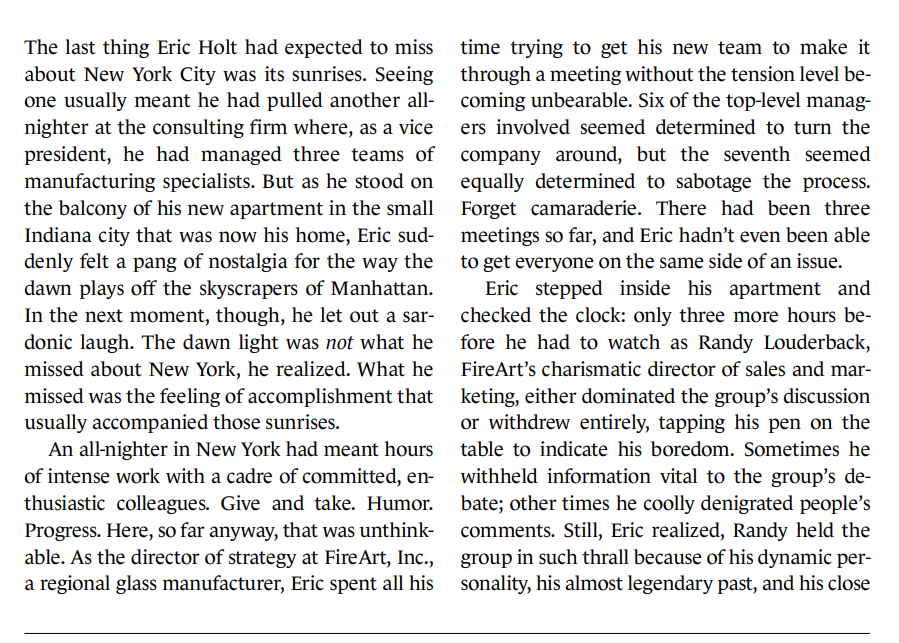
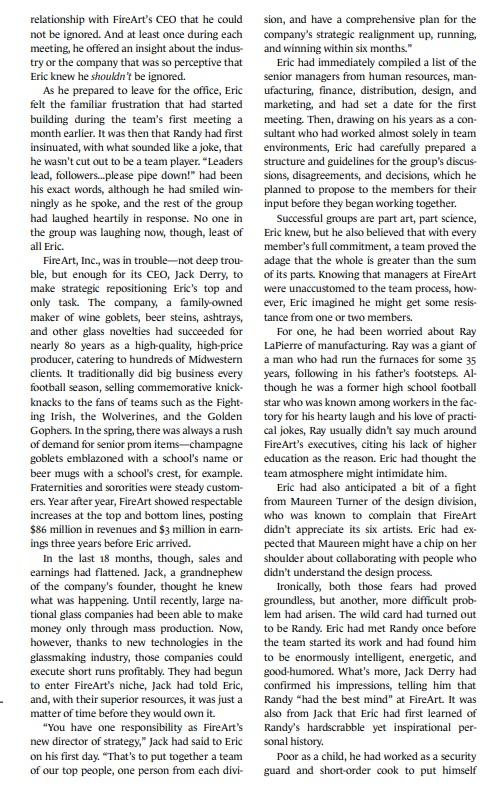
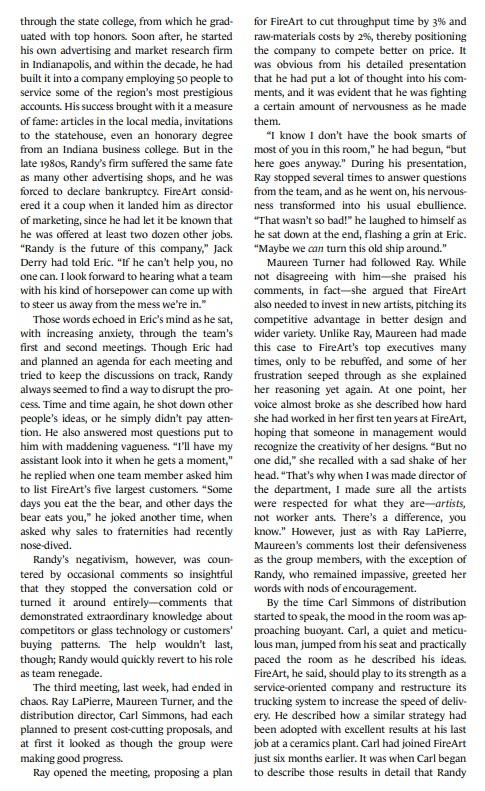
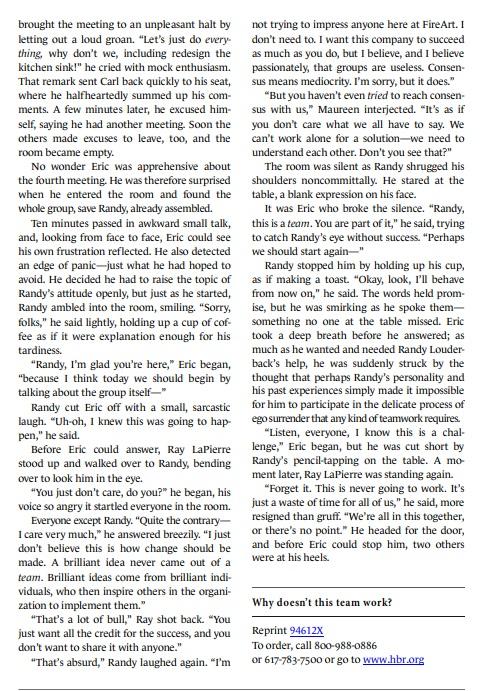
The last thing Eric Holt had expected to miss about New York City was its sunrises. Seeing one usually meant he had pulled another all- nighter at the consulting firm where, as a vice president, he had managed three teams of manufacturing specialists. But as he stood on the balcony of his new apartment in the small Indiana city that was now his home, Eric sud- denly felt a pang of nostalgia for the way the dawn plays off the skyscrapers of Manhattan. In the next moment, though, he let out a sar- donic laugh. The dawn light was not what he missed about New York, he realized. What he missed was the feeling of accomplishment that usually accompanied those sunrises. An all-nighter in New York had meant hours of intense work with a cadre of committed, en- thusiastic colleagues. Give and take. Humor. Progress. Here, so far anyway, that was unthink- able. As the director of strategy at Fire Art, Inc., a regional glass manufacturer, Eric spent all his time trying to get his new team to make it through a meeting without the tension level be- coming unbearable. Six of the top-level manag- ers involved seemed determined to turn the company around, but the seventh seemed equally determined to sabotage the process. Forget camaraderie. There had been three meetings so far, and Eric hadn't even been able to get everyone on the same side of an issue. Eric stepped inside his apartment and checked the clock: only three more hours be- fore he had to watch as Randy Louderback, FireArt's charismatic director of sales and mar- keting, either dominated the group's discussion or withdrew entirely, tapping his pen on the table to indicate his boredom. Sometimes he withheld information vital to the group's de- bate; other times he coolly denigrated people's comments. Still, Eric realized, Randy held the group in such thrall because of his dynamic per- sonality, his almost legendary past, and his close relationship with FireArt's CEO that he could not be ignored. And at least once during each meeting, he offered an insight about the indus- try or the company that was so perceptive that Eric knew he shouldn't be ignored. As he prepared to leave for the office, Eric felt the familiar frustration that had started building during the team's first meeting a month earlier. It was then that Randy had first insinuated, with what sounded like a joke, that he wasn't cut out to be a team player. "Leaders lead, followers...please pipe down!" had been his exact words, although he had smiled win- ningly as he spoke, and the rest of the group had laughed heartily in response. No one in the group was laughing now, though, least of all Eric. Fire Art, Inc., was in trouble-not deep trou- ble, but enough for its CEO, Jack Derry, to make strategic repositioning Eric's top and only task. The company, a family-owned maker of wine goblets, beer steins, ashtrays, and other glass novelties had succeeded for nearly 80 years as a high-quality, high-price producer, catering to hundreds of Midwestern clients. It traditionally did big business every football season, selling commemorative knick- knacks to the fans of teams such as the Fight- ing Irish, the Wolverines, and the Golden Gophers. In the spring, there was always a rush of demand for senior prom items-champagne goblets emblazoned with a school's name or beer mugs with a school's crest, for example. Fraternities and sororities were steady custom- ers. Year after year, FireArt showed respectable increases at the top and bottom lines, posting $86 million in revenues and $3 million in earn- ings three years before Eric arrived. In the last 18 months, though, sales and earnings had flattened. Jack, a grandnephew of the company's founder, thought he knew what was happening. Until recently, large na- tional glass companies had been able to make money only through mass production. Now, however, thanks to new technologies in the glassmaking industry, those companies could execute short runs profitably. They had begun to enter FireArt's niche, Jack had told Eric, and, with their superior resources, it was just a matter of time before they would own it. "You have one responsibility as FireArt's new director of strategy," Jack had said to Eric on his first day. "That's to put together a team of our top people, one person from each divi- sion, and have a comprehensive plan for the company's strategic realignment up, running, and winning within six months." Eric had immediately compiled a list of the senior managers from human resources, man- ufacturing, finance, distribution, design, and marketing, and had set a date for the first meeting. Then, drawing on his years as a con- sultant who had worked almost solely in team environments, Eric had carefully prepared a structure and guidelines for the group's discus- sions, disagreements, and decisions, which he planned to propose to the members for their input before they began working together. Successful groups are part art, part science, Eric knew, but he also believed that with every member's full commitment, a team proved the adage that the whole is greater than the sum of its parts. Knowing that managers at FireArt were unaccustomed to the team process, how- ever, Eric imagined he might get some resis- tance from one or two members. For one, he had been worried about Ray LaPierre of manufacturing. Ray was a giant of a man who had run the furnaces for some 35 years, following in his father's footsteps. Al- though he was a former high school football star who was known among workers in the fac- tory for his hearty laugh and his love of practi- cal jokes, Ray usually didn't say much around FireArt's executives, citing his lack of higher education as the reason. Eric had thought the team atmosphere might intimidate him. Eric had also anticipated a bit of a fight from Maureen Turner of the design division, who was known to complain that FireArt didn't appreciate its six artists. Eric had ex- pected that Maureen might have a chip on her shoulder about collaborating with people who didn't understand the design process. Ironically, both those fears had proved groundless, but another, more difficult prob- lem had arisen. The wild card had turned out to be Randy. Eric had met Randy once before the team started its work and had found him to be enormously intelligent, energetic, and good-humored. What's more, Jack Derry had confirmed his impressions, telling him that Randy "had the best mind" at FireArt. It was also from Jack that Eric had first learned of Randy's hardscrabble yet inspirational per- sonal history. Poor as a child, he had worked as a security guard and short-order cook to put himself through the state college, from which he grad- uated with top honors. Soon after, he started his own advertising and market research firm in Indianapolis, and within the decade, he had built it into a company employing 50 people to service some of the region's most prestigious accounts. His success brought with it a measure of fame: articles in the local media, invitations to the statehouse, even an honorary degree from an Indiana business college. But in the late 1980s, Randy's firm suffered the same fate as many other advertising shops, and he was forced to declare bankruptcy. FireArt consid- ered it a coup when it landed him as director of marketing, since he had let it be known that he was offered at least two dozen other jobs. "Randy is the future of this company," Jack Derry had told Eric. "If he can't help you, no one can. I look forward to hearing what a team with his kind of horsepower can come up with to steer us away from the mess we're in." Those words echoed in Eric's mind as he sat, with increasing anxiety, through the team's first and second meetings. Though Eric had and planned an agenda for each meeting and tried to keep the discussions on track, Randy always seemed to find a way to disrupt the pro- cess. Time and time again, he shot down other people's ideas, or he simply didn't pay atten- tion. He also answered most questions put to him with maddening vagueness. "I'll have my assistant look into it when he gets a moment," he replied when one team member asked him to list FireArt's five largest customers. "Some days you eat the the bear, and other days the bear eats you," he joked another time, when asked why sales to fraternities had recently nose-dived. Randy's negativism, however, was coun tered by occasional comments so insightful that they stopped the conversation cold or turned it around entirely-comments that demonstrated extraordinary knowledge about competitors or glass technology or customers' buying patterns. The help wouldn't last, though; Randy would quickly revert to his role as team renegade. The third meeting, last week, had ended in chaos. Ray LaPierre, Maureen Turner, and the distribution director, Carl Simmons, had each planned to present cost-cutting proposals, and at first it looked as though the group were making good progress. Ray opened the meeting, proposing a plan for FireArt to cut throughput time by 3% and raw-materials costs by 2%, thereby positioning the company to compete better on price. It was obvious from his detailed presentation that he had put a lot of thought into his com- ments, and it was evident that he was fighting a certain amount of nervousness as he made them. "I know I don't have the book smarts of most of you in this room," he had begun, "but here goes anyway." During his presentation, Ray stopped several times to answer questions from the team, and as he went on, his nervous- ness transformed into his usual ebullience. "That wasn't so bad!" he laughed to himself as he sat down at the end, flashing a grin at Eric. "Maybe we can turn this old ship around." Maureen Turner had followed Ray. While not disagreeing with him-she praised his comments, in fact-she argued that FireArt also needed to invest in new artists, pitching its competitive advantage in better design and wider variety. Unlike Ray, Maureen had made this case to FireArt's top executives many times, only to be rebuffed, and some of her frustration seeped through as she explained her reasoning yet again. At one point, her voice almost broke as she described how hard she had worked in her first ten years at FireArt, hoping that someone in management would recognize the creativity of her designs. "But no one did," she recalled with a sad shake of her head. "That's why when I was made director of the department, I made sure all the artists were respected for what they are-artists, not worker ants. There's a difference, you know." However, just as with Ray LaPierre, Maureen's comments lost their defensiveness as the group members, with the exception of Randy, who remained impassive, greeted her words with nods of encouragement. By the time Carl Simmons of distribution started to speak, the mood in the room was ap- proaching buoyant. Carl, a quiet and meticu- lous man, jumped from his seat and practically paced the room as he described his ideas. FireArt, he said, should play to its strength as a service-oriented company and restructure its trucking system to increase the speed of deliv- ery. He described how a similar strategy had been adopted with excellent results at his last job at a ceramics plant. Carl had joined FireArt just six months earlier. It was when Carl began to describe those results in detail that Randy brought the meeting to an unpleasant halt by letting out a loud groan. "Let's just do every thing, why don't we, including redesign the kitchen sink!" he cried with mock enthusiasm. That remark sent Carl back quickly to his seat, where he halfheartedly summed up his com- ments. A few minutes later, he excused him- self, saying he had another meeting. Soon the others made excuses to leave, too, and the room became empty. No wonder Eric was apprehensive about the fourth meeting. He was therefore surprised when he entered the room and found the whole group, save Randy, already assembled. Ten minutes passed in awkward small talk, and, looking from face to face, Eric could see his own frustration reflected. He also detected an edge of panic-just what he had hoped to avoid. He decided he had to raise the topic of Randy's attitude openly, but just as he started, Randy ambled into the room, smiling. "Sorry, folks," he said lightly, holding up a cup of cof- fee as if it were explanation enough for his tardiness. "Randy, I'm glad you're here," Eric began, "because I think today we should begin by talking about the group itself-" Randy cut Eric off with a small, sarcastic laugh. "Uh-oh, I knew this was going to hap- pen," he said. Before Eric could answer, Ray LaPierre stood up and walked over to Randy, bending over to look him in the eye. "You just don't care, do you?" he began, his voice so angry it startled everyone in the room. Everyone except Randy. "Quite the contrary- I care very much," he answered breezily. "I just don't believe this is how change should be made. A brilliant idea never came out of a team. Brilliant ideas come from brilliant indi- viduals, who then inspire others in the organi- zation to implement them." "That's a lot of bull," Ray shot back. "You just want all the credit for the success, and you don't want to share it with anyone." "That's absurd," Randy laughed again. "I'm not trying to impress anyone here at FireArt. I don't need to. I want this company to succeed as much as you do, but I believe, and I believe passionately, that groups are useless. Consen- sus means mediocrity. I'm sorry, but it does." "But you haven't even tried to reach consen- sus with us," Maureen interjected. "It's as if you don't care what we all have to say. We can't work alone for a solution-we need to understand each other. Don't you see that?" The room was silent as Randy shrugged his shoulders noncommittally. He stared at the table, a blank expression on his face. It was Eric who broke the silence. "Randy, this is a team. You are part of it," he said, trying to catch Randy's eye without success. "Perhaps we should start again-" Randy stopped him by holding up his cup, as if making a toast. "Okay, look, I'll behave from now on," he said. The words held prom- ise, but he was smirking as he spoke them- something no one at the table missed. Eric took a deep breath before he answered; as much as he wanted and needed Randy Louder- back's help, he was suddenly struck by the thought that perhaps Randy's personality and his past experiences simply made it impossible for him to participate in the delicate process of ego surrender that any kind of teamwork requires. "Listen, everyone, I know this is a chal- lenge," Eric began, but he was cut short by Randy's pencil-tapping on the table. A mo- ment later, Ray LaPierre was standing again. "Forget it. This is never going to work. It's just a waste of time for all of us," he said, more resigned than gruff. "We're all in this together, or there's no point." He headed for the door, and before Eric could stop him, two others were at his heels. Why doesn't this team work? Reprint 94612X To order, call 800-988-0886 or 617-783-7500 or go to www.hbr.org
Step by Step Solution
There are 3 Steps involved in it
1 Expert Approved Answer
Step: 1 Unlock

Question Has Been Solved by an Expert!
Get step-by-step solutions from verified subject matter experts
Step: 2 Unlock
Step: 3 Unlock