







Question: Question I (Wireless Local Area Networks) a) We know that compared to the Access Point (AP), Stations (STA) often have a fewer number of antenna
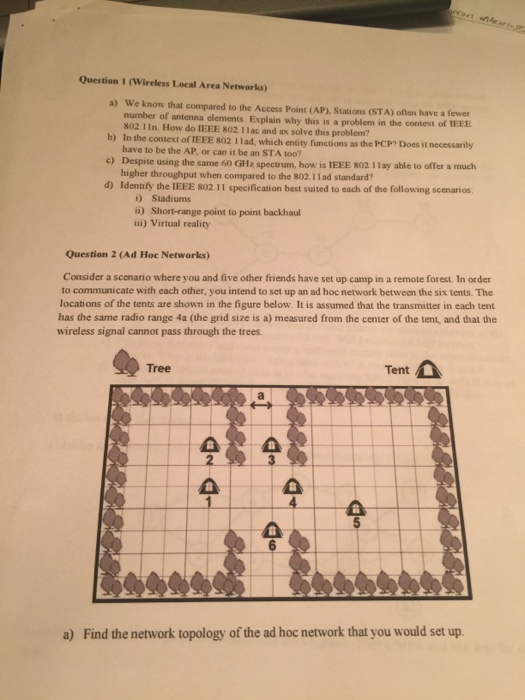
Question I (Wireless Local Area Networks) a) We know that compared to the Access Point (AP), Stations (STA) often have a fewer number of antenna elements. Explain why this is a problem in the context of IEEE b) In the context of TEEE 802.1lad, which entity functions as the PCP? Does it necessarily c) Despite using the same 60 GHz spectrum, how is TEEE 802. 11ay able to offer a much d) Identify the IEEE 802 11 specification best suited to each of the following scenarios 802 11n. How do IEEE 802 11ac and ax solve this problem? have to be the AP, or can it be an STA too? higher throughput when compared to the 802. 11 ad standard i) Stadiums ii) Short-range point to point backhaul ili) Virtual reality Question 2 (Ad Hoc Networks) Consider a scenario where you and five other friends have set up camp in a remote forest. In order to communicate with each other, you intend to set up an ad hoc network between the six tents. The locations of the tents are shown in the figure below. It is assumed that the transmitter in each tent has the same radio range 4a (the grid size is a) measured from the center of the tent, and that the wireless signal cannot pass through the trees Tent Tree a) Find the network topology of the ad hoc network that you would set up
Step by Step Solution
There are 3 Steps involved in it

Get step-by-step solutions from verified subject matter experts
 Study Help