







Question: Question: Implement the below assignment ,please, use python3 Question: Implement the below assignment ,please, use python3 Logical time plays an important role in designing a
Question: Implement the below assignment ,please, use python3
Question: Implement the below assignment ,please, use python3
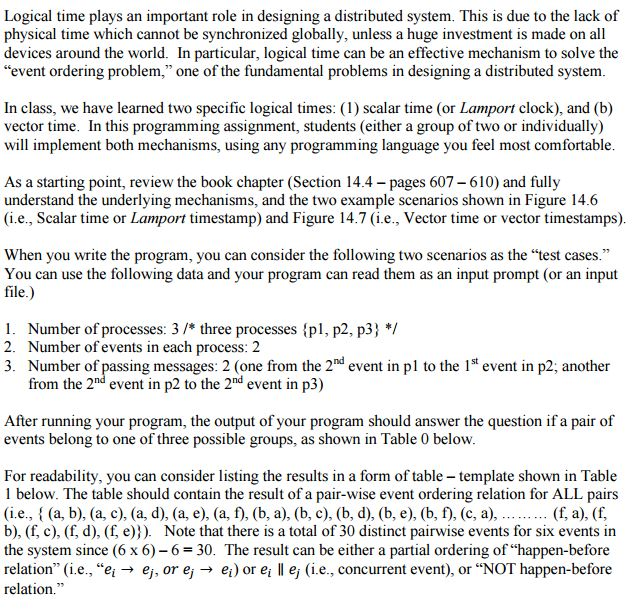
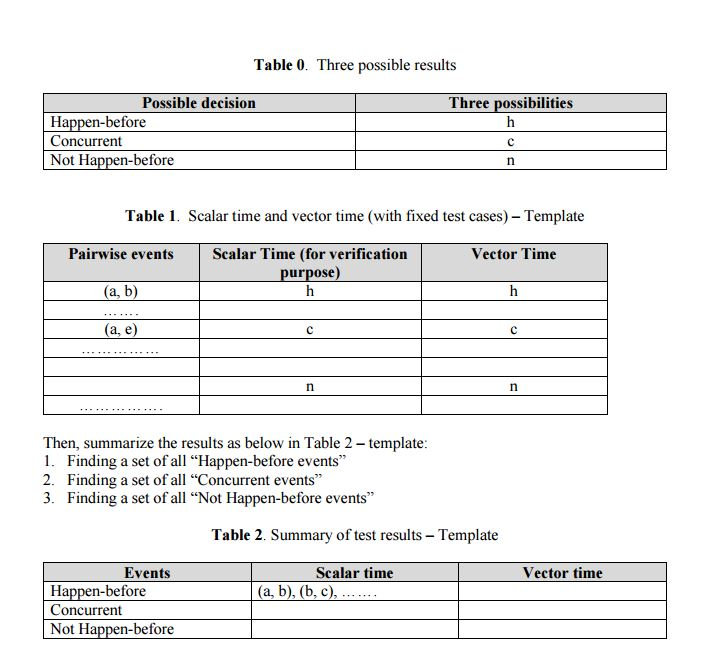
Logical time plays an important role in designing a distributed system. This is due to the lack of physical time which cannot be synchronized globally, unless a huge investment is made on all devices around the world. In particular, logical time can be an effective mechanism to solve the "event ordering problem," one of the fundamental problems in designing a distributed system. In class, we have learned two specific logical times: (1)scalar time (or Lamport clock), and (b) vector time. In this programming assignment, students (either a group of two or individually) will implement both mechanisms, using any programming language you feel most comfortable As a starting point, review the book chapter (Section l4.4-pages 607-610) and fully understand the underlying mechanisms, and the two example scenarios shown in Figure 14.6 (i.ee., Scalar time or Lamport timestamp) and Figure 14.7 (i.ee., Vector time or vector timestamps) When you write the program, you can consider the following two scenarios as the "test cases You can use the following data and your program can read them as an input prompt (or an input file.) l. Number of processes: 3 three processes (pl, p2, p3) 2. Number of events in each process: 2 3. Number of passing messages 2 (one from the 2nd event in pl to the 1st event in p2; another from the 2nd event in the 2nd event in After running your program, the output of your program should answer the question if a pair of events belong to one of three possible groups, as shown in Table 0 below For readability, you can consider listing the results in a form of table-template shown in Table l below. The table should contain the result of a pair-wise event ordering relation for ALL pairs (i.e., (a, b), (a, c), (a, d), (a, e), (a, f (b, a), (b, c), (b, d), (b, e, (b, f (c, a) (f, a), (f, b), (f c), (f, d), (f, e))) Note that there is a total of 30 distinct pairwise events for six events in the system since (6 x 6)-6 30. The result can be either a partial ordering of "happen-before relation (i.e., ei ej, or ej ei) or ei ill ei (i.e., concurrent event), or "NOT happen-before relation Logical time plays an important role in designing a distributed system. This is due to the lack of physical time which cannot be synchronized globally, unless a huge investment is made on all devices around the world. In particular, logical time can be an effective mechanism to solve the "event ordering problem," one of the fundamental problems in designing a distributed system. In class, we have learned two specific logical times: (1)scalar time (or Lamport clock), and (b) vector time. In this programming assignment, students (either a group of two or individually) will implement both mechanisms, using any programming language you feel most comfortable As a starting point, review the book chapter (Section l4.4-pages 607-610) and fully understand the underlying mechanisms, and the two example scenarios shown in Figure 14.6 (i.ee., Scalar time or Lamport timestamp) and Figure 14.7 (i.ee., Vector time or vector timestamps) When you write the program, you can consider the following two scenarios as the "test cases You can use the following data and your program can read them as an input prompt (or an input file.) l. Number of processes: 3 three processes (pl, p2, p3) 2. Number of events in each process: 2 3. Number of passing messages 2 (one from the 2nd event in pl to the 1st event in p2; another from the 2nd event in the 2nd event in After running your program, the output of your program should answer the question if a pair of events belong to one of three possible groups, as shown in Table 0 below For readability, you can consider listing the results in a form of table-template shown in Table l below. The table should contain the result of a pair-wise event ordering relation for ALL pairs (i.e., (a, b), (a, c), (a, d), (a, e), (a, f (b, a), (b, c), (b, d), (b, e, (b, f (c, a) (f, a), (f, b), (f c), (f, d), (f, e))) Note that there is a total of 30 distinct pairwise events for six events in the system since (6 x 6)-6 30. The result can be either a partial ordering of "happen-before relation (i.e., ei ej, or ej ei) or ei ill ei (i.e., concurrent event), or "NOT happen-before relation
Step by Step Solution
There are 3 Steps involved in it

Get step-by-step solutions from verified subject matter experts
 Study Help