







Question: Question: In a laboratory setting, how do we determine the pressure drop caused by the flow of fluid through an orifice plate, the flow using
Question:
In a laboratory setting, how do we determine the pressure drop caused by the flow of fluid through an orifice plate, the flow using an orifice meter, and the corrective coefficient C of an orifice plate? Explain why it is important to find and how we find it in a lab setting in detail. be as specific as possible
Given:
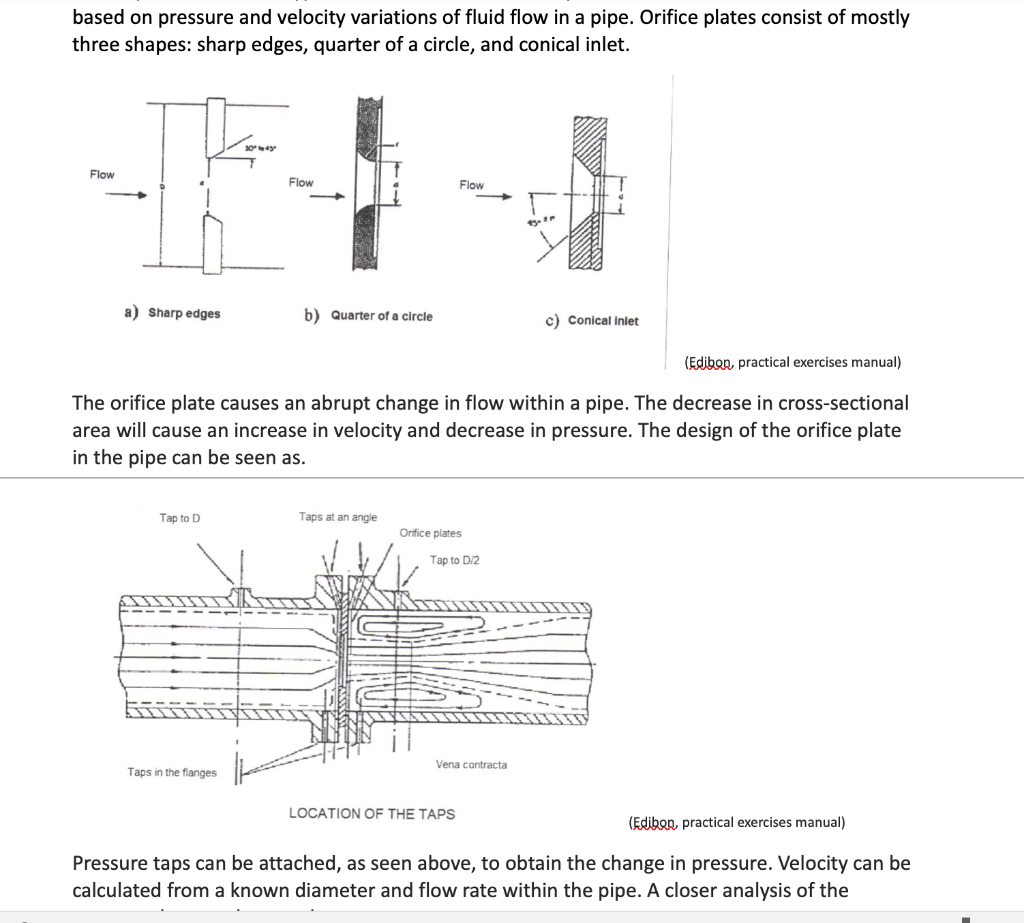
based on pressure and velocity variations of fluid flow in a pipe. Orifice plates consist of mostly three shapes: sharp edges, quarter of a circle, and conical inlet. NO Flow Flow Flow a) Sharp edges b) Quarter of a circle c) Conical Inlet (Ediben, practical exercises manual) The orifice plate causes an abrupt change in flow within a pipe. The decrease in cross-sectional area will cause an increase in velocity and decrease in pressure. The design of the orifice plate in the pipe can be seen as. Tap to D Taps at an angle Orifice plates Tap to D/2 Vena contracta Taps in the flanges LOCATION OF THE TAPS (Ediben, practical exercises manual) Pressure taps can be attached, as seen above, to obtain the change in pressure. Velocity can be calculated from a known diameter and flow rate within the pipe. A closer analysis of the a
Step by Step Solution
There are 3 Steps involved in it

Get step-by-step solutions from verified subject matter experts
 Study Help