







Question: *Question involves MATLAB 1) We've seen that low and high Reynolds number flows can differ, and when this occurs to get a complete solution we
*Question involves MATLAB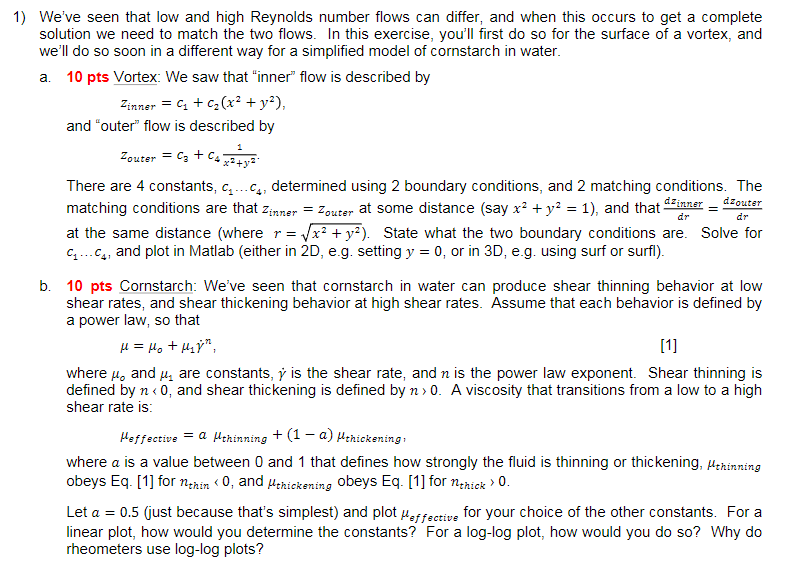
1) We've seen that low and high Reynolds number flows can differ, and when this occurs to get a complete solution we need to match the two flows. In this exercise, you'll first do so for the surface of a vortex, and we'll do so soon in a different way for a simplified model of cornstarch in water. a. 10 pts Vortex: We saw that "inner" flow is described by Zinner = + (x + y), and "outer" flow is described by 1 Zouter = C + C4x+y- There are 4 constants, c.c, determined using 2 boundary conditions, and 2 matching conditions. The matching conditions are that Zinner = Zouter at some distance (say x + y = 1), and that dzinner: dr dzouter dr at the same distance (where r = x + y). State what the two boundary conditions are. Solve for ..., and plot in Matlab (either in 2D, e.g. setting y = 0, or in 3D, e.g. using surf or surfl). b. 10 pts Cornstarch: We've seen that cornstarch in water can produce shear thinning behavior at low shear rates, and shear thickening behavior at high shear rates. Assume that each behavior is defined by a power law, so that = + Mijn, [1] where , and are constants, y is the shear rate, and n is the power law exponent. Shear thinning is defined by n 0. A viscosity that transitions from a low to a high shear rate is: Meffective = a Mthinning + (1 a) Mthickening, where a is a value between 0 and 1 that defines how strongly the fluid is thinning or thickening, Mehinning obeys Eq. [1] for nehin 0. Let a = 0.5 (just because that's simplest) and plot effective for your choice of the other constants. For a linear plot, how would you determine the constants? For a log-log plot, how would you do so? Why do rheometers use log-log plots
Step by Step Solution
There are 3 Steps involved in it

Get step-by-step solutions from verified subject matter experts
 Study Help