



Question: Question is in the picture below 4. Let's recall the definition of horizontal/slant asymptote. Let f be a function defined at least on an interval
Question is in the picture below
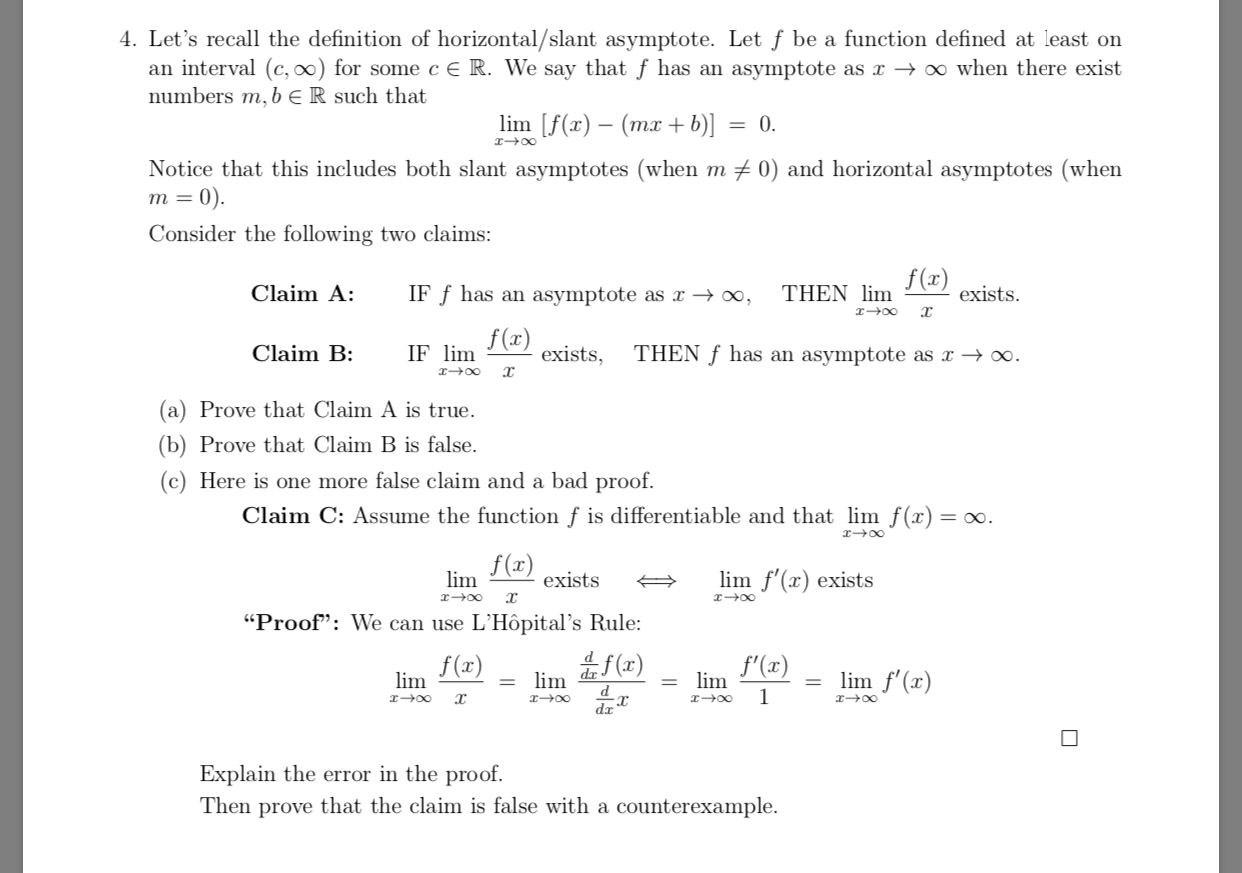
4. Let's recall the definition of horizontal/slant asymptote. Let f be a function defined at least on an interval (c, co) for some c E R. We say that f has an asymptote as x - co when there exist numbers m, b E R such that lim [f(x) - (max + b)] = 0. Notice that this includes both slant asymptotes (when m * 0) and horizontal asymptotes (when m = 0). Consider the following two claims: Claim A: IF f has an asymptote as x - co, THEN lim f(x) exists. I-+Do Claim B: IF lim f(x) exists, THEN f has an asymptote as + co. I-+DO (a) Prove that Claim A is true. (b) Prove that Claim B is false. (c) Here is one more false claim and a bad proof. Claim C: Assume the function f is differentiable and that lim f(x) = co. lim f(x) exists lim f'(x) exists I-+00 I-+00 "Proof": We can use L'Hopital's Rule: lim f(x) lim de f (x) f'(x) = lim = lim f'(x) I-+00 I-+00 ax I-+00 I-+00 0 Explain the error in the proof. Then prove that the claim is false with a counterexample
Step by Step Solution
There are 3 Steps involved in it

Get step-by-step solutions from verified subject matter experts