





Question: Question One (5 points): Three states: State A State B, and State Care concerned about the rising military power and intentions of State Z. States
Question One (5 points): Three states: State A
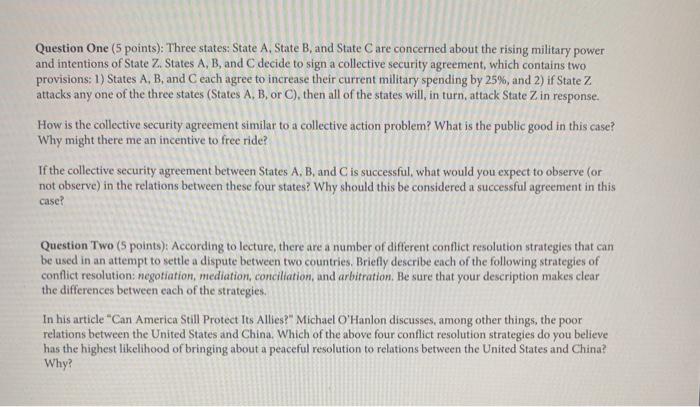
Question One (5 points): Three states: State A State B, and State Care concerned about the rising military power and intentions of State Z. States A, B, and C decide to sign a collective security agreement, which contains two provisions: 1) States A, B, and each agree to increase their current military spending by 25%, and 2) if State Z attacks any one of the three states (States A, B, or C), then all of the states will, in turn, attack State Z in response. How is the collective security agreement similar to a collective action problem? What is the public good in this case? Why might there me an incentive to free ride? If the collective security agreement between States A, B, and C is successful, what would you expect to observe (or not observe) in the relations between these four states? Why should this be considered a successful agreement in this case? Question Two (5 points): According to lecture, there are a number of different conflict resolution strategies that can be used in an attempt to settle a dispute between two countries. Briefly describe each of the following strategies of conflict resolution: negotiation, mediation, conciliation, and arbitration. Be sure that your description makes clear the differences between each of the strategies. In his article "Cari America Still Protect Its Allies?" Michael O'Hanlon discusses, among other things, the poor relations between the United States and China. Which of the above four conflict resolution strategies do you believe has the highest likelihood of bringing about a peaceful resolution to relations between the United States and China? Why

Step by Step Solution

There are 3 Steps involved in it

1 Expert Approved Answer
Step: 1 Unlock blur-text-image

Question Has Been Solved by an Expert!

Get step-by-step solutions from verified subject matter experts

Step: 2 Unlock
Step: 3 Unlock

Students Have Also Explored These Related General Management Questions!