







Question: QUESTION ONE a) A risk averse individual has an Arrow-Pratt ARA coefficient of 2. The individual is considering buying insurance for a risk that involves
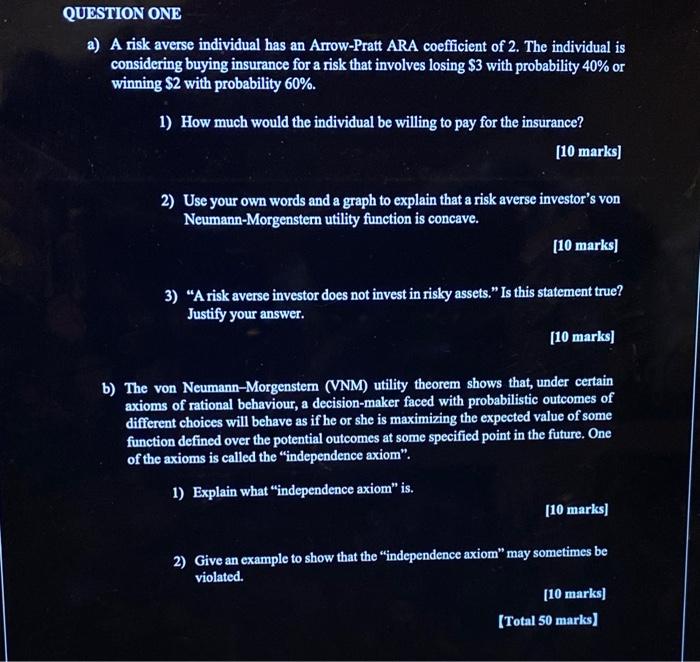
QUESTION ONE a) A risk averse individual has an Arrow-Pratt ARA coefficient of 2. The individual is considering buying insurance for a risk that involves losing $3 with probability 40% or winning $2 with probability 60%. 1) How much would the individual be willing to pay for the insurance? [10 marks) 2) Use your own words and a graph to explain that a risk averse investor's von Neumann-Morgenstern utility function is concave. (10 marks) 3) A risk averse investor does not invest in risky assets. Is this statement true? Justify your answer. [10 marks) b) The von Neumann-Morgenstern (VNM) utility theorem shows that, under certain axioms of rational behaviour, a decision-maker faced with probabilistic outcomes of different choices will behave as if he or she is maximizing the expected value of some function defined over the potential outcomes at some specified point in the future. One of the axioms is called the independence axiom". 1) Explain what independence axiom" is. [10 marks) 2) Give an example to show that the independence axiom" may sometimes be violated. [10 marks] (Total 50 marks) QUESTION ONE a) A risk averse individual has an Arrow-Pratt ARA coefficient of 2. The individual is considering buying insurance for a risk that involves losing $3 with probability 40% or winning $2 with probability 60%. 1) How much would the individual be willing to pay for the insurance? [10 marks) 2) Use your own words and a graph to explain that a risk averse investor's von Neumann-Morgenstern utility function is concave. (10 marks) 3) A risk averse investor does not invest in risky assets. Is this statement true? Justify your answer. [10 marks) b) The von Neumann-Morgenstern (VNM) utility theorem shows that, under certain axioms of rational behaviour, a decision-maker faced with probabilistic outcomes of different choices will behave as if he or she is maximizing the expected value of some function defined over the potential outcomes at some specified point in the future. One of the axioms is called the independence axiom". 1) Explain what independence axiom" is. [10 marks) 2) Give an example to show that the independence axiom" may sometimes be violated. [10 marks] (Total 50 marks)
Step by Step Solution
There are 3 Steps involved in it

Get step-by-step solutions from verified subject matter experts
 Study Help