







Question: Question One: Explain the difference between an efficient market and an arbitrage-free market 12 Marks) Question Two: a) Describe the three different forms of the
![of the Emicient Markets Hypothesis 3 Marks] b) Discuss the implications of](https://dsd5zvtm8ll6.cloudfront.net/si.experts.images/questions/2024/10/67010585bf31f_1976701058524d79.jpg)
![the Efficient Markets Hypothesis. Marks] c At the quarterly meeting of the](https://dsd5zvtm8ll6.cloudfront.net/si.experts.images/questions/2024/10/6701058698b52_1986701058613614.jpg)
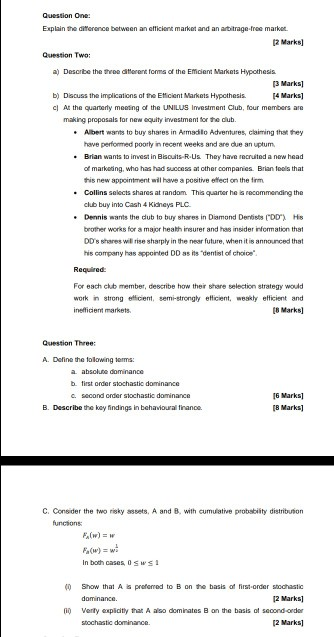
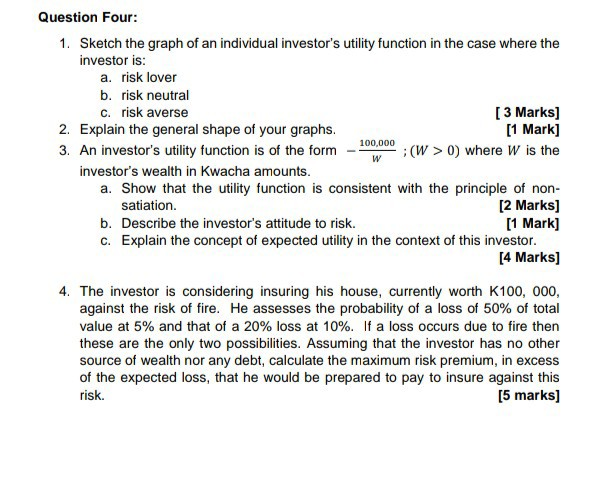
Question One: Explain the difference between an efficient market and an arbitrage-free market 12 Marks) Question Two: a) Describe the three different forms of the Emicient Markets Hypothesis 3 Marks] b) Discuss the implications of the Efficient Markets Hypothesis. Marks] c At the quarterly meeting of the UNILUS Investment Club, four members are making proposals for new equity investment for the club. . Albert wants to buy shares in Armadio Adventures, claiming that they have performed poorly in recent weeks and are due an uptum Brian wants to invest in Biscuits R Us They have recruited a new head of marketing, who has had an other companies. Brian fools that this new appointment will have a positive effect on the firm Collins selects shares at random. This quarter he is recommending the club buy into Cash 4 Kidneys PLC Dennis wants the dub to buy shoes in Diamond Dentist (DD) His brother works for a major health insurer and has insider information that DD's Shares will rise sharply in the near future, when it is announced that his company has appointed DD se dentist of choice Required: For each club member, describe how their store selection strategy would work in strong ethicient, semi-strongly efficient, weakly efficient and inefficient markets [8 Marks] Question Three A. Define the following terms: a absolute dominance b. first order stochastic dominance c. second onder stochastic dominance B. Describe the key findings in behavioural finance 16 Marks] 18 Marks] C. Consider the two risky assets A and B with cumulative protbility distribution functions F.(W) = In both cases, O SWS1 Show that A preferred to B on the basis of first-order stochastic dominance 12 Marks] Verly explicitly that also dominates on the basis of second-order stochastic dominance. 12 Marks] Question Four: 1. Sketch the graph of an individual investor's utility function in the case where the investor is: a. risk lover b. risk neutral c. risk averse [3 Marks] 2. Explain the general shape of your graphs. [1 Mark] 3. An investor's utility function is of the form --.. :(W > 0) where W is the investor's wealth in Kwacha amounts. a. Show that the utility function is consistent with the principle of non- satiation. [2 marks] b. Describe the investor's attitude to risk. [1 Mark] c. Explain the concept of expected utility in the context of this investor. [4 Marks] 4. The investor is considering insuring his house, currently worth K100, 000, against the risk of fire. He assesses the probability of a loss of 50% of total value at 5% and that of a 20% loss at 10%. If a loss occurs due to fire then these are the only two possibilities. Assuming that the investor has no other source of wealth nor any debt, calculate the maximum risk premium, in excess of the expected loss, that he would be prepared to pay to insure against this risk. [5 marks] Question Five. An investor can only invest in the shares of two companies - Alpha Co Ltd and Beta Co Ltd. The expected return on shares in Alpha is EA and the expected return on shares in Beta is Eg. The variances of the returns are VA and VB respectively and CAR is their covariance. A proportion XA is invested in Alpha with XR being invested in Beta. 1. State the formulae for: (i) the expectation return, and (ii) the variance of the return on the portfolio of the two shares 2. Prove that the minimum variance of the portfolio occurs when: - V8-CAB XAVA-2CAB+VB [8 Marks] Question Six: An investor is contemplating an investment with a return of R, where: R = 250,000 - 100,000N , and N is a Normal (1, 1) random variable. Calculate each of the following four measures of risk: a. variance of return b. downside semi-variance of return c. shortfall probability, where the shortfall level is 50,000 [6 Marks] Question Seven: An investor is contemplating an investment with a return of R Kwacha, where: R = 300,000 - 500,000U; Where U is a Uniform (0,1) random variable? Calculate each of the following four measures of risk: a. variance of return b. downside semi-variance of return c. shortfall probability, where the shortfall level is 100,000 d. Value at Risk at the 5% level [8 Marks] Question Eight: A. Define in the context of Mean-Variance Portlolio Theory (MVPT): an inefficient portfolio [2 marks] () an efficient portfolio [2 Marks B. Describe in details all the assumptions that underline the use of the Mean Variance Portfolio Theory (MVPT) [4 Marks C. An investment universe includes two assets, A and B with expected return on asset i of, and variance as set out below. Asset Expected return; Variance of retum 007 0.25 Note: The comelation of retums is .0.2 0 Find an expression for the officient frontier if X, and are the proportions held in asset A and assot Brespectively 14 Marks] 60 An investor uses a utility function that gives rise to an indifference curve V-16, -200 : Where is the expected return on the portfolio Determine the two portfolios on the officient frontier that also lie on the investor's indifference curve. [4 Marks] Question Nine: A State expressions for relative and absolute risk aversion with reference to a utility function UI. [1 mark] B. State the expected utility theorem. [2 Marks! C. A risk averse investor makes decisions using a quadratic utility function: U(w) = w + dwa If the investor is both non satiated and risk averse, state the range of possible values of d. [2 Marks) Explain why the investor can only use a limited range of wealth w to make decisions with this utility fuction. Your answer should include a statement of this range [3 Marks) ) The Investor states that the upper limit of wealth where she can use this utility function is W K 1,000 a Determine the value of d in the investor's utility function. [4 Marks) b. The investor wins a prize of K250 in a gameshow. She is then offered the opportunity to exchange this prize for a larger prize of Kooit she can answer one more question correctly. However, she will receive no prize at all she gets the question wrong. She estimates her chances of answering the question correctly to be 50% Determine whether the investor should take this opportunity to exchange Is Marks
Step by Step Solution
There are 3 Steps involved in it

Get step-by-step solutions from verified subject matter experts
 Study Help