



Question: QUESTION ONE Managers have been tasked with devising lean global supply chains resilient enough to with panies disclosed in their US financial filings the strategies
QUESTION ONE
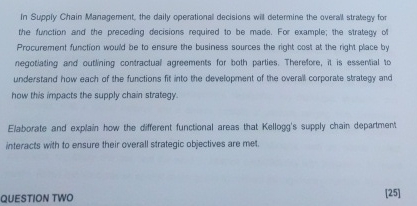
Managers have been tasked with devising lean global supply chains resilient enough to with panies disclosed in their US financial filings the strategies uction during the pandemic. Those strategies include producing ducts; increasing online sales to consumers; securing alternate, local
"The most resilient companies were the ones who had really embraced risk management planning and had visibility into their whole supply chain network, not just their immediate suppliers," said Mike Crum, DBA, professor of supply chain management at lowa State University's Ivy College of Business, in an interview with FM magazine. Companies need to prepare for future supply chain disruptions, due to the potential for extreme weather, financial crises, terrorism, and future pandemics. In a recent report, the McKinsey Global Institute predicts the average company could expect major supply chain disruptions those lasting at least one month to occur every years.
The financial disclosures of Kellogg's, showed that consumerfacing companies radically shifted their supply chains amid the pandemic to serve customers at home after their offices and institutions were forced to shut. Companies made use of slack built into their supply chains and earlier IT investments that let them track raw materials, components, and linished products. And while most credited the heroics of their staff during the pandemic, all three announced cost savings or accelerated investment in automation that could lead to job loss.
Kellogg Co
Food company Kellogg Co had to flip from sending bulk volumes to schools and restaurants to feeding people working from home who suddenly had time for breakfast. Finding enough paperboard packaging for cereal boxes became a constraint.
With families staying home and limiting supermarket trips, the pandemic boosted sales of Kellogg's cereals, noodles, and snacks. For the multinational, food consumed at home more than offset declines in onthego channels. While growth had moderated by September, Kellogg's sales over the first nine months of increased over the yearago period, to $ billion, excluding the effects of divestitures and currency rate fluctuations.
One highlight was the Asia Pacific, Midcle East, and Africa AMEA region, where thindquarter net sales excluding currency fuctuations jumped by nearly to $ milion and operating profit grew to $ milion, over the yearago quarter.
"There was one day in March when our thirdparty warehouse had to do the equrralert to a week's worth of dispatching, and then we worked at that lovel for theee weeks," said Shanaka Wjesuriys. FCMA CGMA, FCPA Aurstralia CFO for Kelogg's in Australa and New Zealand, who also heads up planning and endtoend Iogstics. We are used to big surges during promotions, but this was unprecedented, The Sydneybased Wijesuriya said the company quickly wert through its seversi weeks' "safety stock" in Australia, where Kelogg's has manufactured for years.
Wijesuriys was part of a steering committee that denided to focus on the top stockkeeping urits SKUs of their more than items, includng NutriGrain ceresl bars, Coco Pops, Special K and Corn Flakes, the ariginal product of the Battin Creek, Michiganbabed Ketogg's. Thny quickty used up a lot of the grains stoned in slos and warehousns. Keloggs factory and warehouse empiayees and those of its suppliers and transportation partners "worked incredible hours" to ramp up production and quickly load more trucks and containers. When your retailers are demanding extra things, it's your warehouse that needs to stretch the most," he said. Packaging becarme a bottleneck, as the region's Korean supplier ran short due to shipping detays caused by the COVID pendamic. The procurement team "scoured the world" for a new source of paperboard and found an alternative supplier next door in Now Zealand. Lower transportation costs helped to make up for the higher cost of the New Zealand paperboard.
For Wiesuriya, COVID highlights the importanoe of not having your supply chains spread out all over the world. Is led us to look at the diversity of the supply chain and the benefits of having a supplier closer to home, Wijesuriya said. "Higher inventory was worth it to satisfy consumers who were glad to find a trusted brand on the shelf: As companies move to automate processes, in part to withstand future health crises, Wijesurlya credits the human part of the supply chain for ils abilily to stretch. We were able to do amazing things because of how the people across our business and supply chain banded together to meet demand, he said. "I know mechanisation is coming and it's a good thing, but our human spirit and resilience came out even more."
Source: htpsilwww.fmma
Step by Step Solution
There are 3 Steps involved in it
1 Expert Approved Answer
Step: 1 Unlock

Question Has Been Solved by an Expert!
Get step-by-step solutions from verified subject matter experts
Step: 2 Unlock
Step: 3 Unlock