







Question: Question regarding testing hypotheses about multinomial data: 5. Is this data Binomial? In this problem you will learn to test hypotheses about multinomial data that
Question regarding testing hypotheses about multinomial data:
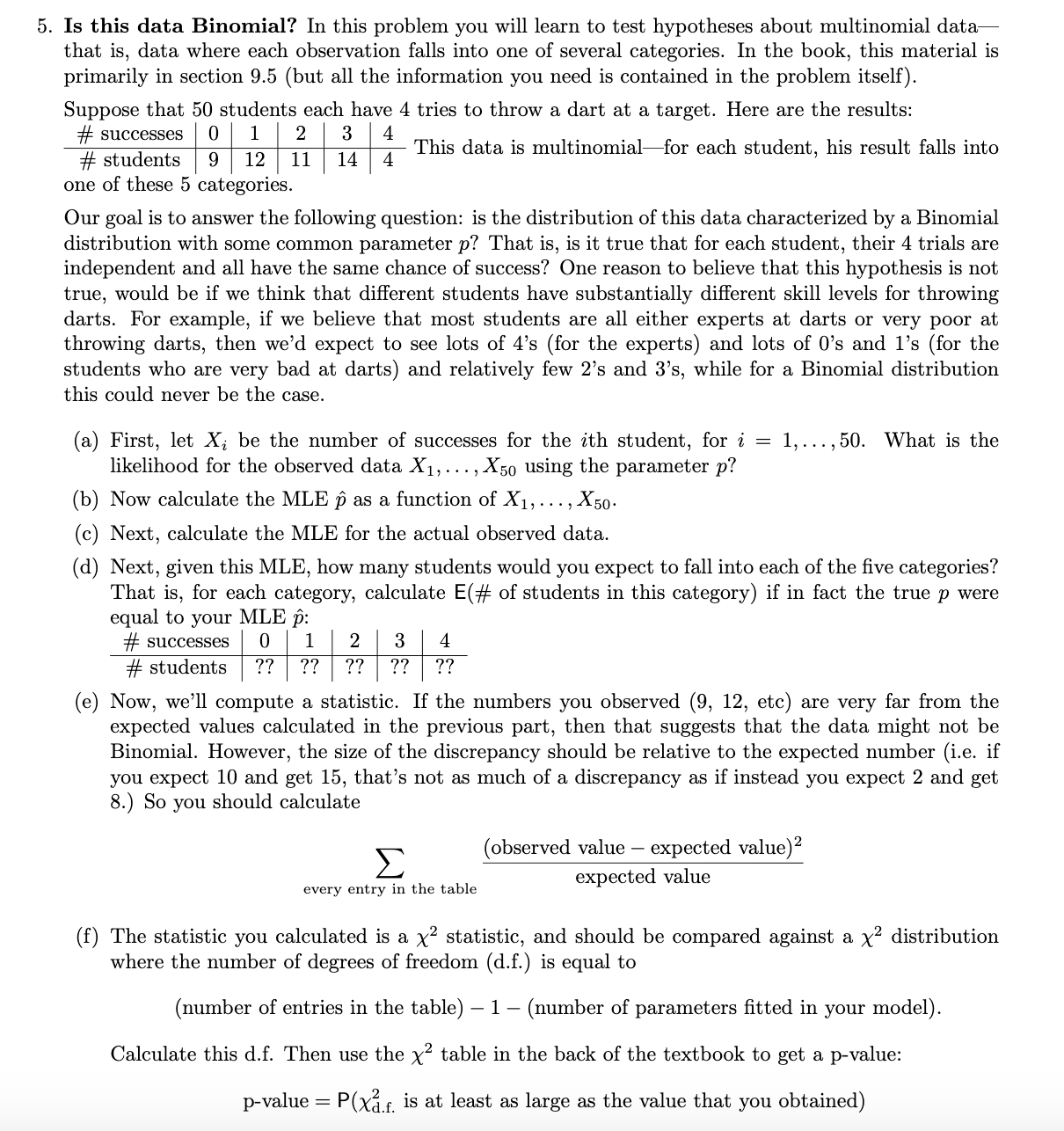
5. Is this data Binomial? In this problem you will learn to test hypotheses about multinomial data that is, data where each observation falls into one of several categories. In the book, this material is primarily in section 9.5 (but all the information you need is contained in the problem itself). Suppose that 50 students each have 4 tries to throw a dart at a target. Here are the results: #successes|0| 1 2 |3 4 #students | 9 | 12 11 | 14 4 one of these 5 categories. This data is multinomialfor each student, his result falls into Our goal is to answer the following question: is the distribution of this data characterized by a Binomial distribution with some common parameter p? That is, is it true that for each student, their 4 trials are independent and all have the same chance of success? One reason to believe that this hypothesis is not true, would be if we think that different students have substantially different skill levels for throwing darts. For example, if we believe that most students are all either experts at darts or very poor at throwing darts, then we'd expect to see lots of 4's (for the experts) and lots of 0's and 1's (for the students who are very bad at darts) and relatively few 2's and 3's, while for a Binomial distribution this could never be the case. (a) First, let X, be the number of successes for the ith student, for i : 1,...,50. What is the likelihood for the observed data X1, . . . ,X5o using the parameter p? (b) Now calculate the MLE 36 as a function of X1, . . . , X50. (c) Next, calculate the MLE for the actual observed data. ((1) Next, given this MLE, how many students would you expect to fall into each of the ve categories? That is, for each category, calculate E(# of students in this category) if in fact the true p were equal to your MLE p: # successes | 0 l 1 # students | '3'? l T? (e) Now, we'll compute a statistic. If the numbers you observed (9, 12, etc) are very far from the expected values calculated in the previous part, then that suggests that the data might not be Binomial. However, the size of the discrepancy should be relative to the expected number (i.e. if you expect 10 and get 15, that's not as much of a discrepancy as if instead you expect 2 and get 8.) So you should calculate 2 ?? 3|4 ??|?? 2 (observed value expected value)2 expected value every entry in the table (f) The statistic you calculated is a X2 statistic, and should be compared against a X2 distribution where the number of degrees of freedom (d.f.) is equal to (number of entries in the table) 1 (number of parameters tted in your model). Calculate this d.f. Then use the X2 table in the back of the textbook to get a p-value: pvalue = P0921, is at least as large as the value that you obtained)
Step by Step Solution
There are 3 Steps involved in it

Get step-by-step solutions from verified subject matter experts
 Study Help