







Question: Question: Specify the supply chain capabilities 7-eleven has developed through its IT investments and elaborate how these capabilities facilitate 7-eleven to manage the impact of
Question: Specify the supply chain capabilities 7-eleven has developed through its IT investments and elaborate how these capabilities facilitate 7-eleven to manage the impact of bullwhip effect across its supply chain.
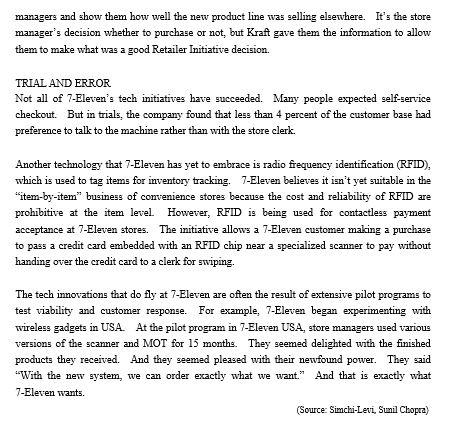
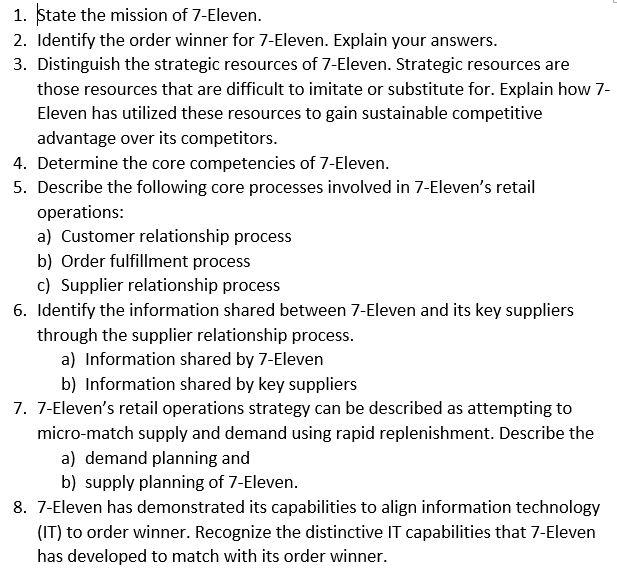
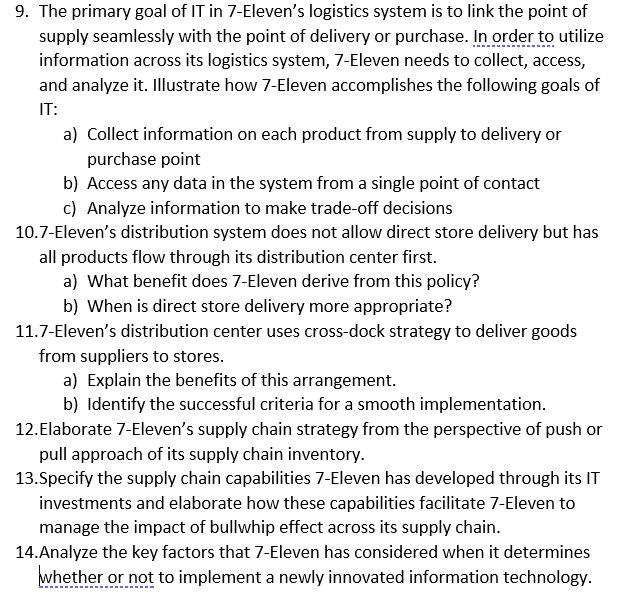
Case Study: 7-Eleven Standing in front of a refrigerated case at the 7-Eleven store, on a Friday morning, store manager Bonnie considered a seemingly tedious, but in fact important, decision: how many chicken sandwiches to order for the next day. To aid her decision, Bonnie held a lightweight wireless tablet with a colorful screen full of information. She noted that she had two. sandwiches that were due to expire that day and six the next. Using the gadget's built-in keyboard, she recorded the inventory information into an electronic form. On the same screen, she saw that the weather forecast will be good for the next five days. Having observed customer behavior as an employee of 7-Eleven since 2015, Bonnie knew good weather was likely to mean good business over the coming weekend. Another part of the screen told her how many chicken sandwiches her store had sold on each of the last four Saturdays. The display also provided information that let her see she had been selling out of the increasingly popular sandwiches the last few days. "I've got to be more aggressive," she concluded as she used the gadget to order four more sandwiches, predicting that six would sell on Friday and another six on Saturday. She transmitted the order to the store's back-office server, then onto the corporate network and data center, and eventually to 7-Eleven's fresh food distributor, where the sandwiches were made, loaded onto a truck, and delivered to the stores around midnight. Thanks to innovative technology that permeates every layer of the world's largest convenience chain store, 7-Eleven knows exactly how many chicken sandwiches it sold in each of its 1,000 Hong Kong stores today, yesterday, last week, last month, and last year. Better yet, it can predict with great accuracy how many of the item each store will sell tomorrow, and it can do the same for each of the roughly 2,500 products sold in its stores. The hundreds of millions of dollars 7-Eleven has invested in technology over the past 10 years appear to be paying off. ITEM BY ITEM 7-Eleven was founded in 1927 by Joe C. Thompson. His famous motto "give the customers what they want, when and where they want it is still embraced by the company today. The innovative demand-chain approach to retailing that Ito-Yokado, the company's majority shareholder, used to great success at Seven-Eleven Japan is known as "item-by-item" management, as opposed to "category-by-category" management. In traditional retailing, the emphasis is on how, say, beverages as a class are selling. In "item-by-item" management, the emphasis is on how a particular beverage is selling. The idea is to pay attention to the fine details of customers' buying preferences and let them dictate which products are carried in the store - and, ultimately, which products are developed. In Hong Kong, the strategy turned 7-Eleven stores into hot spots to shop, especially when it comes to trendy snacks and freshly made food. Customers are likely to visit a 7-Eleven store a few times a week. People are often looking for something new to taste, and delivering appetizing new food items is the key to keeping customers coming back. Technology plays a crucial role in gathering, analyzing, and distributing information in "item-by-item" management. This practice is also known as "retailer initiative". Before 7-Eleven introduced retailer initiative to its stores, the company had no accurate way of knowing which products its stores were selling. The company only knew which products it had bought from suppliers. Suppliers used to decide how much of their products to place on the shelves. Decisions were made in the manufacturers' best interests, not necessarily the customers' best interests. Today, the retailer initiative strategy underlies all technology at 7-Eleven. The philosophy is that decisions about what should be in the store are best made at the store at the moment of truth by people in the store on a real-time basis. Information lets 7-Eleven shape the store and what's in it around the demand curve of the customers who come into the store, based on what they're doing day to day, minute by minute, not based on some focus group or marketing research or nonscientific guess of what a customer might do. WHAT CUSTOMERS WANT The ability to respond quickly to customers' ever-changing tastes is paramount in the convenience store business. The customers will reward those stores who know what they want. 7-Eleven has been a leader and an innovator in using technology to serve customers. It may not be something customers see, but they see it because the store better knows what they want. When it comes to collecting information on customer preferences and using the information both tactically for ordering and strategically for merchandising, 7-Eleven is far ahead of any of its competitors. Other convenience store chains have only gotten around to point-of-sale scanning. They don't have the data and information that 7-Eleven has item by item, store by store, day by day, for the last deca The Mobile Operations Terminal, or MOT, from NEC that helped Bonnie order chicken sandwiches is one of two wireless tools 7-Eleven is installing in stores to reduce the time and labor it takes to count inventory and order new products. The other is the MC3000 color handheld scanner from Symbol Technologies, used to collect data on every item as it comes off the delivery truck. Both devices use the standard Microsoft Windows operating system. The company also introduced a software ordering system. The technology installed in 7-Eleven stores works under a Windows-based proprietary system, known as the retail information system, or RIS. It supports the retailer initiative strategy by providing timely sales data that enables each store to tailor its product assortment to its customers. RIS also helps store operators see which items are selling well and which are not, allowing them to make room for more popular products and for new items. RIS also reduces the risk involved in introducing new products because sales data is available for evaluation within 24 hours of a product's introduction. 7-ELEVEN'S INTEGRATED STORE INFORMATION SYSTEM From its start, 7-Eleven sought to simplify its operations by using advanced information technology. The retail information system (RIS) was installed in every outlet and linked to headquarters, suppliers, and the 7-Eleven distribution centers. The hardware system at each 7-Eleven store includes the following details: Mobile Operations Terminal (MOT): It's a handheld device with a wide-screen graphic display, used by the store owner or manager to place orders. When placing an order, the store manager has access (from the store computer) to detailed analysis of POS data related to the particular item. This includes sales analysis of product categories and stock-keeping-units (SKU) over time, 10-week sales trends by SKU, 10-day sales trends by SKU, sales trends for new products, sales analysis by day and time, list of slow-moving items, analysis of sales and number of customers over time, etc. The store manager uses this information when entering an order into the terminal. Once all the orders are placed, the terminal is returned to its slot, at which point the orders are relayed by the RIS to both the appropriate vendor and the 7-Eleven distribution center. Handheld scanner: Handheld scanners read bar codes and recorded inventory. They are used to receive products coming in from a distribution center. The delivery is automatically checked against a previously placed order, and the two are reconciled. Before the handheld scanners were introduced, truck drivers waited in the store until the delivery was checked. Once the handheld scanners were introduced, the driver simply dropped the delivery in the store, and a store clerk received it at a suitable time when there were few customers. Store computer: This links to the 7-Eleven network, the POS register, the MOT, and the handheld scanner. It communicates among the various input sources, tracks store inventory and sales, places orders, provides detailed analysis of POS data, and maintains and regulates store equipment. Point-of-sale register: As soon as a customer purchases an item and pays at the Point-of-sale (POS) register, sales and other data are stored and transmitted to headquarters through the store computer. The analyzed and updated data are then sent back to the 7-Eleven stores via the network each morning. All this information is available on the MOT with the objective of improving order placement. The information system allows 7-Eleven stores to better match supply with demand. Store staff can adjust the merchandising mix on the shelves according to consumption patterns throughout the day. 7-ELEVEN'S DISTRIBUTION SYSTEM The 7-Eleven distribution system tightly links the entire supply chain for all product categories. All stores are given cutoff times for breakfast, lunch, and dinner ordering. When a store places an order, it is immediately transmitted to the supplier as well as the distribution center (DC). The supplier packs each store order and sends all the orders by truck to the DC where they are cross docked onto the appropriate store truck The key to store delivery is what 7-Eleven called the combined delivery system. At the DC, deliveries of like products from different suppliers (e.g., milk and sandwiches) are directed into a single temperature-controlled truck. There are four categories of temperature-controlled trucks: frozen foods, chilled foods, room-temperature processed foods, and warm foods. Warm and chilled foods are delivered three times daily, whereas room-temperature products are delivered once a day. Frozen products are delivered three to seven times a week, depending on the weather. Each truck makes deliveries to multiple retail stores. The number of stores per truck depends on the sales volume. All deliveries are made during off-peak hours and received using the handheld scanner. The system works on trust and does not require the delivery person to be present when the store personnel scan in the delivery. That reduces the delivery time spent at each store. The distribution system has enabled 7-Eleven to reduce the number of vehicles required for daily delivery service to each store, even though the delivery frequency of each item is quite high. SHARING DATA 7-Eleven shares some of its data analysis with a handful of key suppliers, such as Kraft Foods, and PepsiCo in a partnering program called 7-Exchange. The 7-Exchange data system for category management, which suppliers access through a secure Web site, can provide insights that lead to new products or new packaging. Suppliers may notice a significant shift in consumer behavior around beverage package size. Information from the 7-Exchange system can also alert participating companies to a potential missed opportunity. For example, Kraft Foods may notice that some 7-Eleven stores weren't carrying a new line of cookies and crackers as widely as other stores were. Kraft will then send their field group to talk to store managers and show them how well the new product line was selling elsewhere. It's the store manager's decision whether to purchase or not, but Kraft gave them the information to allow them to make what was a good Retailer Initiative decision. TRIAL AND ERROR Not all of 7-Eleven's tech initiatives have succeeded. Many people expected self-service checkout. But in trials, the company found that less than 4 percent of the customer base had preference to talk to the machine rather than with the store clerk. Another technology that 7-Eleven has yet to embrace is radio frequency identification (RFID), which is used to tag items for inventory tracking. 7-Eleven believes it isn't yet suitable in the "item-by-item" business of convenience stores because the cost and reliability of RFID are prohibitive at the item level. However, RFID is being used for contactless payment acceptance at 7-Eleven stores. The initiative allows a 7-Eleven customer making a purchase to pass a credit card embedded with an RFID chip near a specialized scanner to pay without handing over the credit card to a clerk for swiping. The tech innovations that do fly at 7-Eleven are often the result of extensive pilot programs to test viability and customer response. For example, 7-Eleven began experimenting with wireless gadgets in USA. At the pilot program in 7-Eleven USA, store managers used various versions of the scanner and MOT for 15 months. They seemed delighted with the finished products they received. And they seemed pleased with their newfound power. They said "With the new system, we can order exactly what we want." And that is exactly what 7-Eleven wants. WWW (Source: Simchi-Levi, Sunil Chopra) 1. State the mission of 7-Eleven. 2. Identify the order winner for 7-Eleven. Explain your answers. 3. Distinguish the strategic resources of 7-Eleven. Strategic resources are those resources that are difficult to imitate or substitute for. Explain how 7- Eleven has utilized these resources to gain sustainable competitive advantage over its competitors. 4. Determine the core competencies of 7-Eleven. 5. Describe the following core processes involved in 7-Eleven's retail operations: a) Customer relationship process b) Order fulfillment process c) Supplier relationship process 6. Identify the information shared between 7-Eleven and its key suppliers through the supplier relationship process. a) Information shared by 7-Eleven b) Information shared by key suppliers 7. 7-Eleven's retail operations strategy can be described as attempting to micro-match supply and demand using rapid replenishment. Describe the a) demand planning and b) supply planning of 7-Eleven. 8. 7-Eleven has demonstrated its capabilities to align information technology (IT) to order winner. Recognize the distinctive IT capabilities that 7-Eleven has developed to match with its order winner. 9. The primary goal of IT in 7-Eleven's logistics system is to link the point of supply seamlessly with the point of delivery or purchase. In order to utilize information across its logistics system, 7-Eleven needs to collect, access, and analyze it. Illustrate how 7-Eleven accomplishes the following goals of IT: a) Collect information on each product from supply to delivery or purchase point b) Access any data in the system from a single point of contact c) Analyze information to make trade-off decisions 10.7-Eleven's distribution system does not allow direct store delivery but has all products flow through its distribution center first. a) What benefit does 7-Eleven derive from this policy? b) When is direct store delivery more appropriate? 11.7-Eleven's distribution center uses cross-dock strategy to deliver goods from suppliers to stores. a) Explain the benefits of this arrangement. b) Identify the successful criteria for a smooth implementation. 12. Elaborate 7-Eleven's supply chain strategy from the perspective of push or pull approach of its supply chain inventory. 13.Specify the supply chain capabilities 7-Eleven has developed through its IT investments and elaborate how these capabilities facilitate 7-Eleven to manage the impact of bullwhip effect across its supply chain. 14.Analyze the key factors that 7-Eleven has considered when it determines whether or not to implement a newly innovated information technologyStep by Step Solution
There are 3 Steps involved in it
1 Expert Approved Answer
Step: 1 Unlock

Question Has Been Solved by an Expert!
Get step-by-step solutions from verified subject matter experts
Step: 2 Unlock
Step: 3 Unlock
 Study Help