







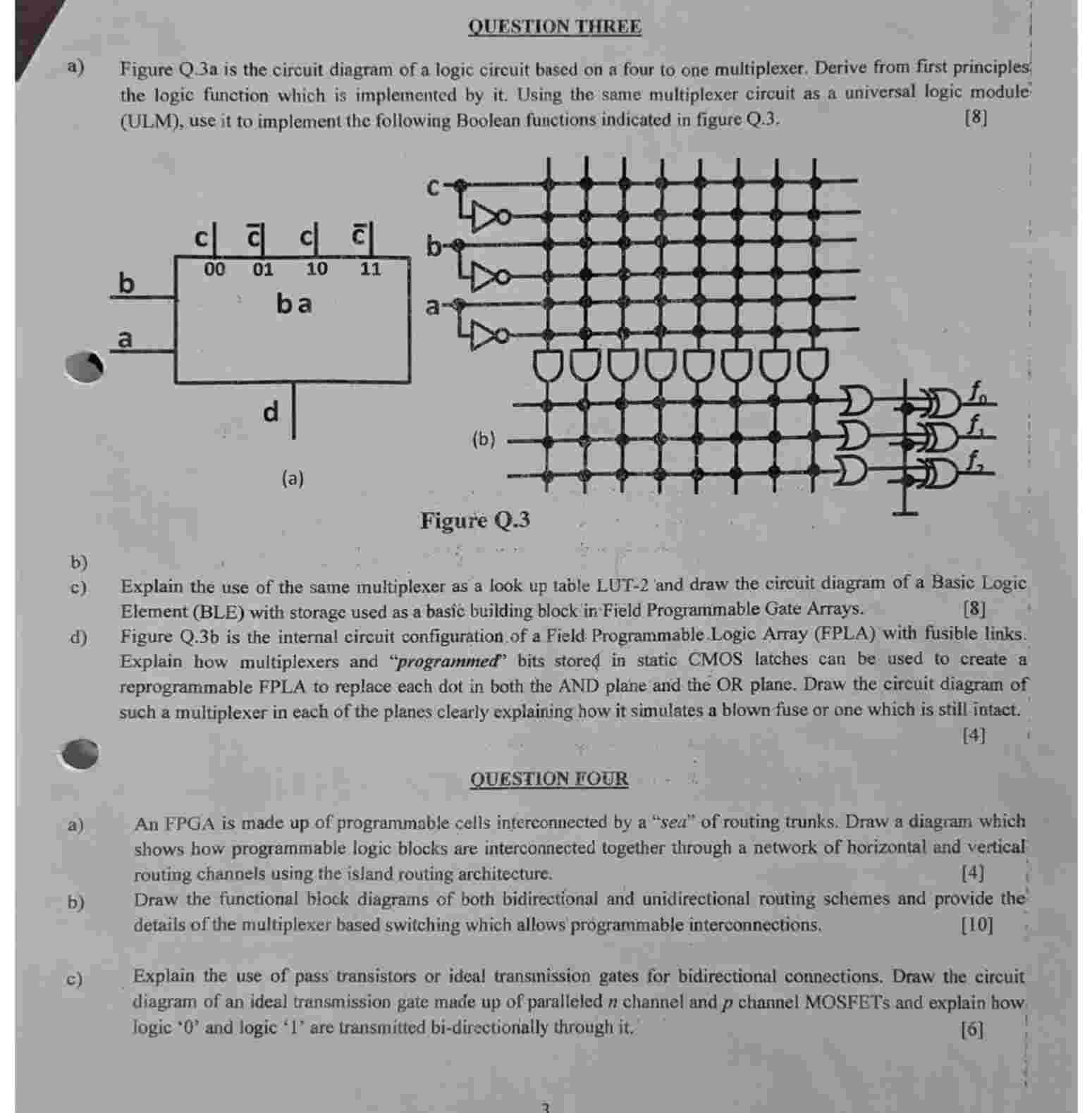
Question: QUESTION THREE a ) Figure Q 3 a is the circuit diagram of a logic circuit based on a four - to - one multiplexer.
QUESTION THREE
a Figure Q a is the circuit diagram of a logic circuit based on a fourtoone multiplexer. Derive from first principles
the logic function which is implemented by it Using the same multiplexer circuit as a universal logic module
ULM use it to implement the following Boolean functions indicated in figure Q
a
b
c Explain the use of the same multiplexer as a look up table LUT and draw the circuit diagram of a Basic Logic
Element BLE with storage used as a basic building block in Field Programmable Gate Arrays.
d Figure Q b is the internal circuit configuration of a Field Programmable Logic Array FPLA with fusible links.
Explain how multiplexers and "programmed" bits stored in static CMOS latches can be used to create a
reprogrammable FPLA to replace each dot in both the AND plane and the OR plane. Draw the circuit diagram of
such a multiplexer in each of the planes clearly explaining how it simulates a blown fuse or one which is still intact.
QUESTION FOUR
a An FPGA is made up of programmable cells interconnected by a "sea" of routing trunks. Draw a diagram which
shows how programmable logic blocks are interconnected together through a network of horizontal and vertical
routing channels using the island routing architecture.
b Draw the functional block diagrams of both bidirectional and unidirectional routing schemes and provide the
details of the multiplexer based switching which allows programmable interconnections,
c Explain the use of pass transistors or ideal transmission gates for bidirectional connections. Draw the circuit
diagram of an ideal transmission gate made up of paralleled n channel and p channel MOSFETs and explain how
logic and logic are transmitted bidirectionally through it
Step by Step Solution
There are 3 Steps involved in it
1 Expert Approved Answer
Step: 1 Unlock

Question Has Been Solved by an Expert!
Get step-by-step solutions from verified subject matter experts
Step: 2 Unlock
Step: 3 Unlock
 Study Help