





Question: Question Three: (a) FORD'S ASSEMBLY LINE Though Ransom E. Olds created the first assembly line in 1901, Henry Ford is recognized for revolutionizing industry by
Question Three: (a) FORD'S ASSEMBLY LINE Though
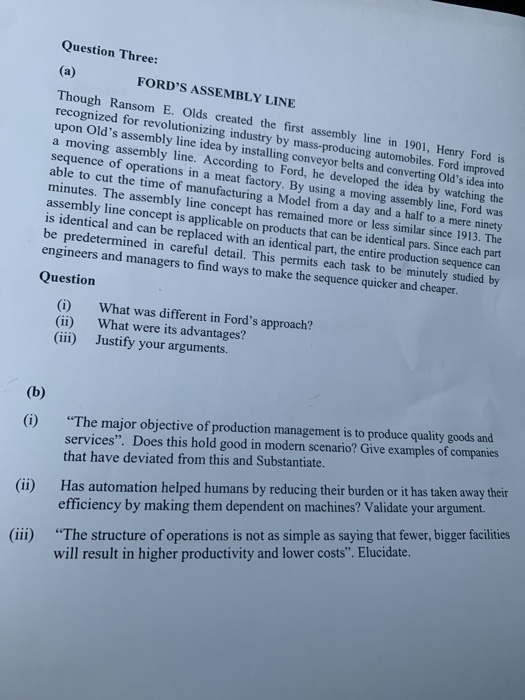
Question Three: (a) FORD'S ASSEMBLY LINE Though Ransom E. Olds created the first assembly line in 1901, Henry Ford is recognized for revolutionizing industry by mass-producing automobiles. Ford improved upon Old's assembly line idea by installing conveyor belts and converting Old's idea into a moving assembly line. According to Ford, he developed the idea by watching the sequence of operations in a meat factory. By using a moving assembly line, Ford was able to cut the time of manufacturing a Model from a day and a half to a mere ninety minutes. The assembly line concept has remained more or less similar since 1913. The assembly line concept is applicable on products that can be identical pars. Since each part is identical and can be replaced with an identical part, the entire production sequence can be predetermined in careful detail. This permits each task to be minutely studied by engineers and managers to find ways to make the sequence quicker and cheaper. Question (1) What was different in Ford's approach? (ii) What were its advantages? (iii) Justify your arguments. (b) (i) "The major objective of production management is to produce quality goods and services". Does this hold good in modem scenario? Give examples of companies that have deviated from this and Substantiate. (ii) Has automation helped humans by reducing their burden or it has taken away their efficiency by making them dependent on machines? Validate your argument. (iii) The structure of operations is not as simple as saying that fewer, bigger facilities will result in higher productivity and lower costs". Elucidate

Step by Step Solution

There are 3 Steps involved in it

1 Expert Approved Answer
Step: 1 Unlock blur-text-image

Question Has Been Solved by an Expert!

Get step-by-step solutions from verified subject matter experts

Step: 2 Unlock
Step: 3 Unlock

Students Have Also Explored These Related General Management Questions!