







Question: QUESTION TWO ( 2 5 Marks ) Undertake a preliminary literature review for the proposed study. Your literature review should be 5 - 6 pages
QUESTION TWO Marks
Undertake a preliminary literature review for the proposed study. Your literature review should be pages long and should
demonstrate a critical understanding of the contemporary developments in as well as the major research avenues of the
digital transformation and organisational resilience literature.
QUESTION THREE Marks
Considering the five research questions you formulated in question above, design a item questionnaire comprising
closedended and openedended questions that you would use to collect data for the proposed study. Ignore biographic
information of the study participants.BY MARENY ARNOLDI
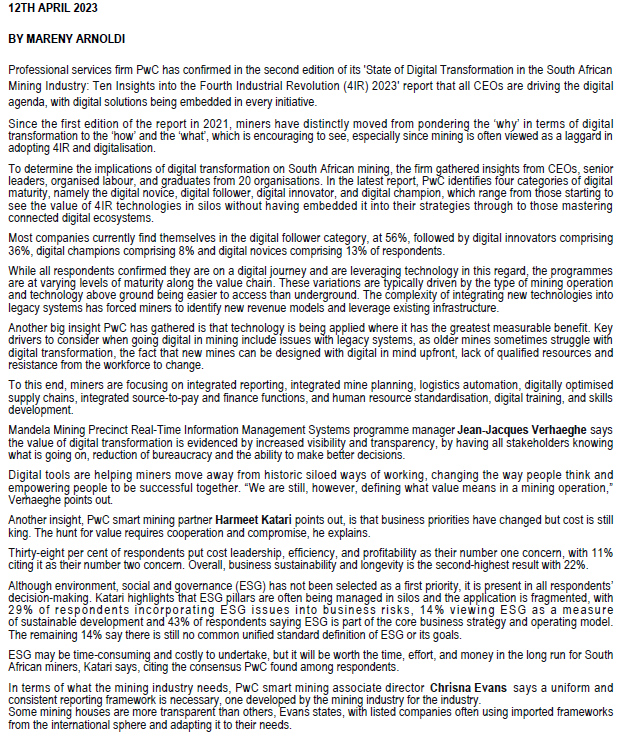
Professional services firm PwC has confirmed in the second edition of its 'State of Digital Transformation in the South African
Mining Industry: Ten Insights into the Fourth Industrial Revolution IR report that all CEOs are driving the digital
agenda, with digital solutions being embedded in every initiative.
Since the first edition of the report in miners have distinctly moved from pondering the 'why' in terms of digital
transformation to the 'how' and the 'what', which is encouraging to see, especially since mining is often viewed as a laggard in
adopting and digitalisation.
To determine the implications of digital transformation on South African mining, the firm gathered insights from CEOs, senior
leaders, organised labour, and graduates from organisations. In the latest report, PwC identifies four categories of digital
maturity, namely the digital novice, digital follower, digital innovator, and digital champion, which range from those starting to
see the value of IR technologies in silos without having embedded it into their strategies through to those mastering
connected digital ecosystems.
Most companies currently find themselves in the digital follower category, at followed by digital innovators comprising
digital champions comprising and digital novices comprising of respondents.
While all respondents confirmed they are on a digital journey and are leveraging technology in this regard, the programmes
are at varying levels of maturity along the value chain. These variations are typically driven by the type of mining operation
and technology above ground being easier to access than underground. The complexity of integrating new technologies into
legacy systems has forced miners to identify new revenue models and leverage existing infrastructure.
Another big insight PwC has gathered is that technology is being applied where it has the greatest measurable benefit. Key
drivers to consider when going digital in mining include issues with legacy systems, as older mines sometimes struggle with
digital transformation, the fact that new mines can be designed with digital in mind upfront, lack of qualified resources and
resistance from the workforce to change.
To this end, miners are focusing on integrated reporting, integrated mine planning, logistics automation, digitally optimised
supply chains, integrated sourcetopay and finance functions, and human resource standardisation, digital training, and skills
development.
Mandela Mining Precinct RealTime Information Management Systems programme manager JeanJacques Verhaeghe says
the value of digital transformation is evidenced by increased visibility and transparency, by having all stakeholders knowing
what is going on reduction of bureaucracy and the ability to make better decisions.
Digital tools are helping miners move away from historic siloed ways of working, changing the way people think and
empowering people to be successful together. We are still, however, defining what value means in a mining operation,"
Verhaeghe points out.
Another insight, PwC smart mining partner Harmeet Katari points out, is that business priorities have changed but cost is still
king. The hunt for value requires cooperation and compromise, he explains.
Thirtyeight per cent of respondents put cost leadership, efficiency, and profitability as their number one concern, with
citing it as their number two concern. Overall, business sustainability and longevity is the secondhighest result with
Although environment, social and governance ESG has not been selected as a first priority, it is present in all respondents'
decisionmaking. Katari highlights that ESG pillars are often being managed in silos and the application is fragmented, with
of respondents incorporating ESG issues into business risks, viewing ESG as a measure
of sustainable development and of respondents saying ESG is part of the core business strategy and operating model.
The remaining
Step by Step Solution
There are 3 Steps involved in it
1 Expert Approved Answer
Step: 1 Unlock

Question Has Been Solved by an Expert!
Get step-by-step solutions from verified subject matter experts
Step: 2 Unlock
Step: 3 Unlock
 Study Help