







Question: QUESTION TWO In statistics the term population has a slightly different meaning from the one given to it in ordinary speech. It need not refer
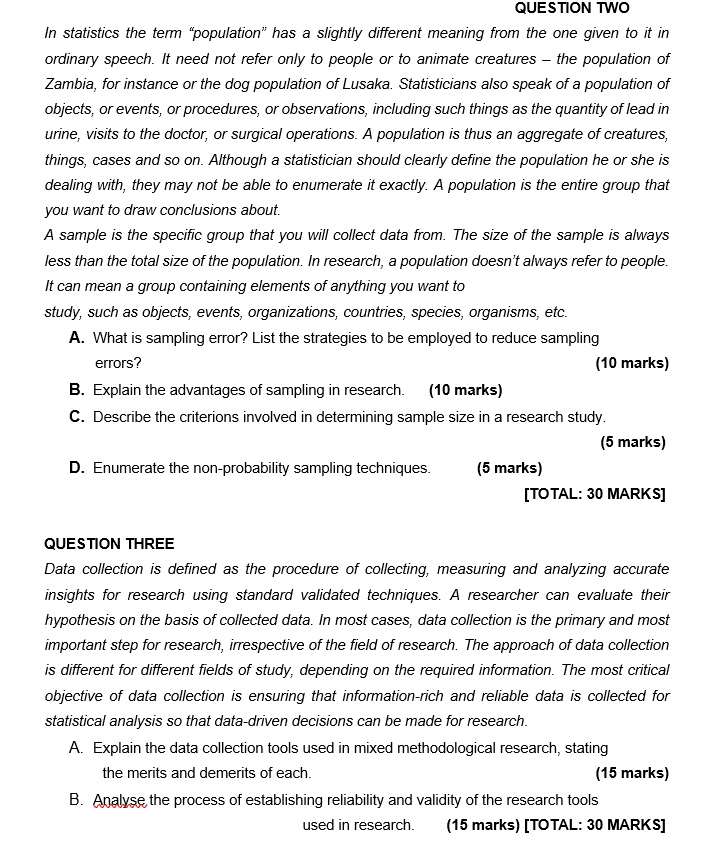
QUESTION TWO In statistics the term "population" has a slightly different meaning from the one given to it in ordinary speech. It need not refer only to people or to animate creatures - the population of Zambia, for instance or the dog population of Lusaka. Statisticians also speak of a population of objects, or events, or procedures, or observations, including such things as the quantity of lead in urine, visits to the doctor, or surgical operations. A population is thus an aggregate of creatures, things, cases and so on. Although a statistician should clearly define the population he or she is dealing with, they may not be able to enumerate it exactly. A population is the entire group that you want to draw conclusions about. A sample is the specific group that you will collect data from. The size of the sample is always less than the total size of the population. In research, a population doesn't always refer to people. It can mean a group containing elements of anything you want to study, such as objects, events, organizations, countries, species, organisms, etc. A. What is sampling error? List the strategies to be employed to reduce sampling errors? (10 marks) B. Explain the advantages of sampling in research. (10 marks) C. Describe the criterions involved in determining sample size in a research study. (5 marks) D. Enumerate the non-probability sampling techniques. (5 marks) [TOTAL: 30 MARKS] QUESTION THREE Data collection is defined as the procedure of collecting, measuring and analyzing accurate insights for research using standard validated techniques. A researcher can evaluate their hypothesis on the basis of collected data. In most cases, data collection is the primary and most important step for research, irrespective of the field of research. The approach of data collection is different for different fields of study, depending on the required information. The most critical objective of data collection is ensuring that information-rich and reliable data is collected for statistical analysis so that data-driven decisions can be made for research. A. Explain the data collection tools used in mixed methodological research, stating the merits and demerits of each. (15 marks) B. Analyse the process of establishing reliability and validity of the research tools used in research. (15 marks) [TOTAL: 30 MARKS]
Step by Step Solution
There are 3 Steps involved in it

Get step-by-step solutions from verified subject matter experts
 Study Help