Question: QUESTION Write Conclusion on the report below Introduction We all know that Tesla has become very famous in the electric car industry over the last
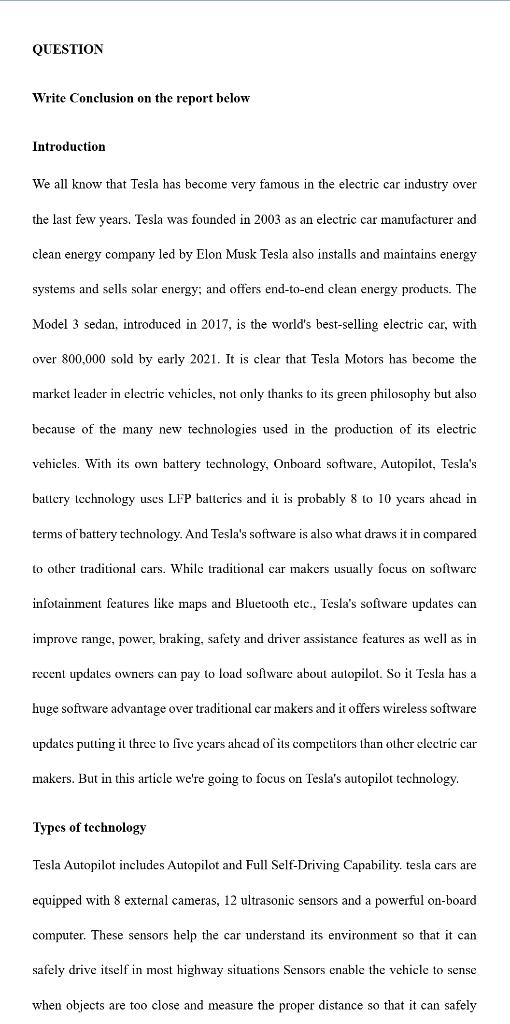
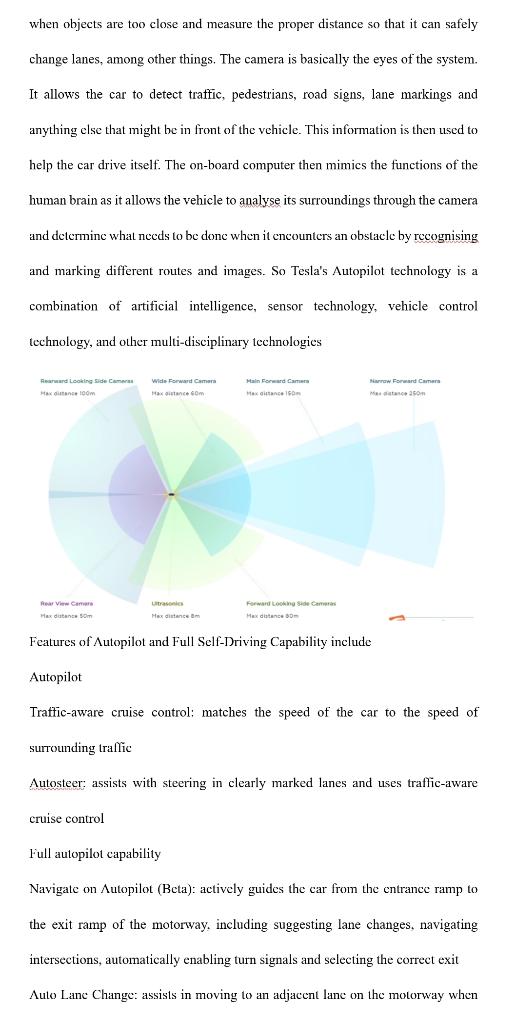
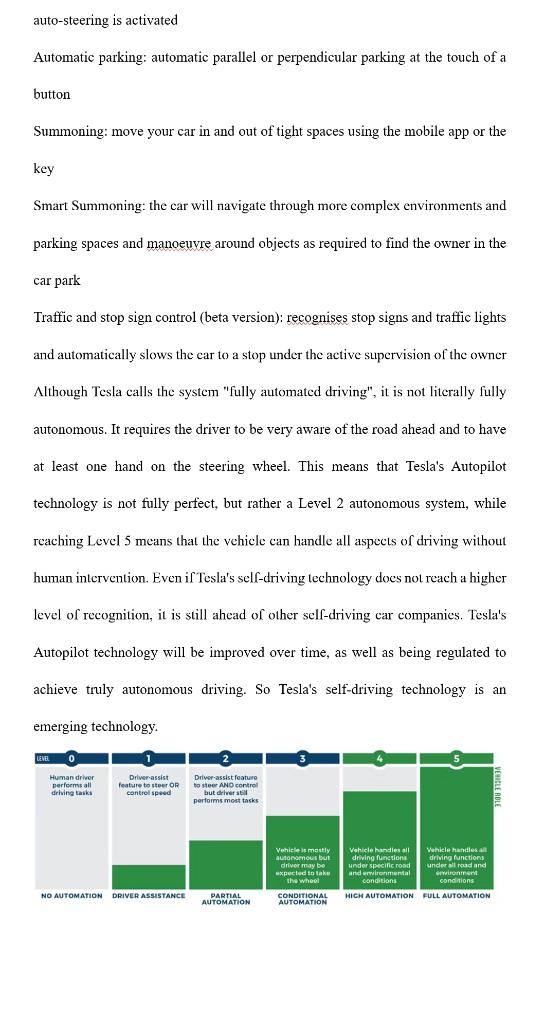
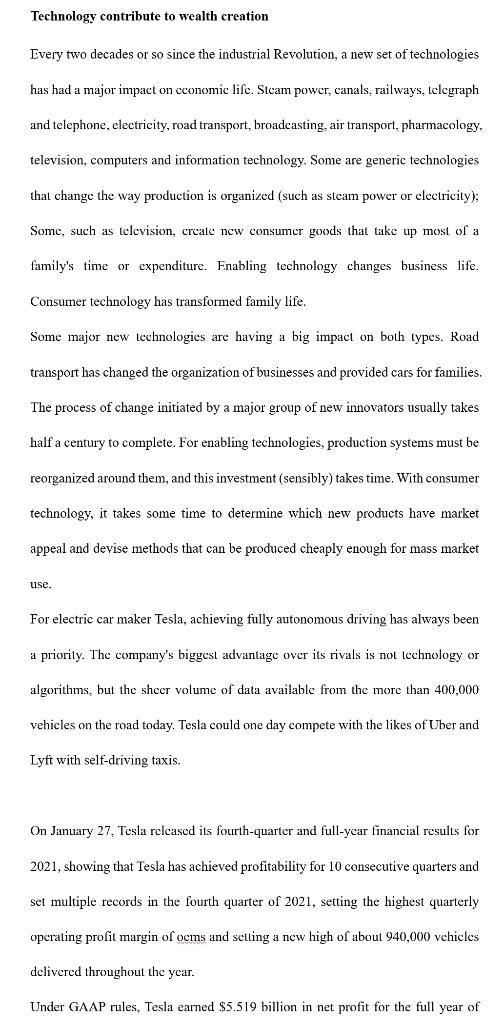
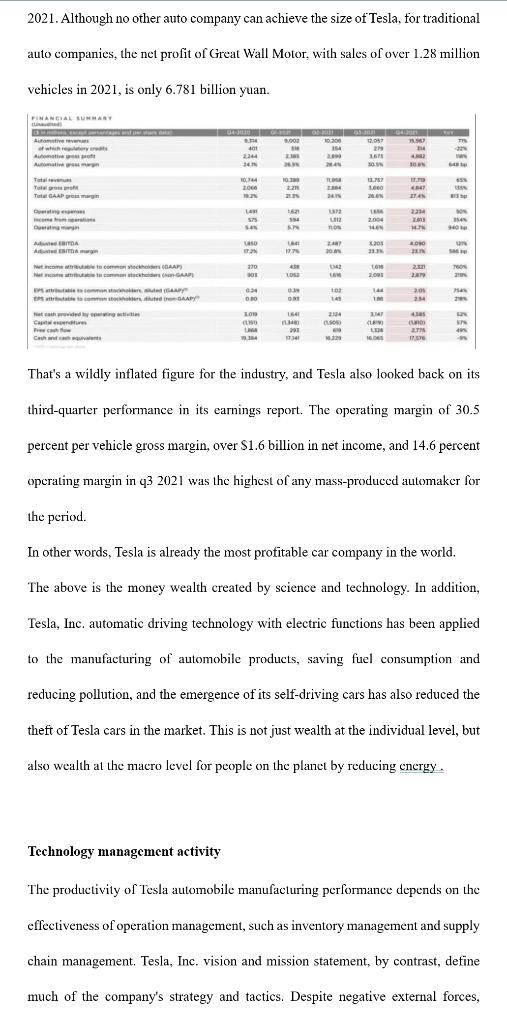
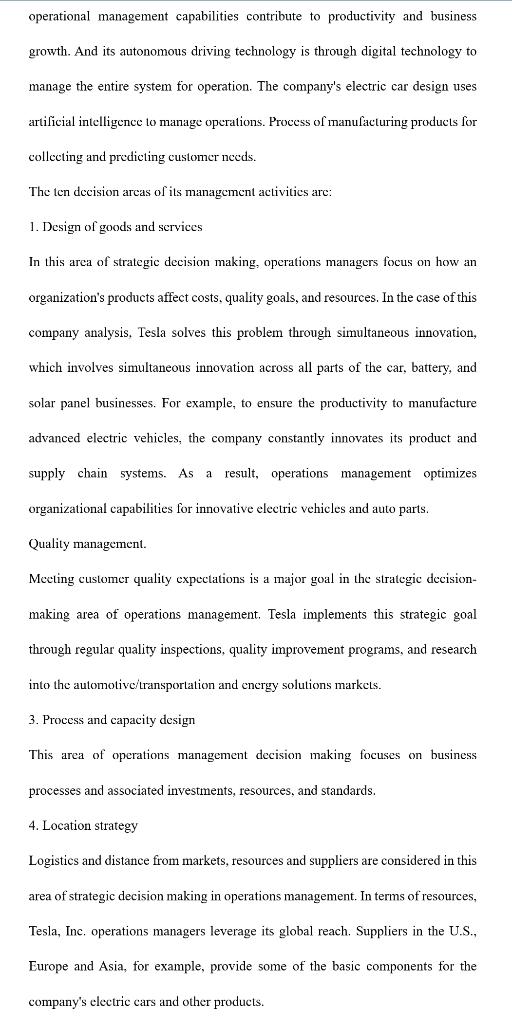
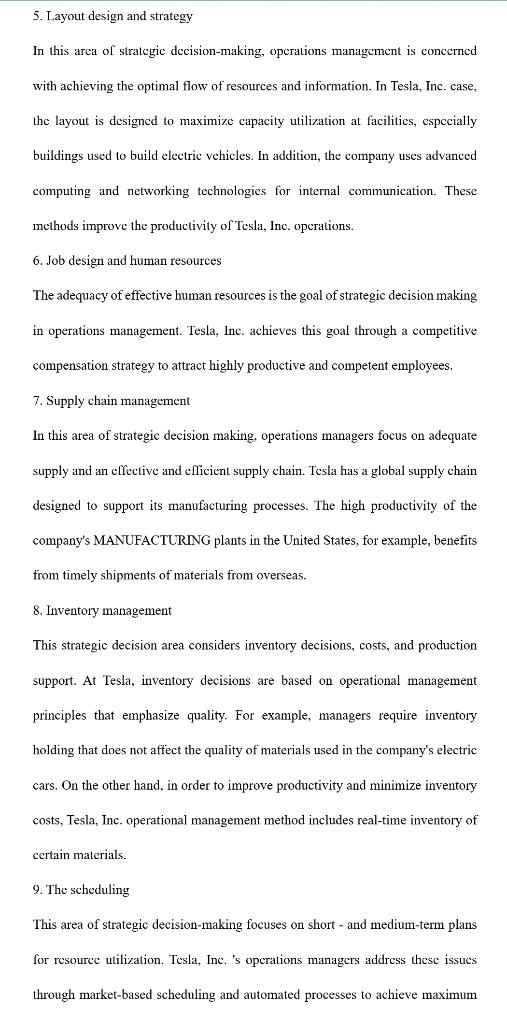
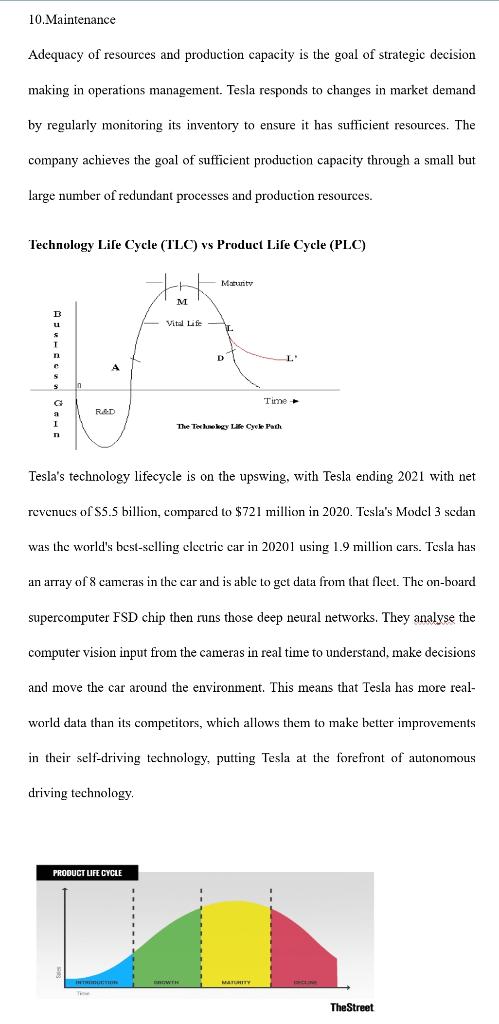
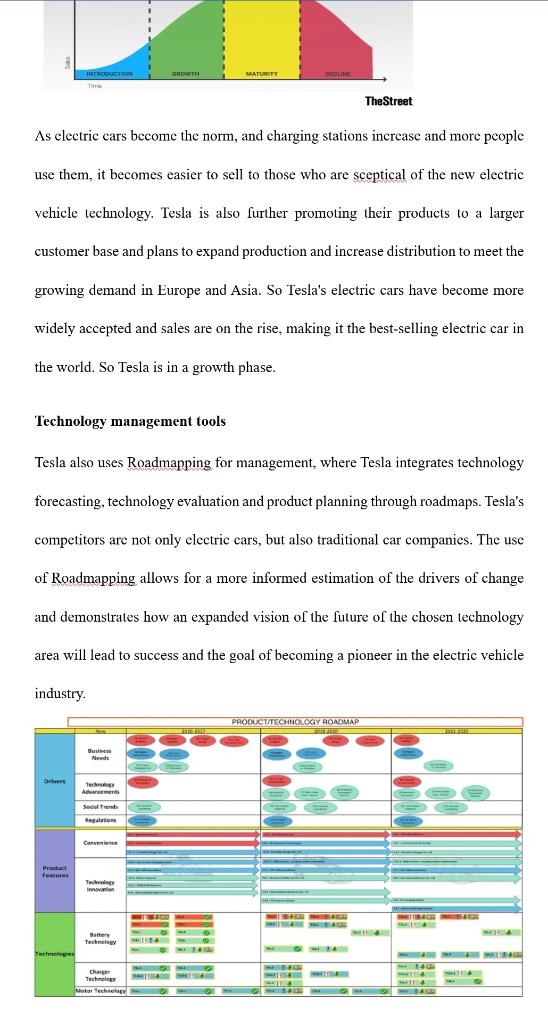
QUESTION Write Conclusion on the report below Introduction We all know that Tesla has become very famous in the electric car industry over the last few years. Tesla was founded in 2003 as an electric car manufacturer and clean energy company led by Elon Musk Tesla also installs and maintains energy systems and sells solar energy; and offers end-to-end clean energy products. The Model 3 sedan, introduced in 2017, is the world's best-selling electric car, with over 800,000 sold by early 2021. It is clear that Tesla Motors has become the market leader in electric vehicles, not only thanks to its green philosophy but also because of the many new technologies used in the production of its electric vehicles. With its own battery technology, Onboard software, Autopilot, Tesla's ballery technology uses LFP batterics and it is probably 8 to 10 ycars ahead in terms of battery technology. And Tesla's software is also what draws it in compared to other traditional cars. While traditional car makers usually focus on software infotainment features like maps and Bluetooth etc., Tesla's software updates can improve range, power, braking, safety and driver assistance features as well as in recent updates owners can pay to load software about autopilot. So it Tesla has a huge software advantage over traditional car makers and it offers wireless software updates putting it three to five years ahcad of its competitors than other electric car makers. But in this article we're going to focus on Tesla's autopilot technology. Types of technology Tesla Autopilot includes Autopilot and Full Self-Driving Capability. tesla cars are equipped with 8 external cameras, 12 ultrasonic sensors and a powerful on-board computer. These sensors help the car understand its environment so that it can safely drive itself in most highway situations Sensors enable the vehicle to sense when objects are too close and measure the proper distance so that it can safely when objects are too close and measure the proper distance so that it can safely change lanes, among other things. The camera is basically the eyes of the system. It allows the car to detect traffic, pedestrians, road signs, lane markings and anything else that might be in front of the vehicle. This information is then used to help the car drive itself. The on-board computer then mimics the functions of the human brain as it allows the vehicle to analyse its surroundings through the camera and determine what needs to be donc when it encounters an obstacle by recognising and marking different routes and images. So Tesla's Autopilot technology is a combination of artificial intelligence, sensor technology, vehicle control technology, and other multi-disciplinary technologies Raward Looking Camars ex 100m widoward Camera Haxtance com Main Forward Car existance Narrow Forward Cams Mac 20 Rear View Camer Hace 50 Forward Locking sidecame Hex distance Hastance Features of Autopilot and Full Self-Driving Capability include Autopilot Traffic-aware cruise control: matches the speed of the car to the speed of surrounding traffic Autosteer; assists with steering in clearly marked lanes and uses traffic-aware cruise control Full autopilot capability Navigate on Autopilot (Beta): actively guides the car from the entrance ramp to the exit ramp of the motorway, including suggesting lane changes, navigating intersections, automatically enabling turn signals and selecting the correct exit Auto Lanc Change: assists in moving to an adjacent lane on the motorway when auto-steering is activated Automatic parking: automatic parallel or perpendicular parking at the touch of a button Summoning: move your car in and out of tight spaces using the mobile app or the key Smart Summoning: the car will navigate through more complex environments and parking spaces and manoeuvre around objects as required to find the owner in the car park Traffic and stop sign control (beta version): recognises stop signs and traffic lights and automatically slows the car to a stop under the active supervision of the owner Although Tesla calls the system "fully automated driving", it is not literally fully autonomous. It requires the driver to be very aware of the road ahead and to have at least one hand on the steering wheel. This means that Tesla's Autopilot technology is not fully perfect, but rather a Level 2 autonomous system, while reaching Level 5 means that the vehicle can handle all aspects of driving without human intervention. Even if Tesla's self-driving technology does not reach a higher level of recognition, it is still ahead of other self-driving car companies. Tesla's Autopilot technology will be improved over time, as well as being regulated to achieve truly autonomous driving. So Tesla's self-driving technology is an emerging technology. LEVEO Human driver performs all driving tasks Driver assist Driver-assist feature feature to steer OR to steer ANO comel control speed but drivers performs most tasks Vehicle is mostly Autonomous but driver may be expected to take the wheel CONDITIONAL AUTOMATION Vehicle handles al Vehicle handles al driving functions driving functions under specific road under all road and and environmental environment conditions conditions HICH AUTOMATION FULL AUTOMATION NO AUTOMATION DRIVER ASSISTANCE PARTIAL AUTOMATION Technology contribute to wealth creation Every two decades or so since the industrial Revolution, a new set of technologies has had a major impact on economic life. Stcam power, canals, railways, telegraph and telephone, electricity, road transport, broadcasting, air transport, pharmacology, television, computers and information technology. Some are generic technologies that change the way production is organized (such as steam power or electricity): Some, such as television, crcate new consumer goods that take up most of a family's time or expenditure. Enabling technology changes business life. Consumer technology has transformed family life. Some major new technologies are having a big impact on both types. Road transport has changed the organization of businesses and provided cars for families. The process of change initiated by a major group of new innovators usually takes half a century to complete. For enabling technologies, production systems must be reorganized around them, and this investment (sensibly) takes time. With consumer technology, it takes some time to determine which new products have market appeal and devise methods that can be produced cheaply enough for mass market use. For electric car maker Tesla, achieving fully autonomous driving has always been a priority. The company's biggest advantage over its rivals is not technology or algorithms, but the sheer volume of data available from the more than 400,000 vehicles on the road today. Tesla could one day compete with the likes of Uber and Lyft with self-driving taxis. On January 27, Tesla released its fourth-quarter and full-year financial results for 2021, showing that Tesla has achieved profitability for 10 consecutive quarters and set multiple records in the fourth quarter of 2021, setting the highest quarterly operating profit margin of oems and selling a new high of about 940,000 vehicles delivered throughout the year. Under GAAP rules, Tesla earned $5.519 billion in net profit for the full year of 2021. Although no other auto company can achieve the size of Tesla, for traditional auto companies, the net profit of Great Wall Motor, with sales of over 1.28 million vehicles in 2021, is only 6.781 billion yuan. FINANCIAL SUMMARY SON 02.097 The Arome of which Automotive Automotive 10.200 154 401 2244 34 1611 10 10:30 5 OY 2.000 Tu 221 1000 11 34 CHI IN GAAP LA 73 162 4 2.000 23 20 UZ TON NO ASIDA ET 30 42 etcome to come GAAP) Metached 200 08 2. LOS 2.00 201 ShAPY 03 0.00 0.30 03 24 101 (18) Crown CH 40 201 19 2. TO That's a wildly inflated figure for the industry, and Tesla also looked back on its third-quarter performance in its earnings report. The operating margin of 30.5 percent per vehicle gross margin, over $1.6 billion in net income, and 14.6 percent opcraling margin in 43 2021 was the highest of any mass-produced automaker for the period. In other words, Tesla is already the most profitable car company in the world. The above is the money wealth created by science and technology. In addition, Tesla, Inc. automatic driving technology with electric functions has been applied to the manufacturing of automobile products, saving fuel consumption and reducing pollution, and the emergence of its self-driving cars has also reduced the theft of Tesla cars in the market. This is not just wealth at the individual level, but also wealth at the macro level for people on the planet by reducing energy Technology management activity The productivity of Tesla automobile manufacturing performance depends on the effectiveness of operation management, such as inventory management and supply chain management. Tesla, Inc. vision and mission statement, by contrast, define much of the company's strategy and tactics. Despite negative external forces, operational management capabilities contribute to productivity and business growth. And its autonomous driving technology is through digital technology to manage the entire system for operation. The company's electric car design uses artificial intelligence to manage operations. Process of manufacturing products for collecting and predicting customer needs. The ten decision areas of ils management activities are: 1. Design of goods and services In this area of strategic decision making, operations managers focus on how an organization's products affect costs. quality goals, and resources. In the case of this company analysis, Tesla solves this problem through simultaneous innovation, which involves simultaneous innovation across all parts of the car, battery, and solar panel businesses. For example, to ensure the productivity to manufacture advanced electric vehicles, the company constantly innovates its product and supply chain systems. As a result, operations management optimizes organizational capabilities for innovative electric vehicles and auto parts. Quality management. Meeting customer quality expectations is a major goal in the strategic decision- making area of operations management. Tesla implements this strategic goal through regular quality inspections, quality improvement programs, and research into the automotive/transportation and energy solutions markets. 3. Process and capacity design This area of operations management decision making focuses on business processes and associated investments, resources, and standards. 4. Location strategy Logistics and distance from markets, resources and suppliers are considered in this area of strategic decision making in operations management. In terms of resources, Tesla, Inc. operations managers leverage its global reach. Suppliers in the U.S., Europe and Asia, for example, provide some of the basic components for the company's electric cars and other products. 5. Layout design and strategy In this area of strategic decision-making, operations management is concerned with achieving the optimal flow of resources and information. In Tesla, Inc. case, the layout is designed to maximize capacity utilization at facilities, especially buildings used to build electric vehicles. In addition, the company uses advanced computing and networking technologies for internal communication. These incthods improve the productivity of Tesla, Inc. operations. 6. Job design and human resources The adequacy of effective human resources is the goal of strategic decision making in operations management. Tesla, Inc. achieves this goal through a competitive compensation strategy to attract highly productive and competent employees. 7. Supply chain management In this area of strategic decision making, operations managers focus on adequate supply and an effective and ellicient supply chain. Tesla has a global supply chain designed to support its manufacturing processes. The high productivity of the company's MANUFACTURING plants in the United States, for example, benefits from timely shipments of materials from overseas. 8. Inventory management This strategic decision area considers inventory decisions, costs, and production support. At Tesla, inventory decisions are based on operational management principles that emphasize quality. For example, managers require inventory holding that does not affect the quality of materials used in the company's electric cars. On the other hand, in order to improve productivity and minimize inventory costs, Tesla, Inc. operational management method includes real-time inventory of certain materials. 9. The scheduling This area of strategic decision-making focuses on short - and medium-term plans for resource utilization. Tesla, Inc.'s operations managers address these issues through market-based scheduling and automated processes to achieve maximum 10. Maintenance Adequacy of resources and production capacity is the goal of strategic decision making in operations management. Tesla responds to changes in market demand by regularly monitoring its inventory to ensure it has sufficient resources. The company achieves the goal of sufficient production capacity through a small but large number of redundant processes and production resources. Technology Life Cycle (TLC) vs Product Life Cycle (PLC) Marunty th M B Vital Life 1 D L. 4 G Time ROD The Terug Life Cycle Pach Tesla's technology lifecycle is on the upswing, with Tesla ending 2021 with net revenues of S5.5 billion, compared to $721 million in 2020. Tesla's Model 3 sedan was the world's best-selling clectric car in 20201 using 1.9 million cars. Tesla has an array of 8 cameras in the car and is able to get data from that flect. The on-board supercomputer FSD chip then runs those deep neural networks. They analyse the computer vision input from the cameras in real time to understand, make decisions and move the car around the environment. This means that Tesla has more real- world data than its competitors, which allows them to make better improvements in their self-driving technology, putting Tesla at the forefront of autonomous driving technology PRODUCT LIFE CYCLE The Street GROWTH MATURITY DECLINE INTRODUCTION Time The Street As clectric cars become the norm, and charging stations increase and more people use them, it becomes easier to sell to those who are sceptical of the new electric vehicle technology. Tesla is also further promoting their products to a larger customer base and plans to expand production and increase distribution to meet the growing demand in Europe and Asia. So Tesla's electric cars have become more widely accepted and sales are on the rise, making it the best-selling electric car in the world. So Tesla is in a growth phase. Technology management tools Tesla also uses Roadmapping for management, where Tesla integrates technology forecasting, technology evaluation and product planning through roadmaps. Tesla's competitors are not only electric cars, but also traditional car companies. The use of Roadmapping allows for a more informed estimation of the drivers of change and demonstrates how an expanded vision of the future of the chosen technology area will lead to success and the goal of becoming a pioneer in the electric vehicle industry. PRODUCT/TECHNOLOGY ROADMAP TEST Business Needs Drus Technology Amen Secil Trends Region Convenience Product Features Techno RE Battery Technology Techree eur Charger Technology Motor Tech









 Study Help