







Question: Question You are given a simple heating system consisting of water being heated on a stove. In this problem, you will analyze two scenarios: one
Question
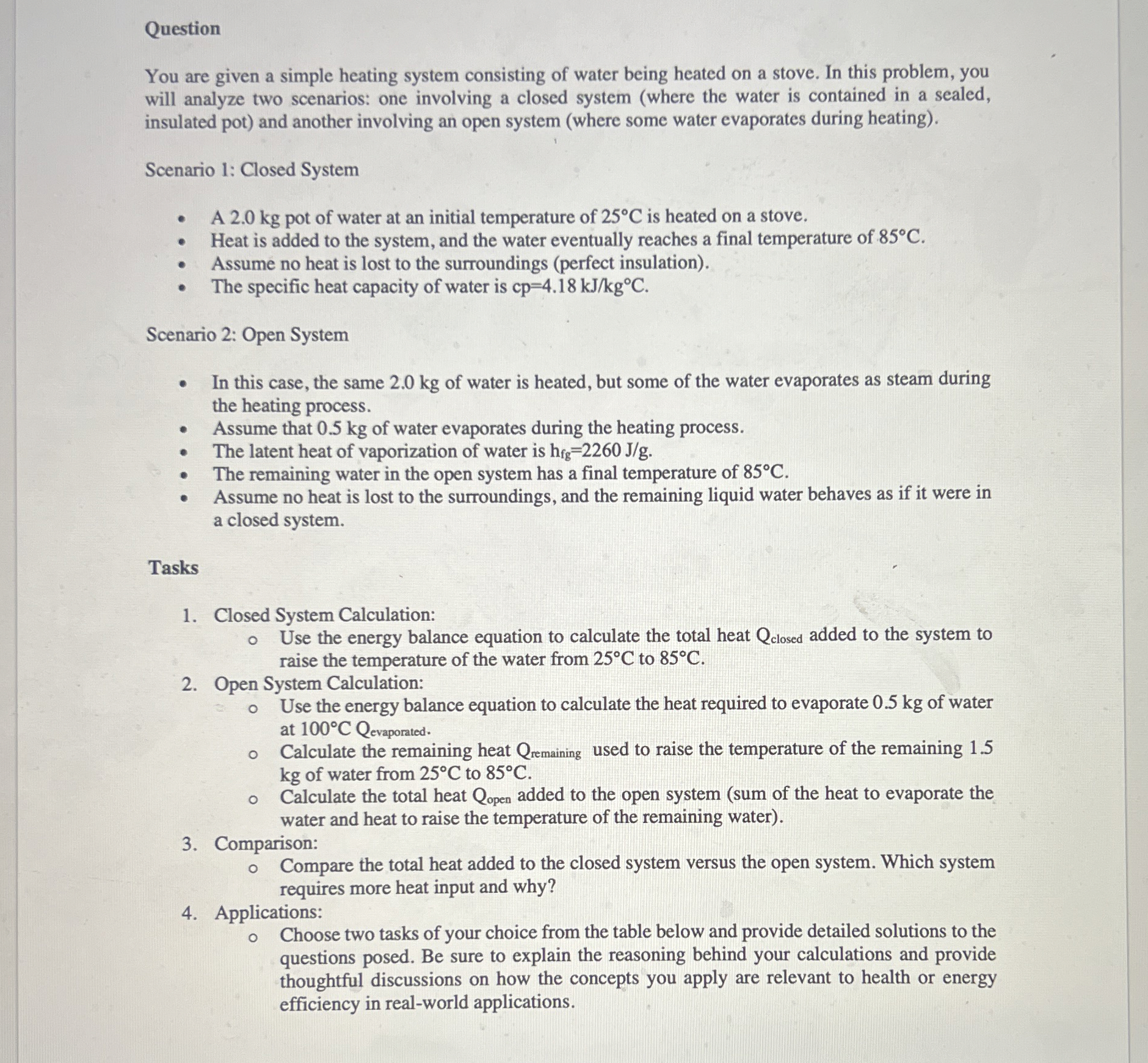
You are given a simple heating system consisting of water being heated on a stove. In this problem, you will analyze two scenarios: one involving a closed system where the water is contained in a sealed, insulated pot and another involving an open system where some water evaporates during heating
Scenario : Closed System
A kg pot of water at an initial temperature of is heated on a stove.
Heat is added to the system, and the water eventually reaches a final temperature of
Assume no heat is lost to the surroundings perfect insulation
The specific heat capacity of water is
Scenario : Open System
In this case, the same kg of water is heated, but some of the water evaporates as steam during the heating process.
Assume that kg of water evaporates during the heating process.
The latent heat of vaporization of water is
The remaining water in the open system has a final temperature of
Assume no heat is lost to the surroundings, and the remaining liquid water behaves as if it were in a closed system.
Tasks
Closed System Calculation:
Use the energy balance equation to calculate the total heat added to the system to raise the temperature of the water from to
Open System Calculation:
Use the energy balance equation to calculate the heat required to evaporate kg of water at
Calculate the remaining heat used to raise the temperature of the remaining kg of water from to
Calculate the total heat added to the open system sum of the heat to evaporate the water and heat to raise the temperature of the remaining water
Comparison:
Compare the total heat added to the closed system versus the open system. Which system requires more heat input and why?
Applications:
Choose two tasks of your choice from the table below and provide detailed solutions to the questions posed. Be sure to explain the reasoning behind your calculations and provide thoughtful discussions on how the concepts you apply are relevant to health or energy efficiency in realworld applications.
Step by Step Solution
There are 3 Steps involved in it
1 Expert Approved Answer
Step: 1 Unlock

Question Has Been Solved by an Expert!
Get step-by-step solutions from verified subject matter experts
Step: 2 Unlock
Step: 3 Unlock
 Study Help