Question: Question-1 80 Marks This question analyses the students' knowledge in Requirements Engineering and Static and Dynamic Modelling, included as an implementation of practical aspects of
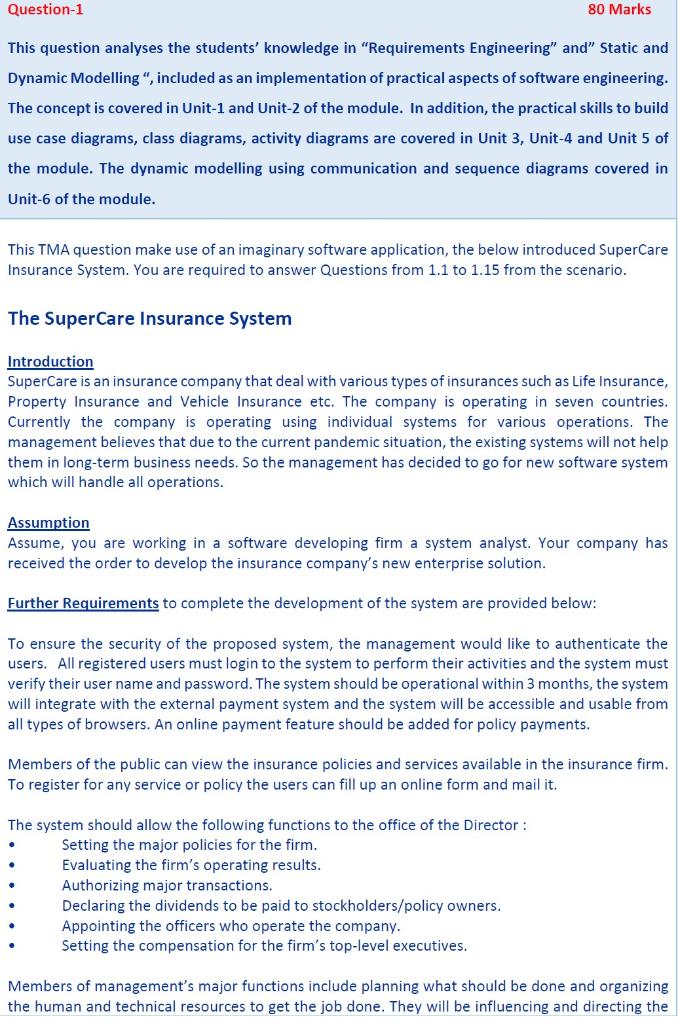
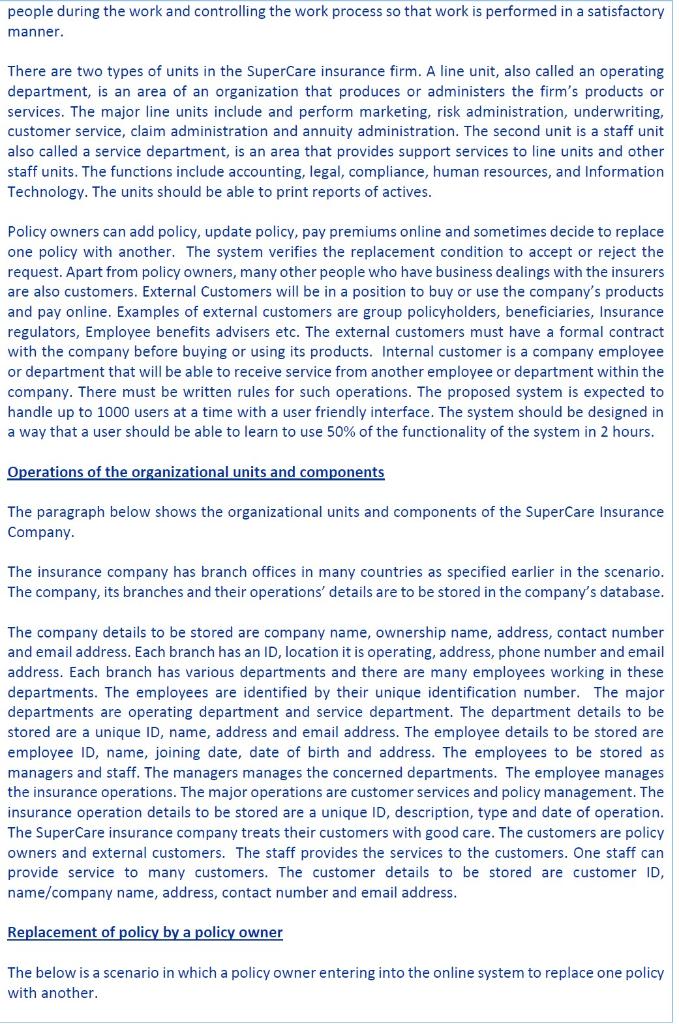
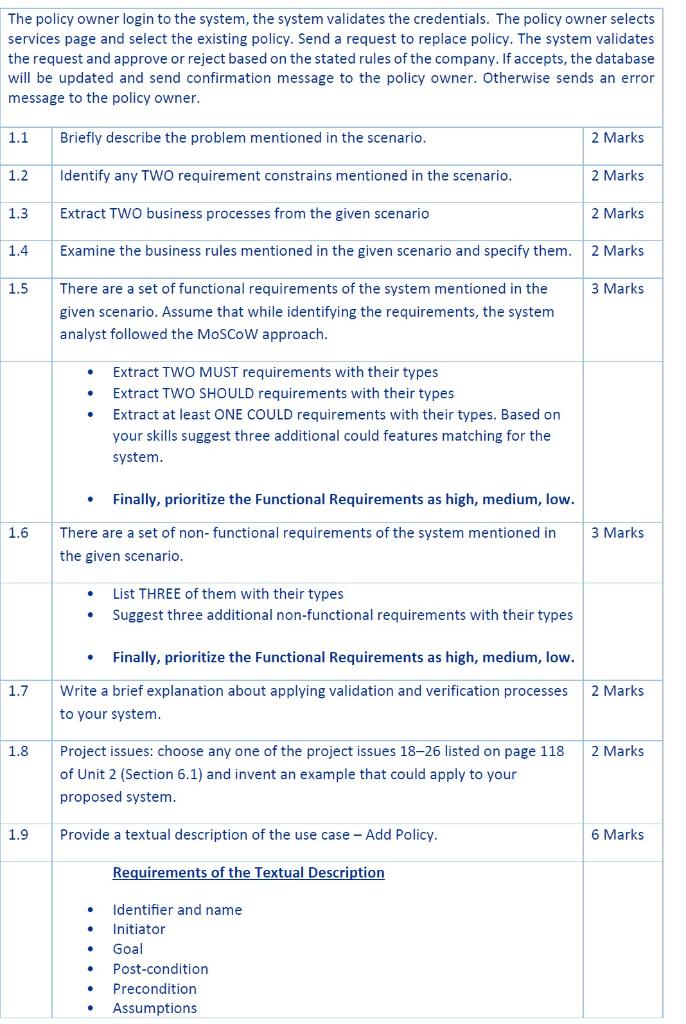
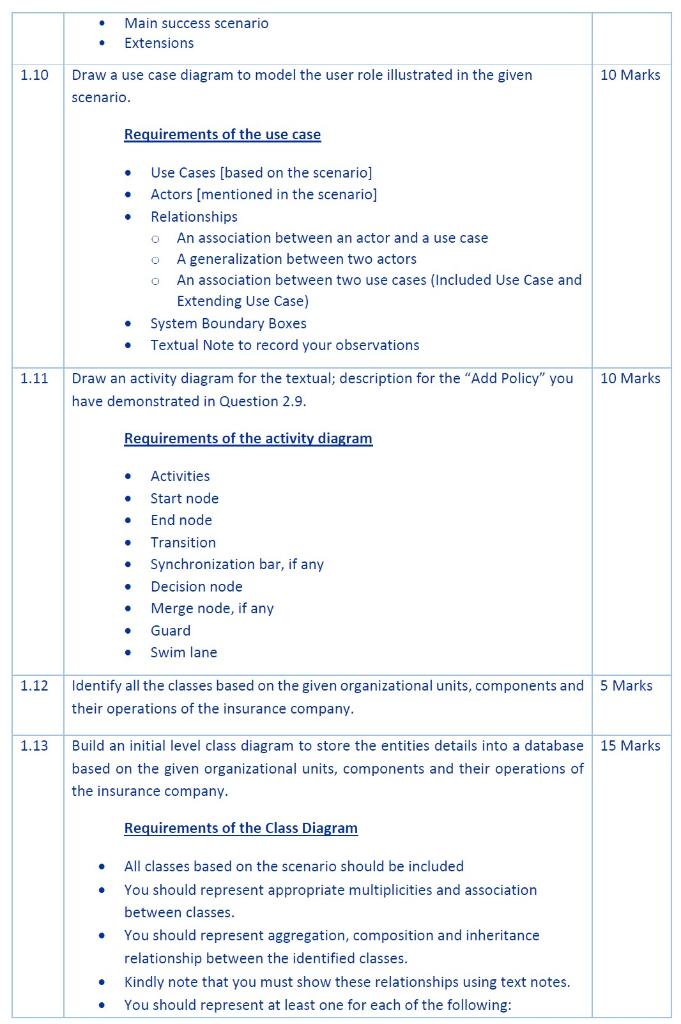
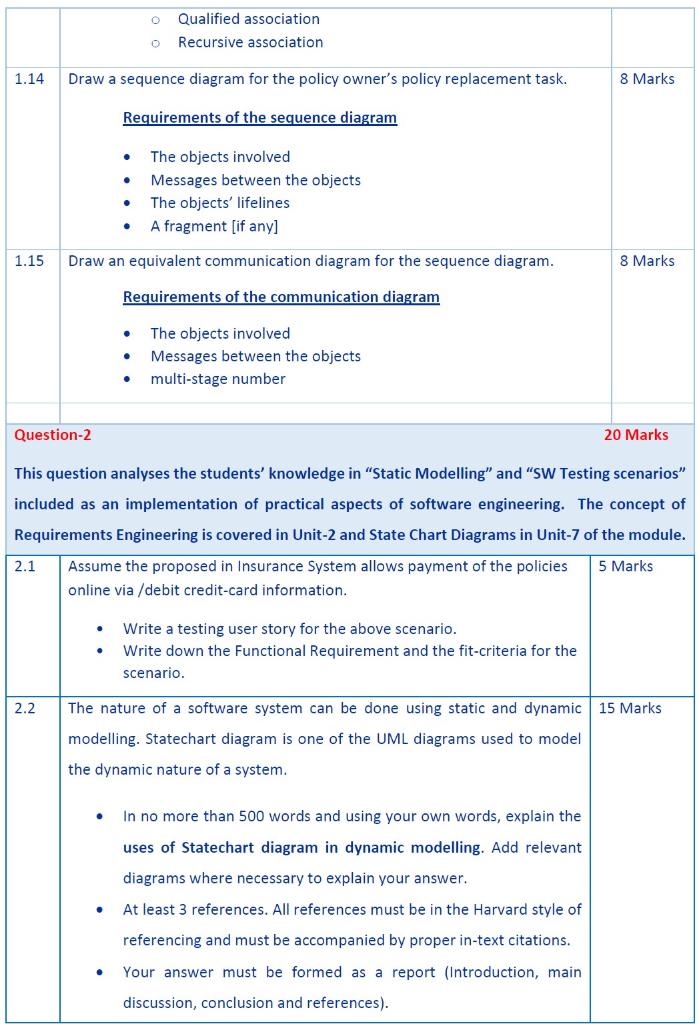
Question-1 80 Marks This question analyses the students' knowledge in "Requirements Engineering" and" Static and Dynamic Modelling", included as an implementation of practical aspects of software engineering. The concept is covered in Unit-1 and Unit-2 of the module. In addition, the practical skills to build use case diagrams, class diagrams, activity diagrams are covered in Unit 3, Unit-4 and Unit 5 of the module. The dynamic modelling using communication and sequence diagrams covered in Unit-6 of the module. This TMA question make use of an imaginary software application, the below introduced SuperCare Insurance System. You are required to answer Questions from 1.1 to 1.15 from the scenario. The SuperCare Insurance System Introduction SuperCare is an insurance company that deal with various types of insurances such as Life Insurance, Property Insurance and Vehicle Insurance etc. The company is operating in seven countries. Currently the company is operating using individual systems for various operations. The management believes that due to the current pandemic situation, the existing systems will not help them in long-term business needs. So the management decided to go for new software system which will handle all operations. Assumption Assume, you are working in a software developing firm a system analyst. Your company has received the order to develop the insurance company's new enterprise solution. Further Requirements to complete the development of the system are provided below: To ensure the security of the proposed system, the management would like to authenticate the users. All registered users must login to the system to perform their activities and the system must verify their user name and password. The system should be operational within 3 months, the system will integrate with the external payment system and the system will be accessible and usable from all types of browsers. An online payment feature should be added for policy payments. Members of the public can view the insurance policies and services available in the insurance firm. To register for any service or policy the users can fill up an online form and mail it. The system should allow the following functions to the office of the Director: Setting the major policies for the firm. Evaluating the firm's operating results. Authorizing major transactions. Declaring the dividends to be paid to stockholders/policy owners. Appointing the officers who operate the company. Setting the compensation for the firm's top-level executives. Members of management's major functions include planning what should be done and organizing the human and technical resources to get the job done. They will be influencing and directing the people during the work and controlling the work process so that work is performed in a satisfactory manner. There are two types of units in the SuperCare insurance firm. A line unit, also called an operating department, is an area of an organization that produces or administers the firm's products or services. The major line units include and perform marketing, risk administration, underwriting, customer service, claim administration and annuity administration. The second unit is a staff unit also called a service department, is an area that provides support services to line units and other staff units. The functions include accounting, legal, compliance, human resources, and Information Technology. The units should be able to print reports of actives. Policy owners can add policy, update policy, pay premiums online and sometimes decide to replace one policy with another. The system verifies the replacement condition to accept or reject the request. Apart from policy owners, many other people who have business dealings with the insurers are also customers. External Customers will be in a position to buy or use the company's products and pay online. Examples of external customers are group policyholders, beneficiaries, Insurance regulators, Employee benefits advisers etc. The external customers must have a formal contract with the company before buying or using its products. Internal customer is a company employee or department that will be able to receive service from another employee or department within the company. There must be written rules for such operations. The proposed system is expected to handle up to 1000 users at a time with a user friendly interface. The system should be designed in a way that a user should be able to learn to use 50% of the functionality of the system in 2 hours. Operations of the organizational units and components The paragraph below shows the organizational units and components of the SuperCare Insurance Company. The insurance company has branch offices in many countries as specified earlier in the scenario. The company, its branches and their operations' details are to be stored in the company's database. The company details to be stored are company name, ownership name, address, contact number and email address. Each branch has an ID, location it is operating, address, phone number and email address. Each branch has various departments and there are many employees working in these departments. The employees are identified by their unique identification number. The major departments are operating department and service department. The department details to be stored are a unique ID, name, address and email address. The employee details to be stored are employee ID, name, joining date, date of birth and address. The employees to be stored as managers and staff. The managers manages the concerned departments. The employee manages the insurance operations. The major operations are customer services and policy management. The insurance operation details to be stored are a unique ID, description, type and date of operation. The SuperCare insurance company treats their customers with good care. The customers are policy owners and external customers. The staff provides the services to the customers. One staff can provide service to man customers. The customer details to be stored are customer ID, name/company name, address, contact number and email address. Replacement of policy by a policy owner The below is a scenario in which a policy owner entering into the online system to replace one policy with another. The policy owner login to the system, the system validates the credentials. The policy owner selects services page and select the existing policy. Send a request to replace policy. The system validates the request and approve or reject based on the stated rules of the company. If accepts, the database will be updated and send confirmation message to the policy owner. Otherwise sends an error message to the policy owner. 1.1 Briefly describe the problem mentioned in the scenario. 2 Marks 1.2 Identify any TWO requirement constrains mentioned in the scenario. 2 Marks 1.3 Extract TWO business processes from the given scenario 2 Marks 1.4 Examine the business rules mentioned in the given scenario and specify them. 2 Marks 1.5 3 Marks There are a set of functional requirements of the system mentioned in the given scenario. Assume that while identifying the requirements, the system analyst followed the MOSCOW approach. . Extract TWO MUST requirements with their types Extract TWO SHOULD requirements with their types Extract at least ONE COULD requirements with their types. Based on your skills suggest three additional could features matching for the system. . Finally, prioritize the Functional Requirements as high, medium, low. 1.6 3 Marks There are a set of non-functional requirements of the system mentioned in the given scenario. List THREE of them with their types Suggest three additional non-functional requirements with their types . Finally, prioritize the Functional Requirements as high, medium, low. 1.7 2 Marks Write a brief explanation about applying validation and verification processes to your system. 1.8 2 Marks Project issues: choose any one of the project issues 18-26 listed on page 118 of Unit 2 (Section 6.1) and invent an example that could apply to your proposed system. 1.9 Provide a textual description of the use case - Add Policy. 6 Marks Requirements of the Textual Description . Identifier and name Initiator Goal Post-condition Precondition Assumptions . Main success scenario Extensions 1.10 10 Marks Draw a use case diagram to model the user role illustrated in the given scenario. Requirements of the use case . Use Cases (based on the scenario] Actors (mentioned in the scenario] Relationships An association between an actor and a use case A generalization between two actors An association between two use cases (Included Use Case and Extending Use Case) System Boundary Boxes Textual Note to record your observations . 1.11 10 Marks Draw an activity diagram for the textual; description for the "Add Policy" you have demonstrated in Question 2.9. Requirements of the activity diagram . . Activities Start node End node Transition Synchronization bar, if any Decision node Merge node, if any Guard Swim lane . 1.12 Identify all the classes based on the given organizational units, components and 5 Marks their operations of the insurance company. 1.13 Build an initial level class diagram to store the entities details into a database 15 Marks based on the given organizational units, components and their operations of the insurance company. Requirements of the Class Diagram All classes based on the scenario should be included You should represent appropriate multiplicities and association between classes. You should represent aggregation, composition and inheritance relationship between the identified classes. Kindly note that you must show these relationships using text notes. You should represent at least one for each of the following: Qualified association Recursive association 0 1.14 Draw a sequence diagram for the policy owner's policy replacement task. 8 Marks Requirements of the sequence diagram . . The objects involved Messages between the objects The objects' lifelines A fragment [if any] . 1.15 Draw an equivalent communication diagram for the sequence diagram. 8 Marks Requirements of the communication diagram . . The objects involved Messages between the objects multi-stage number Question-2 20 Marks This question analyses the students' knowledge in "Static Modelling" and "SW Testing scenarios" included as an implementation of practical aspects of software engineering. The concept of Requirements Engineering is covered in Unit-2 and State Chart Diagrams in Unit-7 of the module. 2.1 Assume the proposed in Insurance System allows payment of the policies 5 Marks online via /debit credit card information. Write a testing user story for the above scenario. Write down the Functional Requirement and the fit-criteria for the scenario. 2.2 The nature of a software system can be done using static and dynamic 15 Marks modelling. Statechart diagram is one of the UML diagrams used to model the dynamic nature of a system. . In no more than 500 words and using your own words, explain the uses of Statechart diagram in dynamic modelling. Add relevant diagrams where necessary to explain your answer. . At least 3 references. All references must be in the Harvard style of . referencing and must be accompanied by proper in-text citations. Your answer must be formed as a report (Introduction, main discussion, conclusion and references)









 Study Help