







Question: question3 please see full questions please help with part D (d) A house in Sydney has recently sold for $1.5 million. Renting an equivalent house
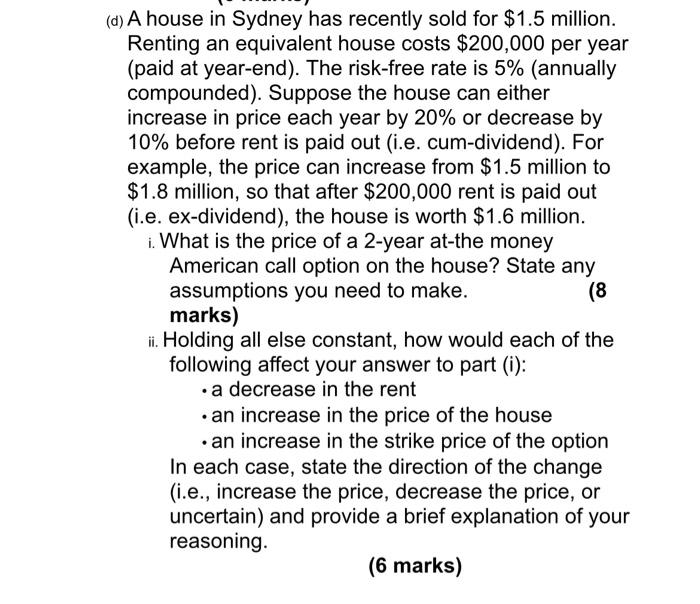
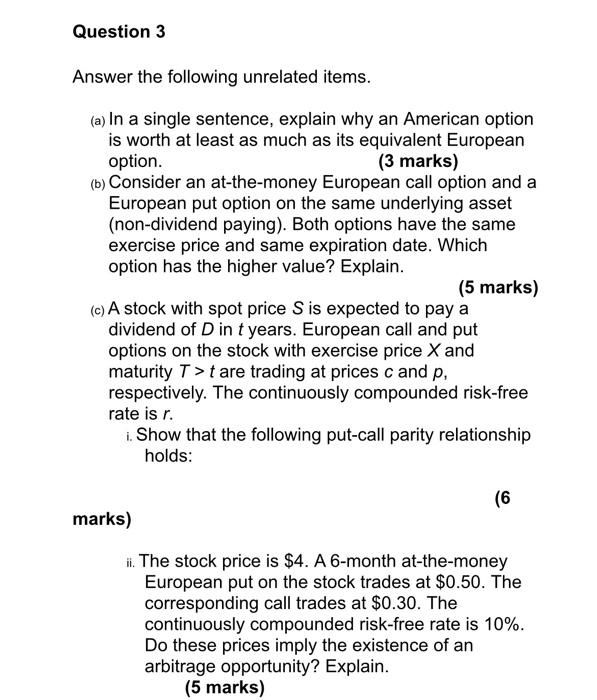
(d) A house in Sydney has recently sold for $1.5 million. Renting an equivalent house costs $200,000 per year (paid at year-end). The risk-free rate is 5% (annually compounded). Suppose the house can either increase in price each year by 20% or decrease by 10% before rent is paid out (i.e. cum-dividend). For example, the price can increase from $1.5 million to $1.8 million, so that after $200,000 rent is paid out (i.e. ex-dividend), the house is worth $1.6 million. i. What is the price of a 2-year at-the money American call option on the house? State any assumptions you need to make. (8 marks) ii. Holding all else constant, how would each of the following affect your answer to part (i): a decrease in the rent an increase in the price of the house an increase in the strike price of the option In each case, state the direction of the change (i.e., increase the price, decrease the price, or uncertain) and provide a brief explanation of your reasoning. (6 marks) Question 3 Answer the following unrelated items. (a) In a single sentence, explain why an American option is worth at least as much as its equivalent European option. (3 marks) (b) Consider an at-the-money European call option and a European put option on the same underlying asset (non-dividend paying). Both options have the same exercise price and same expiration date. Which option has the higher value? Explain. (5 marks) (c) A stock with spot price S is expected to pay a dividend of D in tyears. European call and put options on the stock with exercise price X and maturity T>t are trading at prices c and p, respectively. The continuously compounded risk-free rate is r. i. Show that the following put-call parity relationship holds: (6 marks) i. The stock price is $4.A 6-month at-the-money European put on the stock trades at $0.50. The corresponding call trades at $0.30. The continuously compounded risk-free rate is 10%. Do these prices imply the existence of an arbitrage opportunity? Explain. (5 marks) (d) A house in Sydney has recently sold for $1.5 million. Renting an equivalent house costs $200,000 per year (paid at year-end). The risk-free rate is 5% (annually compounded). Suppose the house can either increase in price each year by 20% or decrease by 10% before rent is paid out (i.e. cum-dividend). For example, the price can increase from $1.5 million to $1.8 million, so that after $200,000 rent is paid out (i.e. ex-dividend), the house is worth $1.6 million. i. What is the price of a 2-year at-the money American call option on the house? State any assumptions you need to make. (8 marks) ii. Holding all else constant, how would each of the following affect your answer to part (i): a decrease in the rent an increase in the price of the house an increase in the strike price of the option In each case, state the direction of the change (i.e., increase the price, decrease the price, or uncertain) and provide a brief explanation of your reasoning. (6 marks) Question 3 Answer the following unrelated items. (a) In a single sentence, explain why an American option is worth at least as much as its equivalent European option. (3 marks) (b) Consider an at-the-money European call option and a European put option on the same underlying asset (non-dividend paying). Both options have the same exercise price and same expiration date. Which option has the higher value? Explain. (5 marks) (c) A stock with spot price S is expected to pay a dividend of D in tyears. European call and put options on the stock with exercise price X and maturity T>t are trading at prices c and p, respectively. The continuously compounded risk-free rate is r. i. Show that the following put-call parity relationship holds: (6 marks) i. The stock price is $4.A 6-month at-the-money European put on the stock trades at $0.50. The corresponding call trades at $0.30. The continuously compounded risk-free rate is 10%. Do these prices imply the existence of an arbitrage opportunity? Explain
Step by Step Solution
There are 3 Steps involved in it

Get step-by-step solutions from verified subject matter experts
 Study Help