







Question: Question-4 (15 points): Dependence analysis of nested loops is a straightforward generalization of the dependence analysis of single loops. Essentially, the index variable becomes an
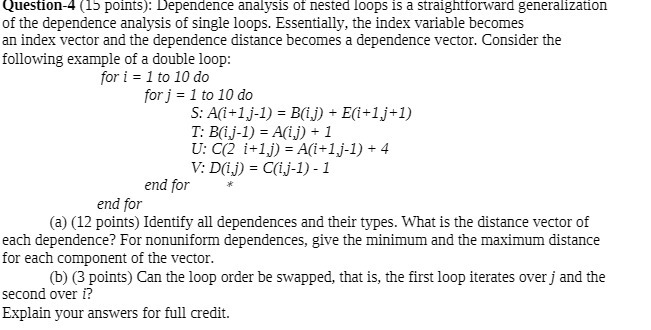
Question-4 (15 points): Dependence analysis of nested loops is a straightforward generalization of the dependence analysis of single loops. Essentially, the index variable becomes an index vector and the dependence distance becomes a dependence vector. Consider the following example of a double loop: for i = 1 to 10 do for j = 1 to 10 do 5: A(i+1,j-1) = B(i,j) + E(i+1,j+1) T: B(i,j-1) = A(i,j) + 1 U: C(2 i+1,j) = A(i+1,j-1) + 4 V: D(i,j) = C(i,j-1) - 1 end for end for (a) (12 points) Identify all dependences and their types. What is the distance vector of each dependence? For nonuniform dependences, give the minimum and the maximum distance for each component of the vector. (b) (3 points) Can the loop order be swapped, that is, the first loop iterates over j and the second over ?? Explain your answers for full credit
Step by Step Solution
There are 3 Steps involved in it

Get step-by-step solutions from verified subject matter experts
 Study Help