







Question: Question:Now recall the grim trigger strategy:Cooperate in the first round, cooperate iff neither player has ever defected. It is an equilibrium for both players to
Question:Now recall the grim trigger strategy:Cooperate in the first round, cooperate iff neither player has ever defected. It is an equilibrium for both players to play grim trigger so long as ? > c/b. Argue that this equilibrium is subgame perfect. That is, suppose the players somehow arrive at a subgame in which at least one of them has defected in the past, and argue that neither would benefit by deviating from always defecting from then on.
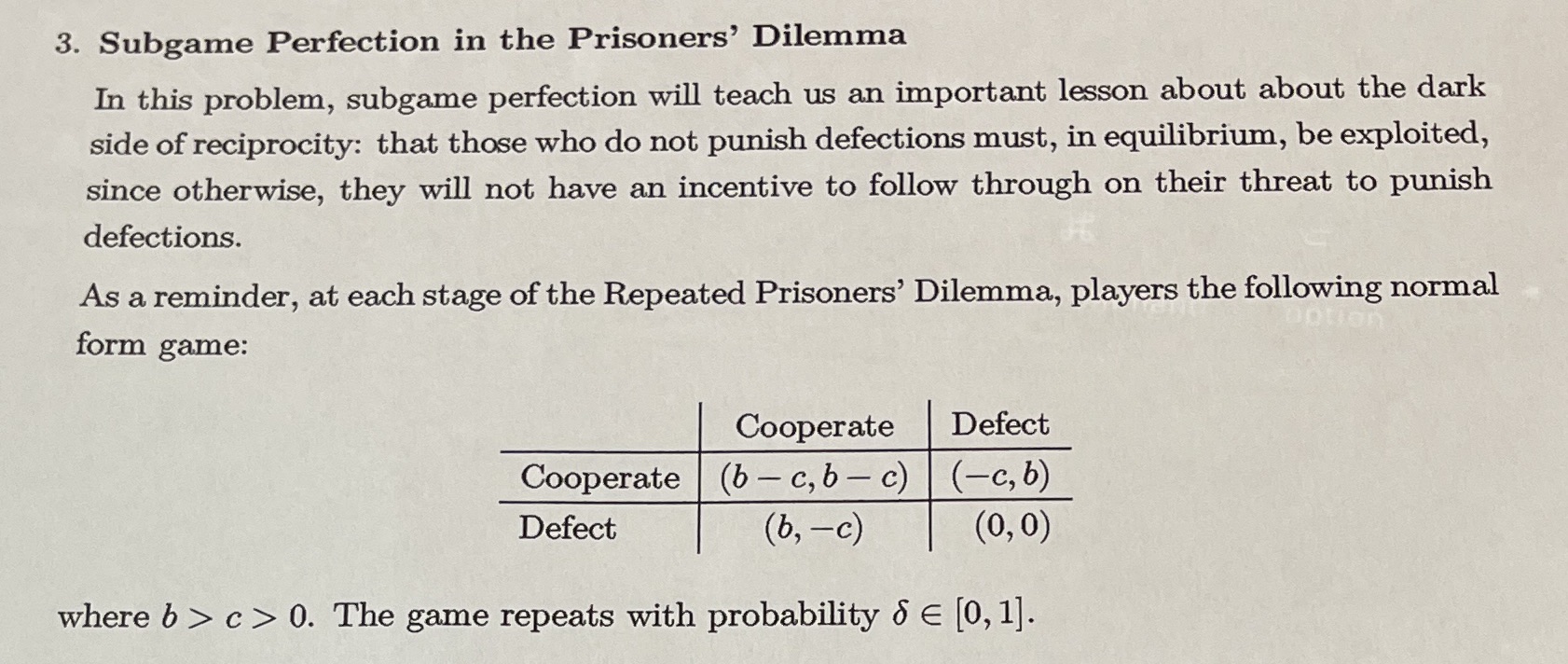
3. Subgame Perfection in the Prisoners' Dilemma In this problem, subgame perfection will teach us an important lesson about about the dark side of reciprocity: that those who do not punish defections must, in equilibrium, be exploited, since otherwise, they will not have an incentive to follow through on their threat to punish defections. As a reminder, at each stage of the Repeated Prisoners' Dilemma, players the following normal form game: Cooperate Defect Cooperate (b - c, b - c) (-c, b) Defect ( b, - c) (0, 0) where b > c > 0. The game repeats with probability o E [0, 1]
Step by Step Solution
There are 3 Steps involved in it

Get step-by-step solutions from verified subject matter experts
 Study Help