







Question: Questions 1. Define the ethical issues. Should labor practices in another country be a relevant consideration in international trade? Why or why not? 2. Identify
Questions 1. Define the ethical issues. Should labor practices in another country be a relevant consideration in international trade? Why or why not? 2. Identify the affected parties and stakeholders presented in the case. 3.Identify the affected parties and stakeholders presented in the case. 4. Identify the consequences of alternative options that are available to governments, businesses, and consumers dealing with practices such as child labor in other countries 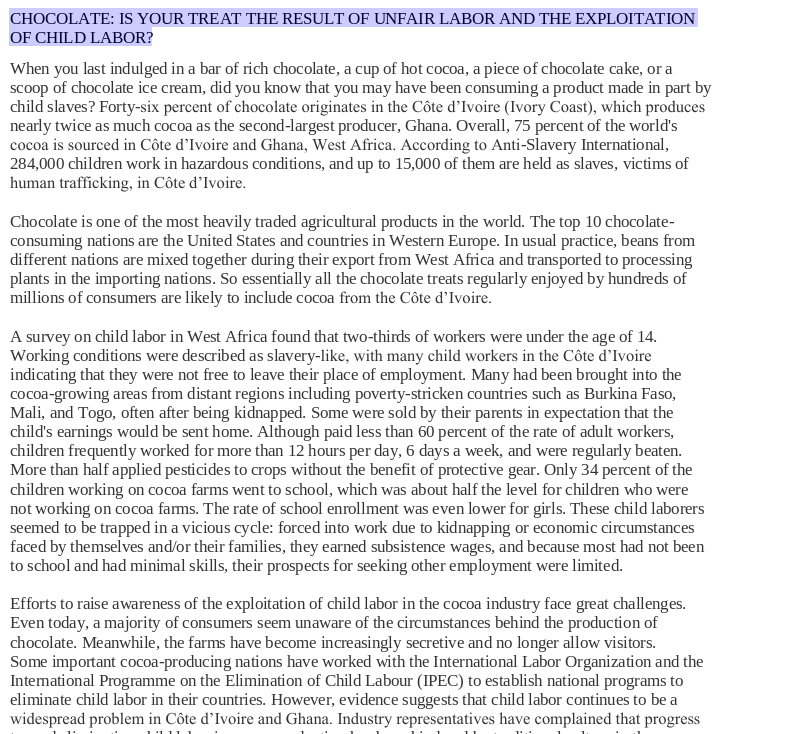
CHOCOLATE: IS YOUR TREAT THE RESULT OF UNFAIR LABOR AND THE EXPLOITATION OF CHILD LABOR? When you last indulged in a bar of rich chocolate, a cup of hot cocoa, a piece of chocolate cake, or a scoop of chocolate ice cream, did you know that you may have been consuming a product made in part by child slaves? Forty-six percent of chocolate originates in the Cte d'Ivoire (Ivory Coast), which produces nearly twice as much cocoa as the second-largest producer, Ghana. Overall, 75 percent of the world's cocoa is sourced in Cte d'Ivoire and Ghana, West Africa. According to Anti-Slavery International, 284,000 children work in hazardous conditions, and up to 15,000 of them are held as slaves, victims of human trafficking, in Cte d'Ivoire. Chocolate is one of the most heavily traded agricultural products in the world. The top 10 chocolateconsuming nations are the United States and countries in Western Europe. In usual practice, beans from different nations are mixed together during their export from West Africa and transported to processing plants in the importing nations. So essentially all the chocolate treats regularly enjoyed by hundreds of millions of consumers are likely to include cocoa from the Cte d'Ivoire. A survey on child labor in West Africa found that two-thirds of workers were under the age of 14 . Working conditions were described as slavery-like, with many child workers in the Cte d'Ivoire indicating that they were not free to leave their place of employment. Many had been brought into the cocoa-growing areas from distant regions including poverty-stricken countries such as Burkina Faso, Mali, and Togo, often after being kidnapped. Some were sold by their parents in expectation that the child's earnings would be sent home. Although paid less than 60 percent of the rate of adult workers, children frequently worked for more than 12 hours per day, 6 days a week, and were regularly beaten. More than half applied pesticides to crops without the benefit of protective gear. Only 34 percent of the children working on cocoa farms went to school, which was about half the level for children who were not working on cocoa farms. The rate of school enrollment was even lower for girls. These child laborers seemed to be trapped in a vicious cycle: forced into work due to kidnapping or economic circumstances faced by themselves and/or their families, they earned subsistence wages, and because most had not been to school and had minimal skills, their prospects for seeking other employment were limited. Efforts to raise awareness of the exploitation of child labor in the cocoa industry face great challenges. Even today, a majority of consumers seem unaware of the circumstances behind the production of chocolate. Meanwhile, the farms have become increasingly secretive and no longer allow visitors. Some important cocoa-producing nations have worked with the International Labor Organization and the International Programme on the Elimination of Child Labour (IPEC) to establish national programs to eliminate child labor in their countries. However, evidence suggests that child labor continues to be a widespread problem in Cte d'Ivoire and Ghana. Industry representatives have complained that progress
Step by Step Solution
There are 3 Steps involved in it

Get step-by-step solutions from verified subject matter experts
 Study Help