







Question: questions 1) differentiate between performance planning and develop planning? 2) parties involved in performance management system? 3) interim reviews pros and cons and purpose? 4)
questions
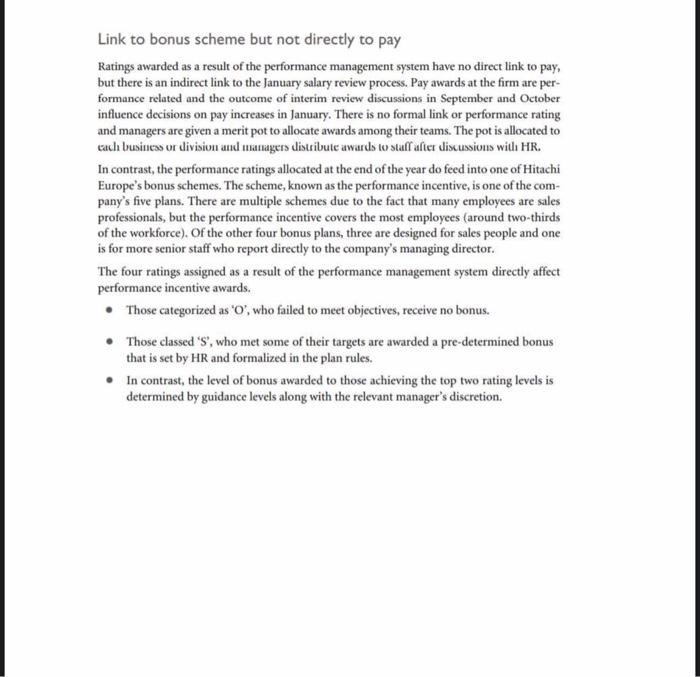
Hitachi Europe Hitachi Europe has a well-established performance management system that has been in place for a number of years. It is designed primarily to enhance staff development in order to add value to the organization and all of the company's 450 staff are covered by the system. The process involves an open, two-way discussion between employees and their managers, with meetings taking place at least twice a year. During meetings, staff and managers focus on current and past performance and future development, and although there is no direct link to pay the system does help inform pay decisions. In contrast, appraisal results for two-thirds of staff are directly linked to one of the company's five bonus plans with performance ratings determining payout levels The process is as much about building relationships with employees in order to agree what is reasonably attainable in the year as it is about setting objectives. It is effective because it focuses people's intentions and produces new thinking on the way they work rather than simply con- tinuing to perform at the same level day-in-day-out. The performance management cycle Hitachi Europe's year begins in April, and prior to this managers and staff are advised to con- sider performance over the previous year and expectations for the coming 12 months. Around March, managers meet with employees to devise a performance development plan that, in practice, involves two dicesione performance planning discussion development planning discussion. The performance planning discussion is focused primarily on whether past objectives have been achieved and what future targets should be. In contrast, the Development Planning Dis. cussion helps the manager and employee consider the individual's development needs and ties in with training and other requirements necessary to help them achieve future objectives Hitachi Europe's performance management guidance says that the purpose of these meting is To ensure that an open, two-way discussion takes place between an employee and their manager. The discussion should review both past performance and development and identify whether past objectives have been met and to agree future objectives. The objec- times set should align to both group and term objectives Performance planning discussion During the performance planning meeting, managers are encouraged to use examples to illus trate to employees where they have performed adequately, exceptionally and below aspect tion. In addition, they also refer to information acquired via consultation with other managers and colleagues of the employee. This rounded approach ensures they have a good understanding of how the employee is per forming and, while the focus of the discussion is on the employee's performance managers must also be prepared to discuss the role they themselves played in helping or hindering the employee in achieving their objectives. Throughout the meeting Hitachi Europe says that there should be mutual understanding and agreement, especially regarding decisions on past objectives and key actions for the future. Objectives Objectives emerging from discussions should be SMART - specific, measurable, achievable. realistic and time bound. From a time perspective, while the process is an annual event some objectives are likely to have differing timescales. In some cases, these may cover periods of less than six months, so managers and staff are given the option to meet more frequently than the usual two times a year if they wish. While the company's guidance says that objectives need to be business related in practice this is not always strictly the case for all staff. Those in more senior roles, for example, have objec tives linked to overall business objectives such as market share and profit targets, while lower down the hierarchy aims are often more closely aligned to specific jobs and sales-specific targets. In practice, the company says that objectives are really intended to encourage indi- viduals to perform beyond the level normally associated with their job roles. Development planning discussion Unlike the performance planning meeting the development planning discussion is employee led. This is because Hitachi believes it is the employees' responsibility to consider their own development requirements for the coming year. To help them do this. tete ate a number of development tools available, while managers also guide and coach where necessary. The range of development tools available is explained in a dedicated section available in the company's guidance and includes Information on a learning log, a development record and a career plan. In addition, in the past the company used a competency framework as part of a previous version of its performance management system and while this is no longer formally in use, employees can refer to its success factors', as the company says they are a useful reference point when exploring and diagnosing development needs. Using these tools, and prior to the development planning discussion, employees are encour- aged to consider their development needs, looking back over the past 12 months and looking forward over the coming year. Moreover, they need to review their previous development objectives, thinking about what they wish to achieve in the future. To aid in the process employees are advised to collate evidence in order to clarify their strengths and areas for improvement. Using this information, they can prepare a plan of recommended solutions to aid in their development for discussion with their manager While these meetings are employee-led, in some cases, Hitachi employees may be unclear or need guidance on their development needs so managers can help them reach a decision. Sim- ilarly, and where appropriate, managers can challenge the proposed development options, but in both cases only after the employee has voiced his or her own opinions. Hitachi is aware of the dangers of the managers leading the process, and provides clear guid- ance outlining certain boundaries to which they should adhere. While the guidance says that is acceptable for managers to question employees' proposed development strategies for example, it adds that they should avoid trying to make career choices for the employees. Sim- ilarly, they are told not to try to push people to develop if they are not ready to, letting the employees make up their own minds Training not always the best option The company finds that in many cases employees conclude that they require a training course as this is an obvious option. Despite this, Hitachi advises employees to avoid jumping to this conclusion as there are a number of other less obvious but more appropriate options that are often also available. The company guidance, for example, highlights on-the-job training and learning because it believes that these are the most effective ways of developing and acquiring new skills, knowledge and experience. This is not to say that training is discouraged, however, as the company states that training courses are a very good way of supporting development needs, providing a foundation for future skills and knowledge. Interim reviews In the autumn, six months on from the initial meetings, managers and employees meet again to have an interim review. The point of the discussion is to make sure that the personal deve- opment plan remains on track and objectives are still relevant. The meeting is a formal stage of the process but there is no rating at this point. Nevertheless, the outcomes of discussions are used to help inform pay rises that take place a few months later, effective from January. Six months after the interim review, the year ends and managers and staff again meet to review objectives and discuss performance over the previous 12 months. If objectives are not attained. the conversation examines why this was the case, with managers considering their own as well as the individual's role when determining why targets were not achieved. Employees also have the opportunity to explain why they believed targets were not met outlining any mitigating circumstances. Based on this interaction, the outcomes of discussions lead to a performance rating being awarded and any failed targets usually feed into the following year's objectives Unlike some other organizations, ratings do not align with a forced distribution and the four potential levels are: O: Failed to meet objectives. 'S! After assessing performance against objectives has met some of the objectives. "M: Meets expectations and has completed all objectives "M": Achieved significantly more than the agreed objectives so performance was exceptional Consistency A common concern with most, if not all, performance management schemes, is maintaining consistency across the whole organization. To ensure this is achieved, Hitachi Europe's HR staff review objectives at the start of the year to check that they are both "SMART and realistic Further, once the process is completed, results are evaluated to determine whether particular departments or divisions have especially high or low outcomes. In addition, even when there are no discernible differences in departmental rankings as a whole. HR staff still examine any individual outliers to determine whether an unfair rating has occurred. Where inconsistencies are found. HR staff meet with the line managers concerned and resist cach part of the process to ensure they are taking a consistent and impartial approach. In some cases, rating inconsistency is a symptom of another underlying problem or issue. Some man agers, for example, might feel that their staff's salaries are too low, while others may have dif- ficulties managing the expectations of their team. Line managers and training Like any initiative originating from human resources that is implemented outside the depart- ment, buy-in from the managers at the operational end is crucial. The company says that the attitudes of line managers are generally good, although there are some variations. As a result, a certain amount of chasing is necessary, especially around key dates. Nevertheless, the com- pany's training programme does help in fostering a positive attitude to the process among line managers. Managers undertake a day's training dedicated to the performance management system that covers the timetable of the process, each component of the appraisal process and how to set objectives. In addition, managers have access to a number of guidance documents available on the intranet, while refresher courses are also available. From a staff perspective, there is no formal training although the performance management system is covered during the induc tion process Link to bonus scheme but not directly to pay Ratings awarded as a result of the performance management system have no direct link to pay, but there is an indirect link to the January salary review process . Pay awards at the firm are per- formance related and the outcome of interim review discussions in September and October influence decisions on pay increases in January. There is no formal link or performance rating and managers are given a merit pot to allocate awards among their teams. The pot is allocated to cach business or division and managers distribute awards to staff after discussions with HR. In contrast, the performance ratings allocated at the end of the year do feed into one of Hitachi Europe's bonus schemes. The scheme, known as the performance incentive, is one of the com- pany's five plans. There are multiple schemes due to the fact that many employees are sales professionals, but the performance incentive covers the most employees (around two-thirds of the workforce). Of the other four bonus plans, three are designed for sales people and one is for more senior staff who report directly to the company's managing director. The four ratings assigned as a result of the performance management system directly affect performance incentive awards. Those categorized as '0', who failed to meet objectives, receive no bonus. Those classed 'S', who met some of their targets are awarded a pre-determined bonus that is set by HR and formalized in the plan rules. In contrast, the level of bonus awarded to those achieving the top two rating levels is determined by guidance levels along with the relevant manager's discretion 1) differentiate between performance planning and develop planning?
2) parties involved in performance management system?
3) interim reviews pros and cons and purpose?
4) why performance management is linked with bonus not with the poj? 
Step by Step Solution
There are 3 Steps involved in it
1 Expert Approved Answer
Step: 1 Unlock

Question Has Been Solved by an Expert!
Get step-by-step solutions from verified subject matter experts
Step: 2 Unlock
Step: 3 Unlock
 Study Help