







Question: QUESTIONS: 1. Differentiate offensive and defensive strategy. 2. Explain the PDCA cycle. 3. Apply the concept of continuous improvement in your personal life. Cite an
QUESTIONS:
1. Differentiate offensive and defensive strategy. 2. Explain the PDCA cycle. 3. Apply the concept of continuous improvement in your personal life. Cite an example. What is the outcome of it? 4. What are the benefits of TQM in the organization? Cite an example. 5. From the different types of strategies, which do you think is the most effective one? Do you think one strategy is better than the other? Why or why not?
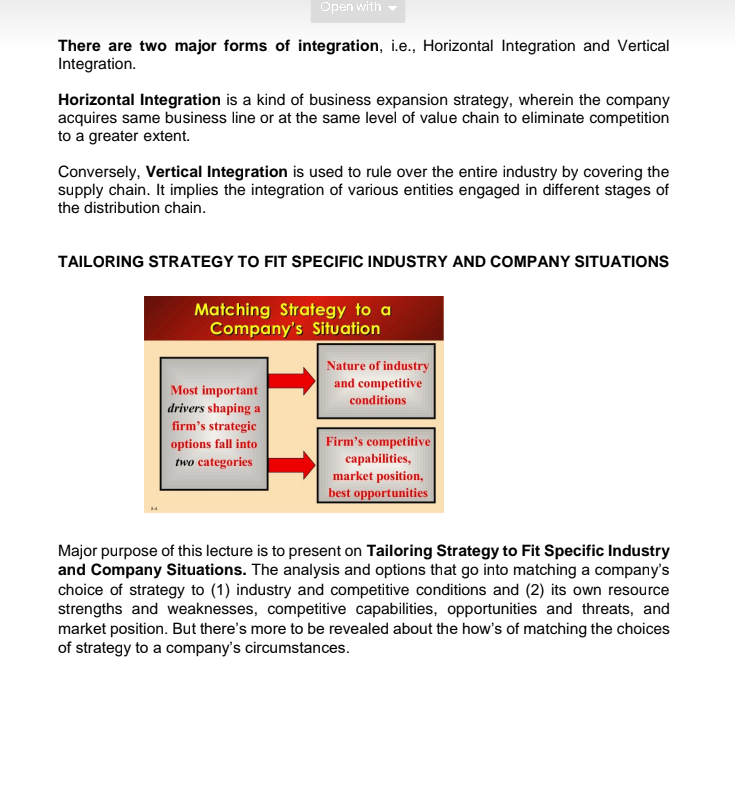
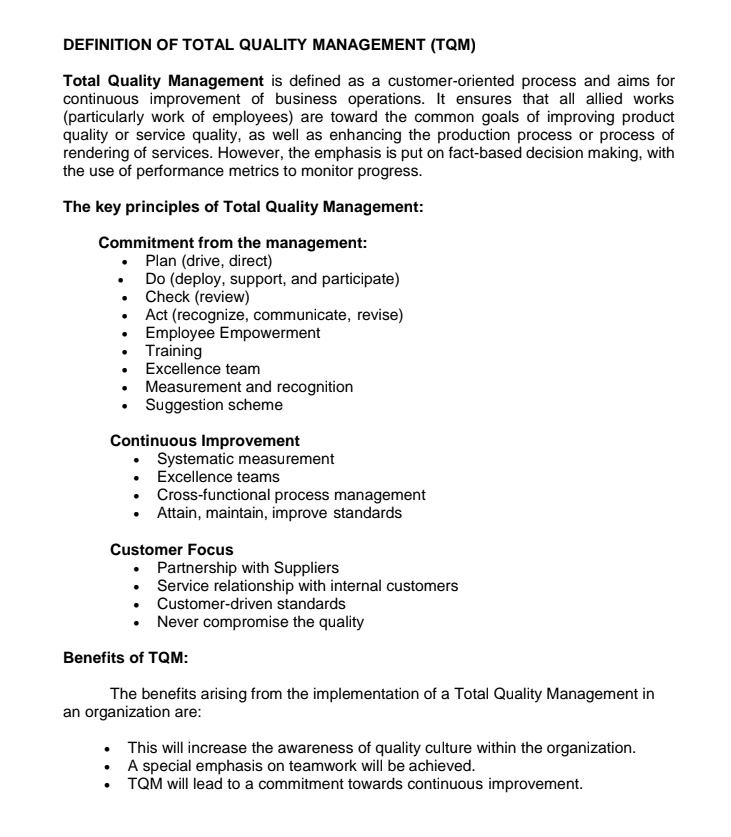
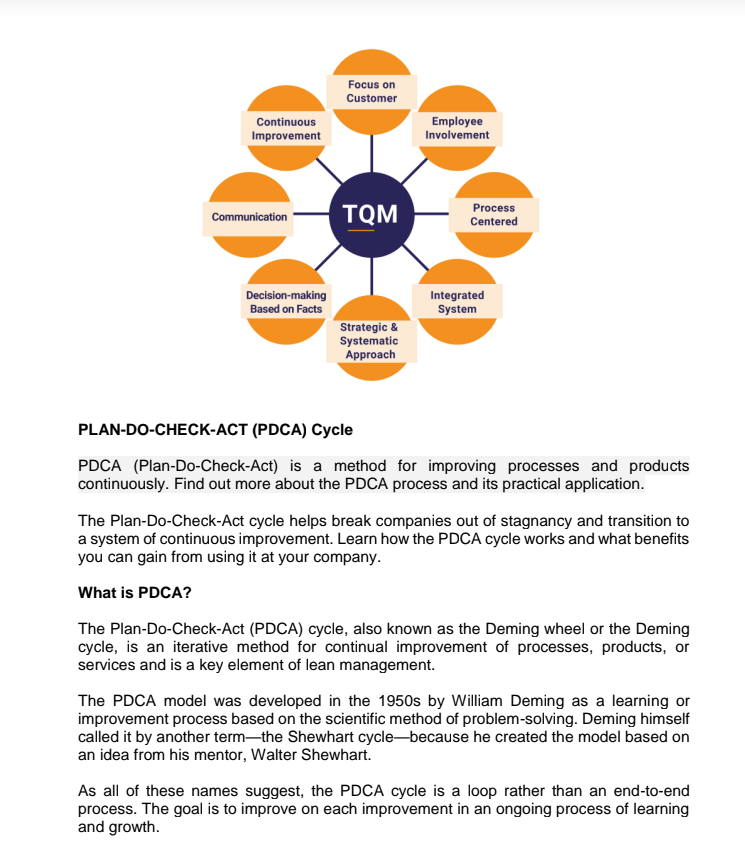
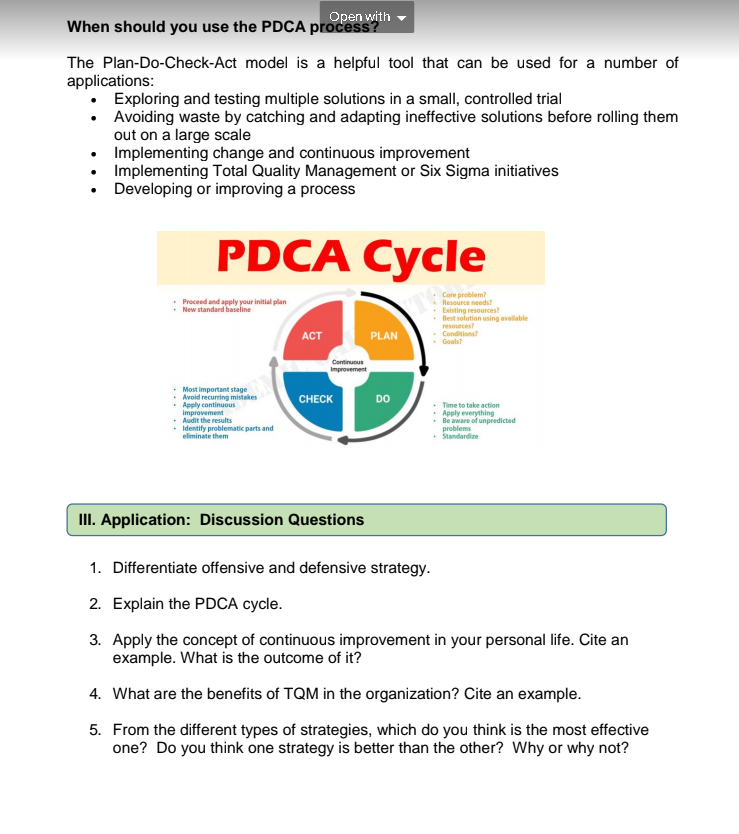
CBMEC 2: STRATEGIC MANAGEMENT Professor: 1 LESSON 4 STRATEGIC ACTIONS: STRATEGY FORMULATION 1. Intended Learning Outcomes At the end of the lesson, you are expected to: 1. Discuss the types of strategies. 2. Explain the offensive and defensive strategy. 3. Explain Total Quality Management and process re-engineering as part of strategy. II. Lesson Proper FOUR GRAND STRATEGIES: 1. Stability strategy: This type of strategy is used by an organization in cases where the organization is satisfied with the current situation and therefore it does not want to move away from such a position. Consequently, in such a case, the organization goes for the stability strategy. However, a stability strategy can prove to be effective when the environment of the organization is also stable. In most of the cases, this type of strategy is used by the organizations. The reason is that it is the least risky course of action. For example, the stability strategy will be adopted by an organization if it is satisfied by dealing with the same product or service, providing its services to the same group of consumers and maintaining the same market share. Sometimes, the organization is not adventurous enough to try new strategies and change its situation. However, the stability strategy can be adopted successfully by the organizations from a mature industry that has a static technology. But because of adopting the stability strategy, the managers may become complacent. In the same way, whenever a change arises in such an organization, the managers find it difficult to deal with such changes. 2. Growth strategy: growth is related with expansion and diversification of the business operations. Therefore, if the management of the organization is not satisfied with the present status of the company, or when changes are taking place in the environment of the organization, or if favorable opportunities arise, it will be helpful for the organization to adopt growth strategy as it helps in expansion and in diversification. A growth strategy can be implemented in the organization through market development, product development, merger, or diversification. In case of product development, the organization adds new products to the existing products, or these new products replace the products that were offered by the organization earlier. On the other hand, in case of vertical integration, the organization may also decide to take backward or forward lines. In such a case, either the company may decide to produce its own raw materials, or it may decide that it will process its own output in future. It is very important that the growth strategy should be controlled and planned in a proper way otherwise such a strategy may not be successful in achieving its objectives. Due to the reason that growth indicates effective management, it is always desirable to adopt such a strategy. 3. Retrenchment strategy: an organization may decide to retreat or the change from its current position for the purpose of improving its position or sometimes to survive. This type of strategy must be adopted by an organization when the company is going through the times of recession, or the competition is tough, or there is a scarcity of resources and as a result, the resources need to be reorganized to reduce waste. In this way, even if the retrenchment or retreat strategy reflects a failure on the part of the organization to some extent, however it is very important that such a strategy should be adopted to ensure the survival of the organization. 4. Combined strategy: in case of large organizations that are working in several industries, there may be a need to adopt the combined strategy. In this way, a combined strategy reflects the mix of the strategies that have been mentioned above. For example, it is possible that a large organization may adopt growth strategy in one area and at the same time it may also adopt the retreat strategy in another area. To making sure that the combined strategy turns out to be effective, objective decisions should be made by the managers that are taken, keeping in view all the relevant factors. OFFENSIVE AND THE DEFENSIVE STRATEGY Competitive strategies can be divided into the offensive and the defensive. Companies pursuing offensive strategies directly target competitors from which they want to capture market share. In contrast, defensive strategies are used to discourage or turn back an offensive strategy on the part of the competitor. There are a number of ways in which a company can pursue an offensive strategy: Direct attack: It can slash prices, introduce new features, launch comparison advertisements unfavourable to the competition, or go after parts of the market that the competition has served poorly. For smaller companies, such strategies can be accompanied by low-cost guerrilla marketing campaigns designed to attract attention. End-run: Companies can avoid direct competition but still pursue an offensive attack by going into unoccupied markets or countries that have been ignored completely by the rest of the industry. Pre-emption: Sometimes the first company into a market gains a position from which later entrants cannot dislodge it. The first company into a market can secure relationships with the best suppliers, it can acquire the best locations, and it can target and build relationships with the best customers. Acquisition: A truly aggressive company with deep pockets can eliminate a rival simply by purchasing it. Acquiring a company in a foreign market can also bring with it a position in the marketplace, geographic coverage, and established relationships. Even so, such a strategy is complex and expensive, and it should not be pursued unless it can be shown to be contributing to the firm's bottom line. It may also run afoul of local competitive or anti-monopoly legislation. On the other side, there are also several defensive strategies that managers can adopt to deflect attacks from competitors. Exclusion: One way of defending a position is to set up exclusive arrangements with key suppliers in the market. Such exclusive arrangements can block the access of rivals to the best suppliers, sources, or partners. Pricing: A simple strategy is to match any price cuts by the competition with similar discounts, if the price war does not get out of hand and ruin both sides. Features: Adding new features or capabilities can be a positive and appealing way of countering a competitive challenge. Service: A company can respond to competitor price- cuts or new features by emphasizing after-sales service or warranties, implicitly demonstrating that it stands by the superiority of its products. Advertising: A strong public campaign demonstrating commitment to the market, confidence in the products, or a willingness to meet the competitor's challenge. Counter-parry: Companies respond to an attack in their own market from a foreign competitor by moving into the competitor's home market. This can draw off resources and blunt the initial foray. When Fujitsu entered the American market, Kodak responded by marketing in Japan. Goodyear responded to Michelin in North America by marketing in Europe. To do this effectively, the new entry must establish itself as a good corporate citizen in the new environment. Companies will participate in community and family- oriented events to position themselves as friendly and familiar rather than foreign and aggressive. Growth and expansion are the two needs of every firm, irrespective of its size and nature. Firms can grow and expand themselves by way of integration. Open with There are two major forms of integration, i.e., Horizontal Integration and Vertical Integration Horizontal Integration is a kind of business expansion strategy, wherein the company acquires same business line or at the same level of value chain to eliminate competition to a greater extent. Conversely, Vertical Integration is used to rule over the entire industry by covering the supply chain. It implies the integration of various entities engaged in different stages of the distribution chain. TAILORING STRATEGY TO FIT SPECIFIC INDUSTRY AND COMPANY SITUATIONS Matching Strategy to a Company's Situation Nature of industry and competitive conditions Most important drivers shaping a firm's strategic options fall into two categories Firm's competitive capabilities, market position, best opportunities Major purpose of this lecture is to present on Tailoring Strategy to Fit Specific Industry and Company Situations. The analysis and options that go into matching a company's choice of strategy to (1) industry and competitive conditions and (2) its own resource strengths and weaknesses, competitive capabilities, opportunities and threats, and market position. But there's more to be revealed about the how's of matching the choices of strategy to a company's circumstances. DEFINITION OF TOTAL QUALITY MANAGEMENT (TQM) Total Quality Management is defined as a customer-oriented process and aims for continuous improvement of business operations. It ensures that all allied works (particularly work of employees) are toward the common goals of improving product quality or service quality, as well as enhancing the production process or process of rendering of services. However, the emphasis is put on fact-based decision making, with the use of performance metrics to monitor progress. The key principles of Total Quality Management: Commitment from the management: Plan (drive, direct) Do (deploy, support, and participate) Check (review) Act (recognize, communicate, revise) Employee Empowerment Training Excellence team Measurement and recognition Suggestion scheme Continuous Improvement Systematic measurement Excellence teams Cross-functional process management Attain, maintain, improve standards Customer Focus Partnership with Suppliers Service relationship with internal customers Customer-driven standards Never compromise the quality Benefits of TQM: The benefits arising from the implementation of a Total Quality Management in an organization are: This will increase the awareness of quality culture within the organization. A special emphasis on teamwork will be achieved. TQM will lead to a commitment towards continuous improvement. Focus on Customer Continuous Improvement Employee Involvement Communication TQM Process Centered Decision-making Based on Facts Integrated System Strategic & Systematic Approach PLAN-DO-CHECK-ACT (PDCA) Cycle PDCA (Plan-Do-Check-Act) is a method for improving processes and products continuously. Find out more about the PDCA process and its practical application. The Plan-Do-Check-Act cycle helps break companies out of stagnancy and transition to a system of continuous improvement. Learn how the PDCA cycle works and what benefits you can gain from using it at your company. What is PDCA? The Plan-Do-Check-Act (PDCA) cycle, also known as the Deming wheel or the Deming cycle, is an iterative method for continual improvement of processes, products, or services and is a key element of lean management. The PDCA model was developed in the 1950s by William Deming as a learning or improvement process based on the scientific method of problem-solving. Deming himself called it by another termthe Shewhart cyclebecause he created the model based on an idea from his mentor, Walter Shewhart. As all of these names suggest, the PDCA cycle is a loop rather than an end-to-end process. The goal is to improve on each improvement in an ongoing process of learning and growth. Open with When should you use the PDCA process? The Plan-Do-Check-Act model is a helpful tool that can be used for a number of applications: Exploring and testing multiple solutions in a small, controlled trial Avoiding waste by catching and adapting ineffective solutions before rolling them out on a large scale Implementing change and continuous improvement Implementing Total Quality Management or Six Sigma initiatives Developing or improving a process PDCA Cycle Proceed and apply your initial plan New standard baseline Core problem? Resource needs! Existing resources Best solution using wallable resources Conditional Goals? ACT PLAN Continues Improvement CHECK DO . Most important stage Avoid recurring mistakes Apply continuous improvement Audit the results Identify problematic parts and eliminate them Time to take action Apply everything Be aware of unpredicted problems Standardize III. Application: Discussion Questions 1. Differentiate offensive and defensive strategy. 2. Explain the PDCA cycle. 3. Apply the concept of continuous improvement in your personal life. Cite an example. What is the outcome of it? 4. What are the benefits of TQM in the organization? Cite an example. 5. From the different types of strategies, which do you think is the most effective one? Do you think one strategy is better than the other? Why or why notStep by Step Solution
There are 3 Steps involved in it
1 Expert Approved Answer
Step: 1 Unlock

Question Has Been Solved by an Expert!
Get step-by-step solutions from verified subject matter experts
Step: 2 Unlock
Step: 3 Unlock
 Study Help