







Question: Questions 1. Explain the difference between training and development. How have changes in customer expectations affected Tesco and its need to train staff? 2. List
Questions
1. Explain the difference between training and development. How have changes in customer expectations affected Tesco and its need to train staff?
2. List the methods of training carried out by Tesco. Describe how training needs are identified.
3. Analyse Tescos method of developing its employees. Consider the strengths and weaknesses of such a programme.
4. Evaluate the benefits for Tesco in providing a structured training programme. To what extent do you think the training has achieved a Return on Investment?
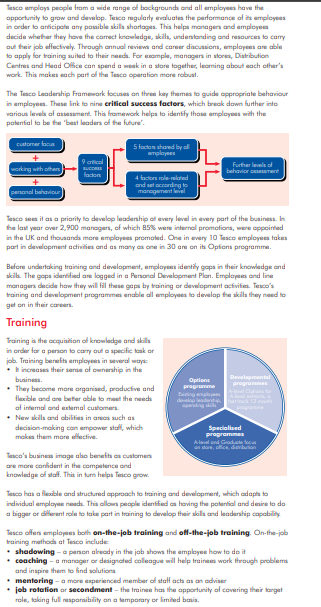
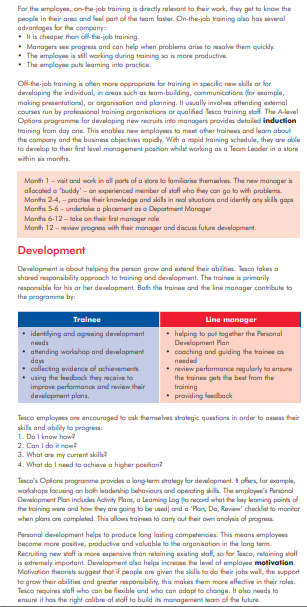
How training and development supports business growth Introduction Tesco is the largest British retailer and is also the world's third largest grocery retailer with outlets across Europe, USA and Asia. The business began in 1919 with one mon, Jack Cohen, selling groceries from a stall in the East End of London Jack bought surplus stocks of tea from a company called T.E. Stockwell T.E. Stockwell and Cohen combined their namesto brand the tea Cohen originally sold - TESCO tea. In 1929, the first Tesco store opened in north London Tesco has expanded since then by a combination of acquisition of new stores, retail services and by adapting to the needs of consumers. Tesco has net profits before tou of around 3 billion. Tesco's primary aim is to serve the customer'. Keeping existing customers happy is important, as they are more likely to return. This is more cost effective for the business than acquiring new ones. In the UK Tesco now has over 2,200 stores ranging from the large Extra hypermarket style stores to small Tesco Express high street outlets. Tesco's original product range of grocery and general merchandise has diversified to include banking, insurance services, electrical goods as well as telephone equipment and airtime. This move towards 'one stop shopping' means customers can meet all their purchasing needs from one place. Tesco has also expanded its customer base through its Tesco.com website which atrods one million regular users. As the company has grown, so has is workforce. From one man and a stall, Tesco now has approximately 280,000 employees in the UK and over 460,000 worldwide. To serve its widening markets it needs flexible and well-trained staff that can recognise the needs of the customer Tesco's employees work in a wide range of roles in both store and non-store funcions, such as Customer Assistants on the shop floor the directly assisting customers or preparing orders for delivery to customers who have ordered online Department Managers leading a team of Customer Assistants Warehouse employees who help catalogue and store clothing, food or brown goods in Tesco Distribution Centres or in stores .Office-based staff working in a range of functions at Head Ofice, including Finance, Purchasing, Personnel or Marketing Logistics staff who plan and carry out the distribution of products to stores. Tesco recognises that increasing knowledge, improving skills and job satisfaction of employees are all vital to the continued growth of the company. This case study looks at how Tesco provides training and development opportunities for its employees Identifying training needs Tesca's aim to expand and diversify requires the business to have the right people, in the right place at the right time. Many factors affect workforce planning The opening of new stores in new locations means that Tesco must adapt to different demands made by consumers. For instance, stores in highly populated diverse areas may need to sell a high proportion of specialty goods to meet the requirements of its customers, so selecting that stock requires a clear understanding of the customer profile in that area. In-store and non-store based posts may require different technical skills and competencies . Employees with a wide skills range who can work flexibly are more productive for the business Tesco employ people from a wide range of backgrounds and all employees have the opportunity to grow and develop. Tesco regularly evaluate the performance of its employees in order to anticipo any possible skills shortages. This helps managers and employees decide whether they have the correct knowledge, skills, understanding and resources to carry out their job effectively. Through annual review and career discussion, employees are able to apply for training suited to their needs. For comple, managers in stores, Distribution Centres and Head Office can spend a week in store together, learning about each other's work. This makes each part of the Tesco operation more robust The Tesco Leadership Framework focuses on three key themes to guide appropriate behaviour in employees. These link to nine critical success factors, which break down further into various levels of cement. This framework helps to identify the employees with the potential to be the best leaders of the future customer ben Sfacton stand by a working with the Furthermo behavior factors 4 tadan oland and at according to management al personal behavio Tesco sait as a priority to develop leadership al every level in every part of the business. In the last year over 2,900 managers, of which 85% were internal promotions were appointed in the UK and thousands more employees promoted. One in every 10 Tesco employees takes part in development activities and as many as one in 30 are on its Options programme Before undertaking training and development, employees idently seps in their knowledge and skills. The gaps identified are logged in a Personal Development Plan. Employees and line managers decide how they will fill these gaps by training or development activities. Tesco's training and development programmes enable all employees to develop the skills they need to get on in their career Training Training is the cuisition of knowledge and skills in order for a person to carry out a specific toskor job. Training beralih employees in several ways increases their sense of ownership in the business Options They become more organised, productive and programmes Flexible and are better able to meet the neech of internal and extemal customers New skills and abilities in ons such as decision-making con empower soll, which Specialised makes them more effective programmes Alovland Gradec Tesco's business image ali bas os customers cre more confident in the competence and knowledge of soll. This in turn help Tesco grow Tesco has a flexible and structured approach to training and development, which adapts to individual employee reach. This allow people identified as having the potential and desire to do a bigger or different role to take part in training to develop their skills and leadership capability Tesco offen employees both on-the-job training and off-the-job training On-the-job training methods at Tesco include shadowing-panion already in the job show the employee how to do it coaching - a manager or designated colleague will help trainees work through problems and inspire them to find solutions mentoring - a more experienced member of staff ach an adviser job rotation or secondment - the train has the opportunity of covering their forget role, taking ful responsibility on a temporary or limited basis. For the employee, on-the-job training is directly relevant to their work, they get to know the people in their aree and feel part of the team faster. On-the-job training also has several advantages for the company: . It is cheaper then all the-job training. Managers see progress and can help when problems arise to resolve them quickly The employee is still working during training to a more productive The employee put leaming into practice Ole-job training is often more appropriate for training in specific new skills or for developing the individual, increas such as team-building communications Wer example, making presentation, or organisation and planning. It usually involves attending esdemal Courses run by professional training organisations or qualijed Tesce training stof. The A-level Oplans programme for developing new recruits into managers provides detailed induction training from day one. This enable new employees to meet other trainees and learn about the company and the business objectives rapidly Waharopid training schedule, they care able to develop to their first level management position while working as a Team Leader in a store within six months Manth 1 - visit and work in all parts of a store to familiarise there. The new manager a alocated a "buddy' - an experienced member of staff who they can go to with problema Mantis 2-4- prode their knowledge and skila in real situations and identify any killagape Monta 5-6 - undertake a plocamentos Department Manager Months 6-12 - take on their first manager role Mantu 12 - review progress with their manager and discuss future development. Development Development is about helping the person grow and edend their abilities. Tesco take a shared responsibility approach to training and development. The train is primarily responsible for his or her development. Both the trainee and the line manager contribute to the programme by Trainee identifying and agreeing development needs atending workshop and development days collecting evidence of achievements using the feedback they receive to improve performance and review their development plans. Line manager helping to put together the Personal Development Plan coaching and guiding the trainee needed review performance regularly to unwr the trainee gets the best from the training providing feedback Tesco employees are encouraged to make the rives strategic questions in order to the skills and ability to progress 1. Do I know how? 2. Can I do now? 3. What are my current skill 4. What do I need to achieve a higher position Tuncer's Options programme provides a long-term strategy for development. Tolers, for example, workshops focusing on both local behaviour and operating skills. The employee's Personal Development Plan includes Activity Plans, a Leaming Logo record to the bay leaming points of the training were and how they are going to bed and a pler, Da, Ravi' checklist to monitor when please completed. This allows to carry out their own any of progress. Personal development helps to produce long lasting competencies. This means employees become more positive, productive and valuable to the organisation in the long term. Recruiting new staff is more expensive than retaining existing stati, so for Tesco, retaining staff is extremely important. Development also help increase the level of employee motivation Motivation theorists suggest that if people are given the skills to do their job wel, the support to grow their abilities and greater responsibility, this makes them more effective in their roles. Tesco requires staff who can be flexible and who can adapt to change. It also needs to enure it has the right calibre al telf to build its monagement team of the future. The benefits of training and development A business needs to monitor and evaluate the costs and benefits of its training and development activities for financial and non-financial reasons. The business needs to know if the investment in time and money is producing improvements. Employees need positive, structured feedback on their progress in order to find direction and gain confidence. This will reflect in their behaviour with customers and inspire higher customer confidence in Tesco - one of Tesco's main aims. Tesco provides tools for highly structured monitoring and evaluation of training and development. This includes scheduled tasks, timetables, measures and checklists. Employees assess themselves by setting objectives in Activity Plons, Personal Development Plans and recording outcomes in Learning Logs. These continue to measure their improvement in performance after training. Activity Plans need to have SMART objectives Specific - describes exactly what needs doing Measurable-has a target that can be measured against Achievable - is possible within the trainee's current role, skills and experience Realistic - is achievable within the time and resources available Time-framed - has a dear deadline. Tesco also uses a method known as 360-degree appraisal. This means all stakeholders who have contact with the employee assess the person's performance and give feedback. For example, a store department manager may get feedback from their manager, their 'buddy'. other department managers, the HR department and their team. This helps to identify areas that may require further development Tesco also uses a more informal approach to development by asking employees to write down three things they believe they are good at and three things they believe they could do better. The employee identifies actions to continue to do more of the good things and improve areas they could do better Managers and trainees hold a weekly informal review session as well as more formal four- weekly sessions to track progress against their personal development plans. The feedback is recorded and is carefully scored. Trainees are given a colour coded development rating: Red - where progress is not on schedule Amber - where some elements need more work Green - where all activities are on target Blue -- where the trainee is ahead of the programme and using skills to add value. Conclusion Efficient and effective training and development of employees is an essential element for Tesco's continuing growth in an increasingly commercial world. Tesco requires employees who are committed and flexible in order to aid its expansion of the business. The expansion of Tesco relies on retaining existing customers and acquiring new ones. All customers need to be confident and happy in Tesco. This relies on committed and flexible employees delivering the highest standards of service to meet Tesco's objectives. Tesco's structured approach to training and developing its existing and new employees provides a strong foundation for its continuing growthStep by Step Solution
There are 3 Steps involved in it
1 Expert Approved Answer
Step: 1 Unlock

Question Has Been Solved by an Expert!
Get step-by-step solutions from verified subject matter experts
Step: 2 Unlock
Step: 3 Unlock
 Study Help