


Question: QUESTIONS: 1. H purchases components from three suppliers. Components purchased from A are priced at $4.5 each and used at the rate of 20,000 units
QUESTIONS: 1. H purchases components from three

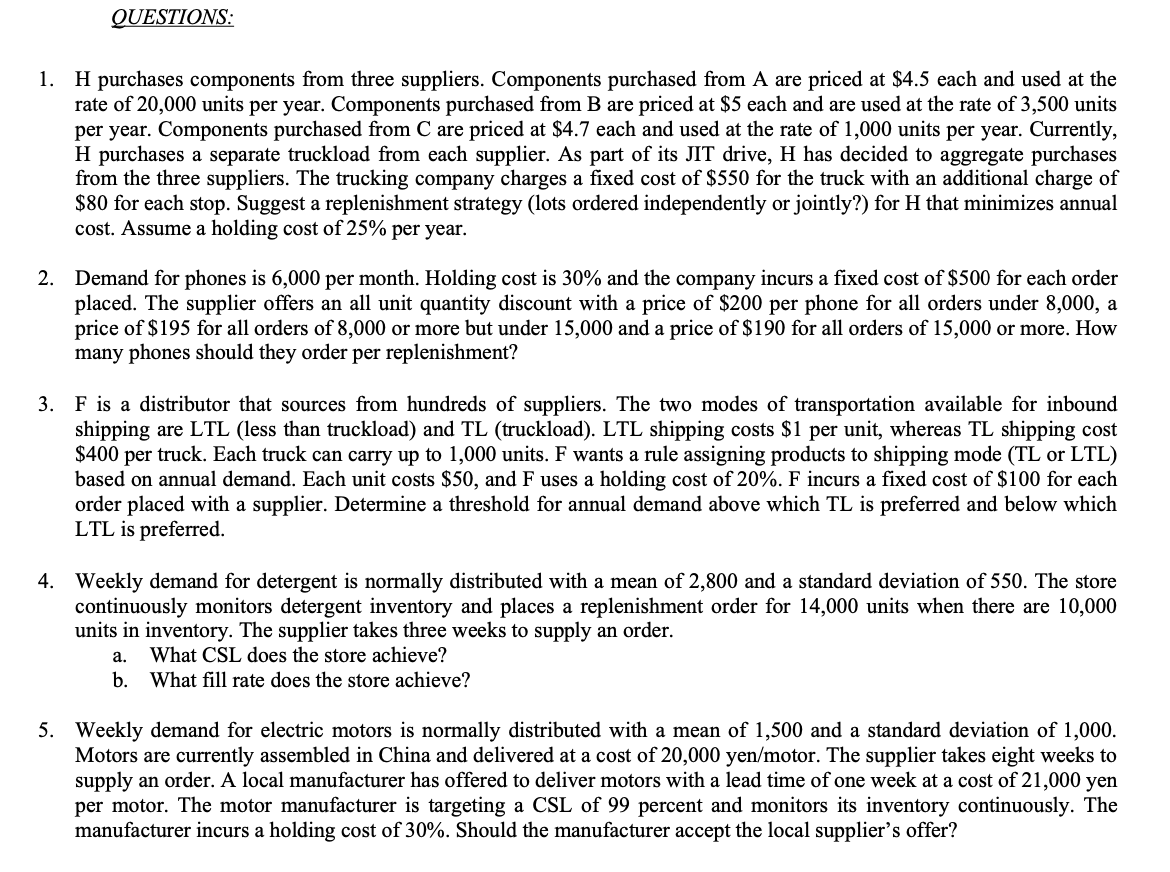
QUESTIONS: 1. H purchases components from three suppliers. Components purchased from A are priced at $4.5 each and used at the rate of 20,000 units per year. Components purchased from B are priced at $5 each and are used at the rate of 3,500 units per year. Components purchased from C are priced at $4.7 each and used at the rate of 1,000 units per year. Currently, H purchases a separate truckload from each supplier. As part of its JIT drive, H has decided to aggregate purchases from the three suppliers. The trucking company charges a fixed cost of $550 for the truck with an additional charge of $80 for each stop. Suggest a replenishment strategy (lots ordered independently or jointly?) for H that minimizes annual cost. Assume a holding cost of 25% per year. 2. Demand for phones is 6,000 per month. Holding cost is 30% and the company incurs a fixed cost of $500 for each order placed. The supplier offers an all unit quantity discount with a price of $200 per phone for all orders under 8,000, a price of $195 for all orders of 8,000 or more but under 15,000 and a price of $190 for all orders of 15,000 or more. How many phones should they order per replenishment? 3. F is a distributor that sources from hundreds of suppliers. The two modes of transportation available for inbound shipping are LTL (less than truckload) and TL (truckload). LTL shipping costs $1 per unit, whereas TL shipping cost $400 per truck. Each truck can carry up to 1,000 units. F wants a rule assigning products to shipping mode (TL or LTL) based on annual demand. Each unit costs $50, and F uses a holding cost of 20%. F incurs a fixed cost of $100 for each order placed with a supplier. Determine a threshold for annual demand above which TL is preferred and below which LTL is preferred. 4. Weekly demand for detergent is normally distributed with a mean of 2,800 and a standard deviation of 550. The store continuously monitors detergent inventory and places a replenishment order for 14,000 units when there are 10,000 units in inventory. The supplier takes three weeks to supply an order. a. What CSL does the store achieve? b. What fill rate does the store achieve? 5. Weekly demand for electric motors is normally distributed with a mean of 1,500 and a standard deviation of 1,000. Motors are currently assembled in China and delivered at a cost of 20,000 yen/motor. The supplier takes eight weeks to supply an order. A local manufacturer has offered to deliver motors with a lead time of one week at a cost of 21,000 yen per motor. The motor manufacturer is targeting a CSL of 99 percent and monitors its inventory continuously. The manufacturer incurs a holding cost of 30%. Should the manufacturer accept the local supplier's offer

Step by Step Solution

There are 3 Steps involved in it

1 Expert Approved Answer
Step: 1 Unlock blur-text-image

Question Has Been Solved by an Expert!

Get step-by-step solutions from verified subject matter experts

Step: 2 Unlock
Step: 3 Unlock

Students Have Also Explored These Related General Management Questions!