Questions
1. What is a matrix organization? Why are matrix organizations useful today? How does globalization encourage the use of a matrix organization?
2. What are the disadvantages of the matrix organization?
3. Why is the matrix form unavoidable in some cases?
(simple answers please type no handwriting)
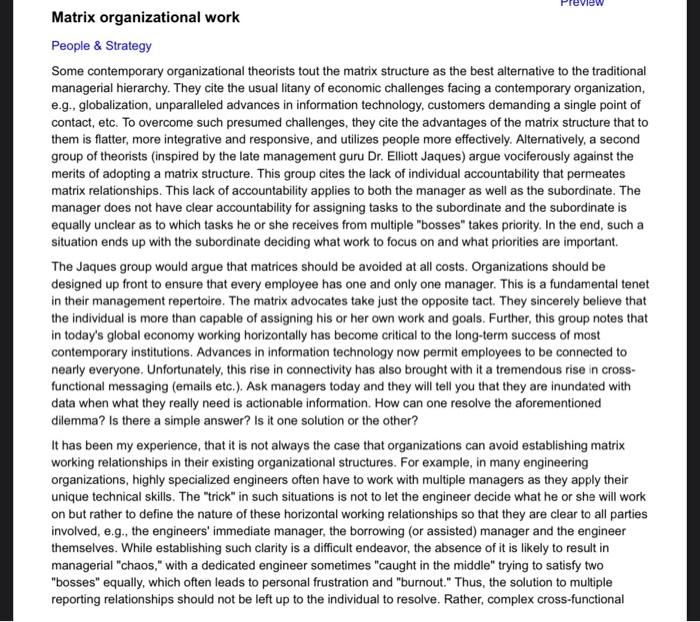
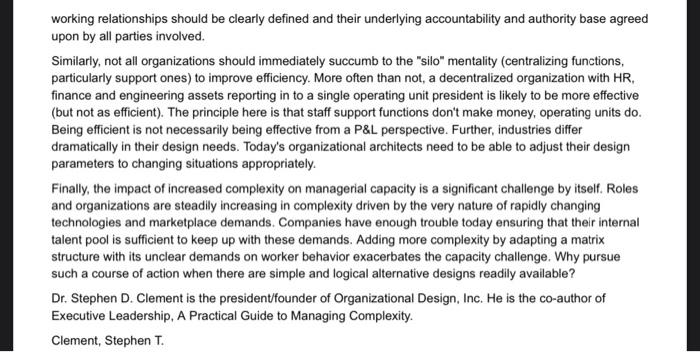
Matrix organizational work People & Strategy Some contemporary organizational theorists tout the matrix structure as the best alternative to the traditional managerial hierarchy. They cite the usual litany of economic challenges facing a contemporary organization, e.... globalization, unparalleled advances in information technology, customers demanding a single point of contact, etc. To overcome such presumed challenges, they cite the advantages of the matrix structure that to them is flatter, more integrative and responsive, and utilizes people more effectively. Alternatively, a second group of theorists inspired by the late management guru Dr. Elliott Jaques) argue vociferously against the merits of adopting a matrix structure. This group cites the lack of individual accountability that permeates matrix relationships. This lack of accountability applies to both the manager as well as the subordinate. The manager does not have clear accountability for assigning tasks to the subordinate and the subordinate is equally unclear as to which tasks he or she receives from multiple "bosses" takes priority. In the end, such a situation ends up with the subordinate deciding what work to focus on and what priorities are important. The Jaques group would argue that matrices should be avoided at all costs. Organizations should be designed up front to ensure that every employee has one and only one manager. This is a fundamental tenet in their management repertoire. The matrix advocates take just the opposite tact. They sincerely believe that the individual is more than capable of assigning his or her own work and goals. Further, this group notes that in today's global economy working horizontally has become critical to the long-term success of most contemporary institutions. Advances in information technology now permit employees to be connected to nearly everyone. Unfortunately, this rise in connectivity has also brought with it a tremendous rise in cross- functional messaging (emails etc.). Ask managers today and they will tell you that they are inundated with data when what they really need is actionable information. How can one resolve the aforementioned dilemma? Is there a simple answer? Is it one solution or the other? It has been my experience, that it is not always the case that organizations can avoid establishing matrix working relationships in their existing organizational structures. For example, in many engineering organizations, highly specialized engineers often have to work with multiple managers as they apply their unique technical skills. The "trick" in such situations is not to let the engineer decide what he or she will work on but rather to define the nature of these horizontal working relationships so that they are clear to all parties involved, e.g., the engineers' immediate manager, the borrowing (or assisted) manager and the engineer themselves. While establishing such clarity is a difficult endeavor, the absence of it is likely to result in managerial "chaos," with a dedicated engineer sometimes "caught in the middle" trying to satisfy two "bosses" equally, which often leads to personal frustration and "burnout." Thus, the solution to multiple reporting relationships should not be left up to the individual to resolve. Rather, complex cross-functional working relationships should be clearly defined and their underlying accountability and authority base agreed upon by all parties involved. Similarly, not all organizations should immediately succumb to the "silo" mentality (centralizing functions, particularly support ones) to improve efficiency. More often than not, a decentralized organization with HR. finance and engineering assets reporting into a single operating unit president is likely to be more effective (but not as efficient). The principle here is that staff support functions don't make money, operating units do. Being efficient is not necessarily being effective from a P&L perspective. Further, industries differ dramatically in their design needs. Today's organizational architects need to be able to adjust their design parameters to changing situations appropriately. Finally, the impact of increased complexity on managerial capacity is a significant challenge by itself. Roles and organizations are steadily increasing in complexity driven by the very nature of rapidly changing technologies and marketplace demands. Companies have enough trouble today ensuring that their internal talent pool is sufficient to keep up with these demands. Adding more complexity by adapting a matrix structure with its unclear demands on worker behavior exacerbates the capacity challenge. Why pursue such a course of action when there are simple and logical alternative designs readily available? Dr. Stephen D. Clement is the president/founder of Organizational Design, Inc. He is the co-author of Executive Leadership, A Practical Guide to Managing Complexity. Clement, Stephen T