







Question: questions + article are below, thank u Six Pros and cons of Open Source Software When software is open source, it means that it
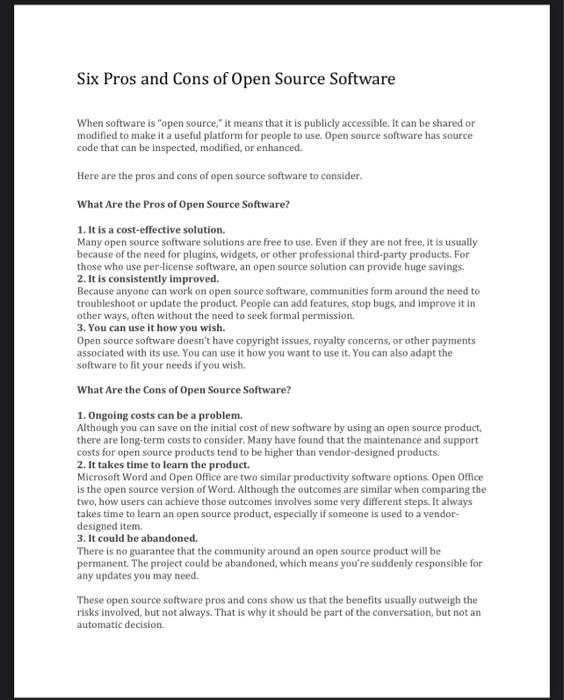
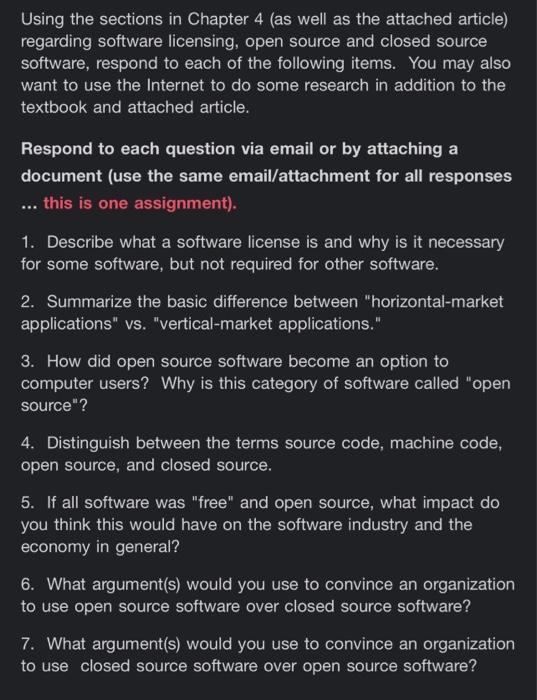
Six Pros and cons of Open Source Software When software is "open source, " it means that it is publicly accessible. It can be shared or modified to make it a useful platform for people to use. Open source software has source code that can be inspected, modified or enhanced. Here are the pros and cons of open source software to consider. What Are the Pros of Open Source Software? 1. It is a cost-effective solution. Many open source software solutions are free to use. Even if they are not free, it is usually because of the need for plugins, widgets, or other professional third-party products. For those who use per-license software an open source solution can provide huge savings. 2. It is consistently improved. Because anyone can work on open source software, communities form around the need to troubleshoot or update the product. People can add features, stop bugs, and improve it in other ways often without the need to seek formal permission. 3. You can use it how you wish. Open source software doesn't have copyright issues, royalty concerns, or other payments associated with its use. You can use it how you want to use it. You can also adapt the software to fit your needs if you wish. What Are the Cons of Open Source Software? 1. Ongoing costs can be a problem. Although you can save on the initial cost of new software by using an open source product there are long-term costs to consider. Many have found that the maintenance and support costs for open source products tend to be higher than vendor-designed products. 2. It takes time to learn the product. Microsoft Word and Open Office are two similar productivity software options. Open Office is the open source version of Word. Although the outcomes are similar when comparing the two, how users can achieve those outcomes involves some very different steps. It always takes time to learn an open source product, especially if someone is used to a vendor- designed item. 3. It could be abandoned. There is no guarantee that the community around an open source product will be permanent. The project could be abandoned, which means you're suddenly responsible for any updates you may need. These open source software pros and cons show us that the benefits usually outweigh the risks involved, but not always. That is why it should be part of the conversation, but not an automatic decision Using the sections in Chapter 4 (as well as the attached article) regarding software licensing, open source and closed source software, respond to each of the following items. You may also want to use the Internet to do some research in addition to the textbook and attached article. Respond to each question via email or by attaching a document (use the same email/attachment for all responses ... this is one assignment). 1. Describe what a software license is and why is it necessary for some software, but not required for other software. 2. Summarize the basic difference between "horizontal-market applications" vs. "vertical-market applications." 3. How did open source software become an option to computer users? Why is this category of software called "open source"? 4. Distinguish between the terms source code, machine code, open source, and closed source. 5. If all software was "free" and open source, what impact do you think this would have on the software industry and the economy in general? 6. What argument(s) would you use to convince an organization to use open source software over closed source software? 7. What argument(s) would you use to convince an organization to use closed source software over open source software
Step by Step Solution
There are 3 Steps involved in it

Get step-by-step solutions from verified subject matter experts
 Study Help