



Question: Questions Based on the above Beechie has asked you to present a Detailed One Year Growth Plan within the next two weeks that will enable
Questions Based on the above Beechie has asked you to present a Detailed One Year Growth Plan within the next two weeks that will enable him to achieve his objective. As you prepare your analysis that will achieve Magloms objective (s), be sure that the following are included/addressed in your growth plan:
2.Problems/Issues
3. Strategic Objectives. Ensure these objectives are SMART.
4. Recommended Strategies. Be sure to consider and assess Beechies strategic options that he seemed to have explored. You can make assumptions in this instance
5. A risk analysis when considering your recommended strategies
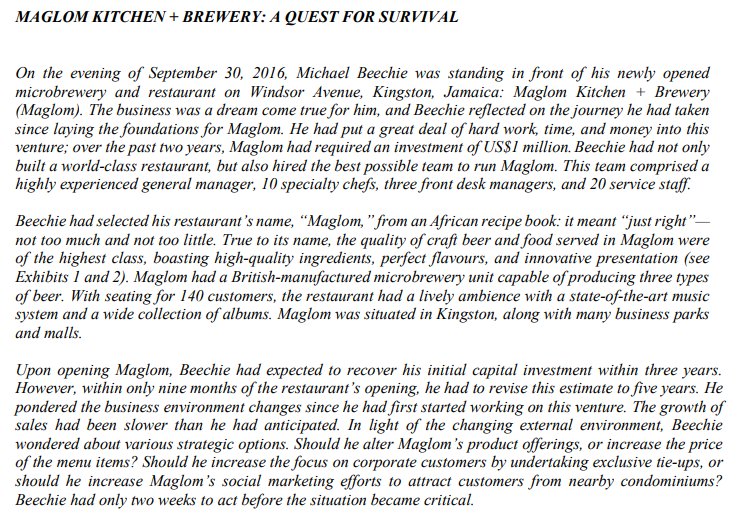
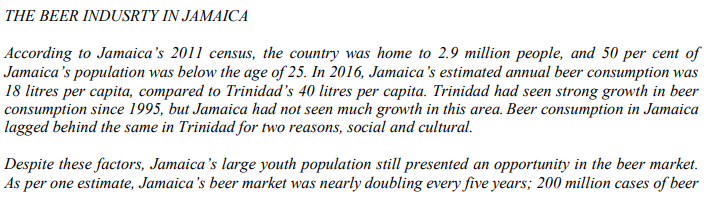
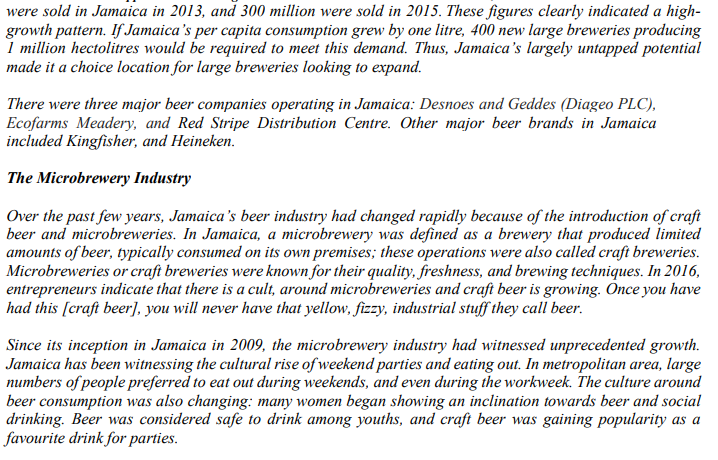
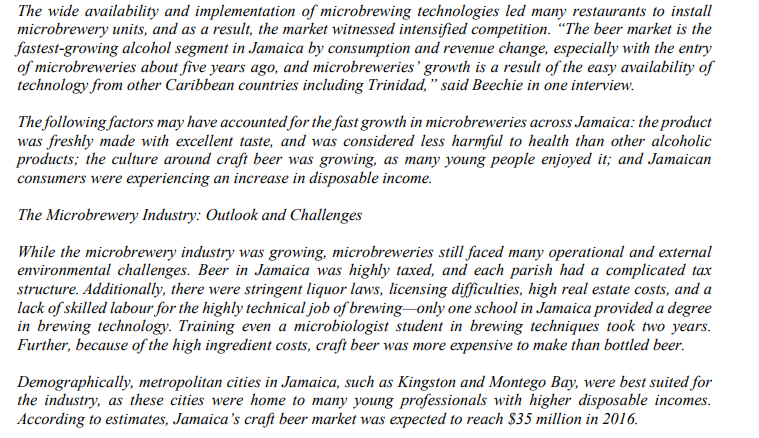
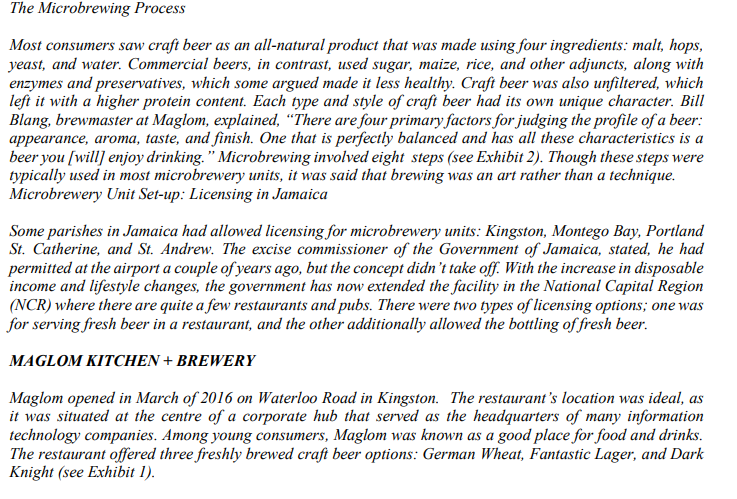
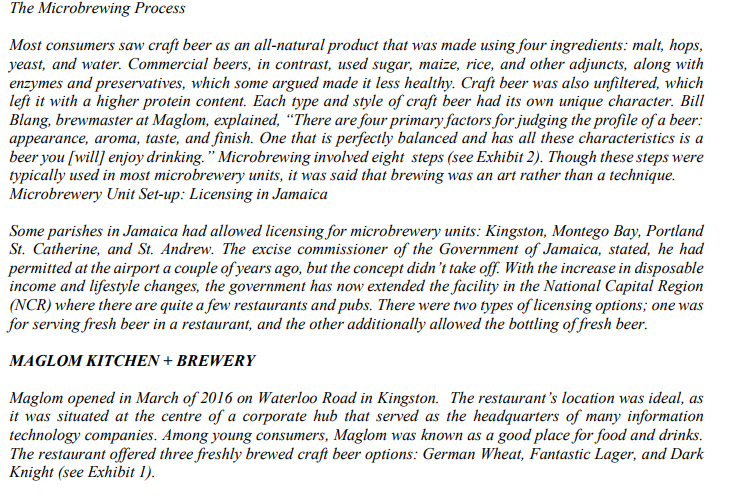
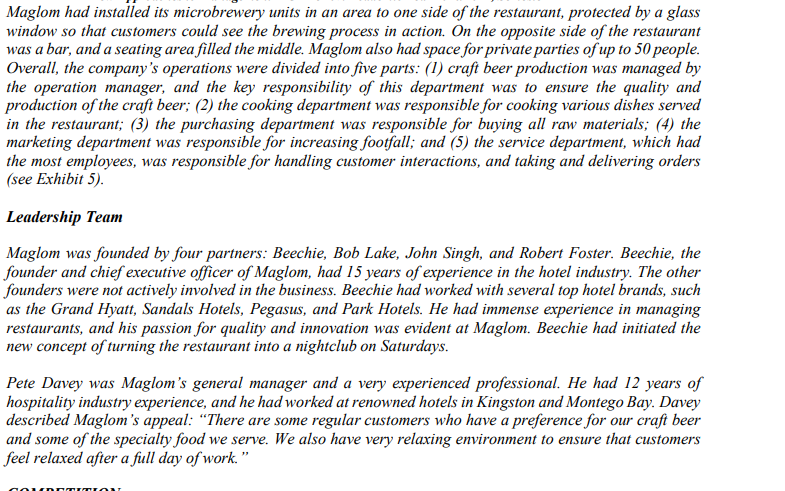
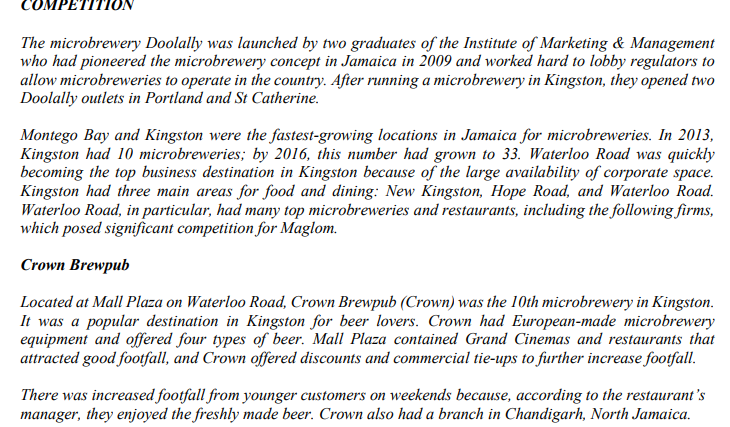
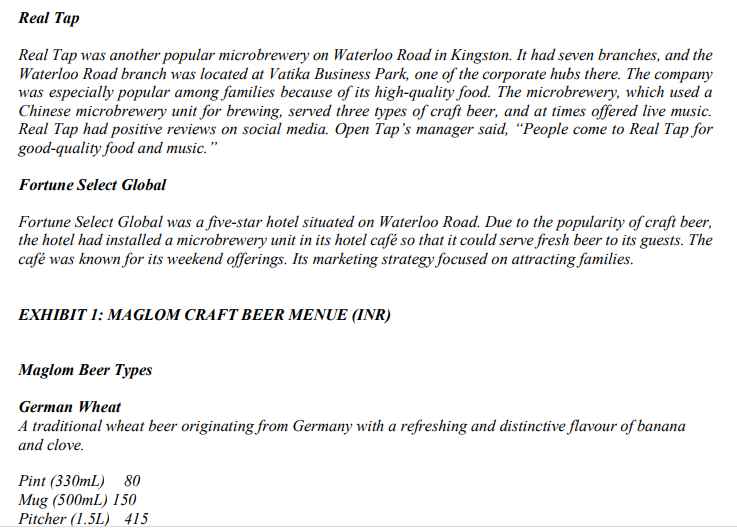
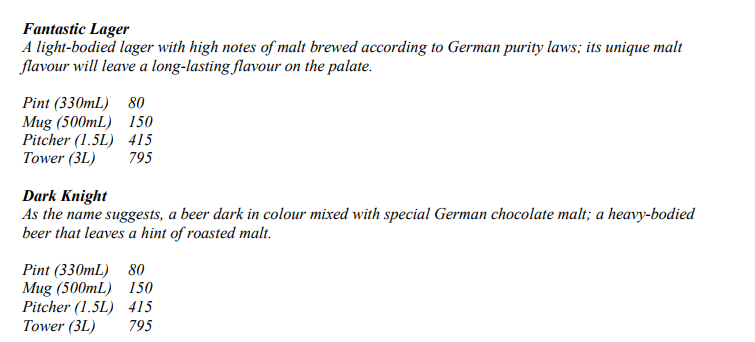
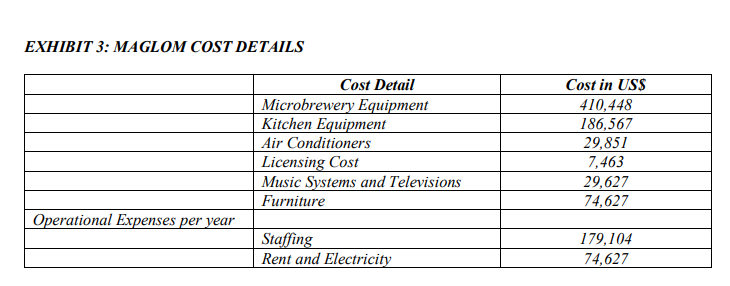
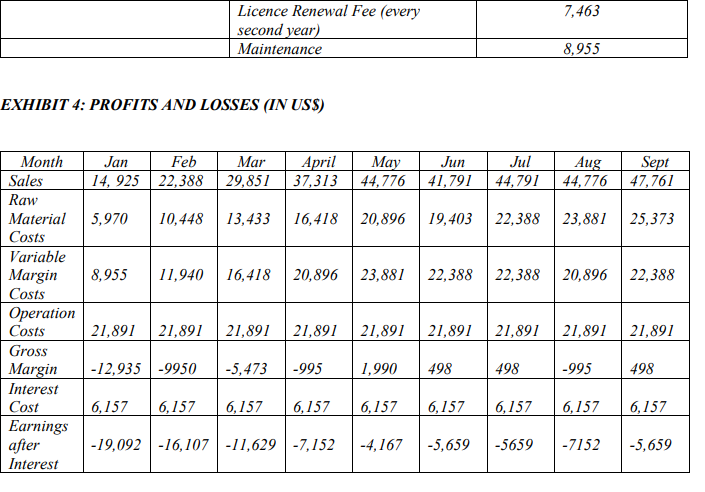
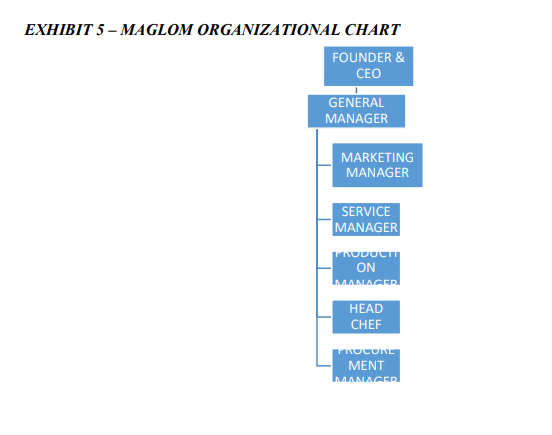
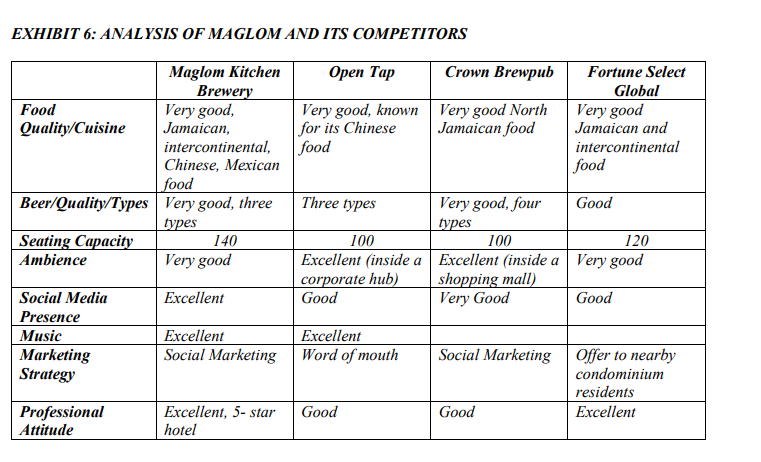
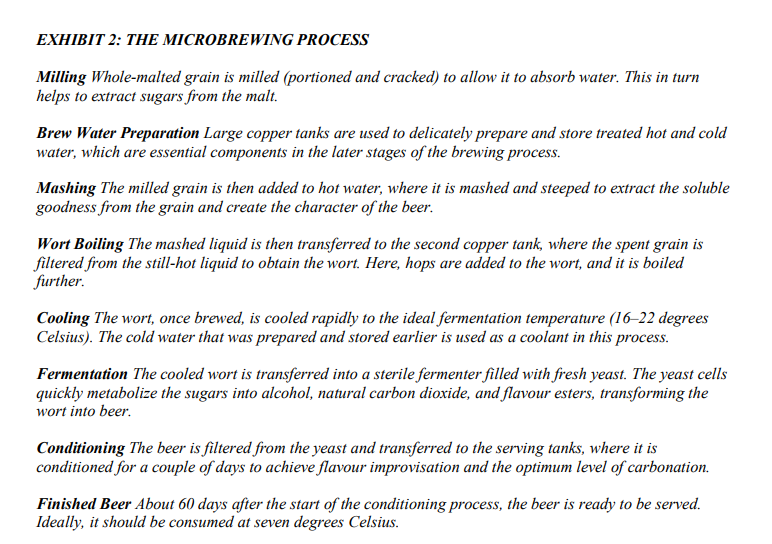
MAGLOM KITCHEN + BREWERY: A QUEST FOR SURVIVAL On the evening of September 30, 2016, Michael Beechie was standing in front of his newly opened microbrewery and restaurant on Windsor Avenue, Kingston, Jamaica: Maglom Kitchen + Brewery (Maglom). The business was a dream come true for him, and Beechie reflected on the journey he had taken since laying the foundations for Maglom. He had put a great deal of hard work, time, and money into this venture; over the past two years, Maglom had required an investment of US$1 million. Beechie had not only built a world-class restaurant, but also hired the best possible team to run Maglom. This team comprised a highly experienced general manager, 10 specialty chefs, three front desk managers, and 20 service staff Beechie had selected his restaurant's name, Maglom," from an African recipe book: it meant just right- not too much and not too little. True to its name, the quality of craft beer and food served in Maglom were of the highest class, boasting high-quality ingredients, perfect flavours, and innovative presentation (see Exhibits 1 and 2). Maglom had a British-manufactured microbrewery unit capable of producing three types of beer. With seating for 140 customers, the restaurant had a lively ambience with a state-of-the-art music system and a wide collection of albums. Maglom was situated in Kingston, along with many business parks and malls. Upon opening Maglom, Beechie had expected to recover his initial capital investment within three years. However, within only nine months of the restaurant's opening, he had to revise this estimate to five years. He pondered the business environment changes since he had first started working on this venture. The growth of sales had been slower than he had anticipated. In light of the changing external environment, Beechie wondered about various strategic options. Should he alter Maglom's product offerings, or increase the price of the menu items? Should he increase the focus on corporate customers by undertaking exclusive tie-ups, or should he increase Maglom's social marketing efforts to attract customers from nearby condominiums? Beechie had only two weeks to act before the situation became critical. THE BEER INDUSRTY IN JAMAICA According to Jamaica's 2011 census, the country was home to 2.9 million people, and 50 per cent of Jamaica's population was below the age of 25. In 2016, Jamaica's estimated annual beer consumption was 18 litres per capita, compared to Trinidad's 40 litres per capita. Trinidad had seen strong growth in beer consumption since 1995, but Jamaica had not seen much growth in this area. Beer consumption in Jamaica lagged behind the same in Trinidad for two reasons, social and cultural. Despite these factors, Jamaica's large youth population still presented an opportunity in the beer market. As per one estimate, Jamaica's beer market was nearly doubling every five years; 200 million cases of beer The wide availability and implementation of microbrewing technologies led many restaurants to install microbrewery units, and as a result, the market witnessed intensified competition. "The beer market is the fastest-growing alcohol segment in Jamaica by consumption and revenue change, especially with the entry of microbreweries about five years ago, and microbreweries' growth is a result of the easy availability of technology from other Caribbean countries including Trinidad, said Beechie in one interview. The following factors may have accounted for the fast growth in microbreweries across Jamaica: the product was freshly made with excellent taste, and was considered less harmful to health than other alcoholic products; the culture around craft beer was growing, as many young people enjoyed it; and Jamaican consumers were experiencing an increase in disposable income. The Microbrewery Industry: Outlook and Challenges While the microbrewery industry was growing, microbreweries still faced many operational and external environmental challenges. Beer in Jamaica was highly taxed, and each parish had a complicated tax structure. Additionally, there were stringent liquor laws, licensing difficulties, high real estate costs, and a lack of skilled labour for the highly technical job of brewing only one school in Jamaica provided a degree in brewing technology. Training even a microbiologist student in brewing techniques took two years. Further, because of the high ingredient costs, craft beer was more expensive to make than bottled beer. Demographically, metropolitan cities in Jamaica, such as Kingston and Montego Bay, were best suited for the industry, as these cities were home to many young professionals with higher disposable incomes. According to estimates, Jamaica's craft beer market was expected to reach $35 million in 2016. The Microbrewing Process Most consumers saw craft beer as an all-natural product that was made using four ingredients: malt, hops, yeast, and water. Commercial beers, in contrast, used sugar, maize, rice, and other adjuncts, along with enzymes and preservatives, which some argued made it less healthy. Craft beer was also unfiltered, which left it with a higher protein content. Each type and style of craft beer had its own unique character. Bill Blang, brewmaster at Maglom, explained, "There are four primary factors for judging the profile of a beer: appearance, aroma, taste, and finish. One that is perfectly balanced and has all these characteristics is a beer you [will) enjoy drinking. Microbrewing involved eight steps (see Exhibit 2). Though these steps were typically used in most microbrewery units, it was said that brewing was an art rather than a technique. Microbrewery Unit Set-up: Licensing in Jamaica Some parishes in Jamaica had allowed licensing for microbrewery units: Kingston, Montego Bay, Portland St. Catherine, and St. Andrew. The excise commissioner of the Government of Jamaica, stated, he had permitted at the airport a couple of years ago, but the concept didn't take off . With the increase in disposable income and lifestyle changes, the government has now extended the facility in the National Capital Region (NCR) where there are quite a few restaurants and pubs. There were two types of licensing options; one was for serving fresh beer in a restaurant, and the other additionally allowed the bottling of fresh beer. MAGLOM KITCHEN + BREWERY Maglom opened in March of 2016 on Waterloo Road in Kingston. The restaurant's location was ideal, as it was situated at the centre of a corporate hub that served as the headquarters of many information technology companies. Among young consumers, Maglom was known as a good place for food and drinks. The restaurant offered three freshly brewed craft beer options: German Wheat, Fantastic Lager, and Dark Knight (see Exhibit 1). The Microbrewing Process Most consumers saw craft beer as an all-natural product that was made using four ingredients: malt, hops, yeast, and water. Commercial beers, in contrast, used sugar, maize, rice, and other adjuncts, along with enzymes and preservatives, which some argued made it less healthy. Craft beer was also unfiltered, which left it with a higher protein content. Each type and style of craft beer had its own unique character. Bill Blang, brewmaster at Maglom, explained, "There are four primary factors for judging the profile of a beer: appearance, aroma, taste, and finish. One that is perfectly balanced and has all these characteristics is a beer you [will) enjoy drinking. Microbrewing involved eight steps (see Exhibit 2). Though these steps were typically used in most microbrewery units, it was said that brewing was an art rather than a technique. Microbrewery Unit Set-up: Licensing in Jamaica Some parishes in Jamaica had allowed licensing for microbrewery units: Kingston, Montego Bay, Portland St. Catherine, and St. Andrew. The excise commissioner of the Government of Jamaica, stated, he had permitted at the airport a couple of years ago, but the concept didn't take off . With the increase in disposable income and lifestyle changes, the government has now extended the facility in the National Capital Region (NCR) where there are quite a few restaurants and pubs. There were two types of licensing options; one was for serving fresh beer in a restaurant, and the other additionally allowed the bottling of fresh beer. MAGLOM KITCHEN + BREWERY Maglom opened in March of 2016 on Waterloo Road in Kingston. The restaurant's location was ideal, as it was situated at the centre of a corporate hub that served as the headquarters of many information technology companies. Among young consumers, Maglom was known as a good place for food and drinks. The restaurant offered three freshly brewed craft beer options: German Wheat, Fantastic Lager, and Dark Knight (see Exhibit 1). Maglom had installed its microbrewery units in an area to one side of the restaurant, protected by a glass window so that customers could see the brewing process in action. On the opposite side of the restaurant was a bar, and a seating area filled the middle. Maglom also had space for private parties of up to 50 people. Overall, the company's operations were divided into five parts: (1) craft beer production was managed by the operation manager, and the key responsibility of this department was to ensure the quality and production of the craft beer; (2) the cooking department was responsible for cooking various dishes served in the restaurant; (3) the purchasing department was responsible for buying all raw materials; (4) the marketing department was responsible for increasing footfall; and (5) the service department, which had the most employees, was responsible for handling customer interactions, and taking and delivering orders (see Exhibit 5). Leadership Team Maglom was founded by four partners: Beechie, Bob Lake, John Singh, and Robert Foster. Beechie, the founder and chief executive officer of Maglom, had 15 years of experience in the hotel industry. The other founders were not actively involved in the business. Beechie had worked with several top hotel brands, such as the Grand Hyatt, Sandals Hotels, Pegasus, and Park Hotels. He had immense experience in managing restaurants, and his passion for quality and innovation was evident at Maglom. Beechie had initiated the new concept of turning the restaurant into a nightclub on Saturdays. Pete Davey was Maglom's general manager and a very experienced professional. He had 12 years of hospitality industry experience, and he had worked at renowned hotels in Kingston and Montego Bay. Davey described Maglom's appeal: "There are some regular customers who have a preference for our craft beer and some of the specialty food we serve. We also have very relaxing environment to ensure that customers feel relaxed after a full day of work." The microbrewery Doolally was launched by two graduates of the Institute of Marketing & Management who had pioneered the microbrewery concept in Jamaica in 2009 and worked hard to lobby regulators to allow microbreweries to operate in the country. After running a microbrewery in Kingston, they opened two Doolally outlets in Portland and St Catherine. Montego Bay and Kingston were the fastest-growing locations in Jamaica for microbreweries. In 2013, Kingston had 10 microbreweries; by 2016, this number had grown to 33. Waterloo Road was quickly becoming the top business destination in Kingston because of the large availability of corporate space. Kingston had three main areas for food and dining: New Kingston, Hope Road, and Waterloo Road. Waterloo Road, in particular, had many top microbreweries and restaurants, including the following firms, which posed significant competition for Maglom. Crown Brewpub Located at Mall Plaza on Waterloo Road, Crown Brewpub (Crown) was the 10th microbrewery in Kingston. It was a popular destination in Kingston for beer lovers. Crown had European-made microbrewery equipment and offered four types of beer. Mall Plaza contained Grand Cinemas and restaurants that attracted good footfall, and Crown offered discounts and commercial tie-ups to further increase footfall. There was increased footfall from younger customers on weekends because, according to the restaurant's manager, they enjoyed the freshly made beer. Crown also had a branch in Chandigarh, North Jamaica. Real Tap Real Tap was another popular microbrewery on Waterloo Road in Kingston. It had seven branches, and the Waterloo Road branch was located at Vatika Business Park, one of the corporate hubs there. The company was especially popular among families because of its high-quality food. The microbrewery, which used a Chinese microbrewery unit for brewing, served three types of craft beer, and at times offered live music. Real Tap had positive reviews on social media. Open Tap's manager said, People come to Real Tap for good-quality food and music. Fortune Select Global Fortune Select Global was a five-star hotel situated on Waterloo Road. Due to the popularity of craft beer, the hotel had installed a microbrewery unit in its hotel caf so that it could serve fresh beer to its guests. The caf was known for its weekend offerings. Its marketing strategy focused on attracting families. EXHIBIT 1: MAGLOM CRAFT BEER MENUE (INR) Maglom Beer Types German Wheat A traditional wheat beer originating from Germany with a refreshing and distinctive flavour of banana and clove. Pint (330mL) 80 Mug (500mL) 150 Pitcher (1.5L) 415 Fantastic Lager A light-bodied lager with high notes of malt brewed according to German purity laws; its unique malt flavour will leave a long-lasting flavour on the palate. Pint (330mL) 80 Mug (500mL) 150 Pitcher (1.5L) 415 Tower (3) 795 Dark Knight As the name suggests, a beer dark in colour mixed with special German chocolate malt; a heavy-bodied beer that leaves a hint of roasted malt. Pint (330mL) 80 Mug (500mL) 150 Pitcher (1.5L) 415 Tower (3) 795 EXHIBIT 3: MAGLOM COST DETAILS Cost Detail Microbrewery Equipment Kitchen Equipment Air Conditioners Licensing Cost Music Systems and Televisions Furniture Cost in US$ 410,448 186,567 29,851 7,463 29,627 74,627 Operational Expenses per year Staffing Rent and Electricity 179,104 74,627 7,463 Licence Renewal Fee (every second year) Maintenance 8,955 EXHIBIT 4: PROFITS AND LOSSES (IN USS) May Aug Jan Feb 14, 925 22,388 Mar 29,851 April 37,313 Jun 41.791 44,776 Jul 44,791 Sept 47,761 44,776 5,970 10,448 13,433 16,418 20,896 19,403 22,388 23,881 25,373 8,955 11,940 16,418 20,896 23,881 22,388 22,388 20,896 22,388 Month Sales Raw Material Costs Variable Margin Costs Operation Costs Gross Margin Interest Cost Earnings after Interest 21,891 21,891 21,891 21,891 21,891 21,891 21,891 21,891 21,891 -12,935-9950 -5,473 -995 1,990 498 498 -995 498 6,157 6,157 6,157 6,157 6,157 6,157 6,157 6,157 6,157 -19,092-16, 107-11,629 -7,152 -4,167 -5,659 -5659 -7152 -5,659 EXHIBIT 5 - MAGLOM ORGANIZATIONAL CHART FOUNDER & CEO GENERAL MANAGER MARKETING MANAGER SERVICE MANAGER TNUDULTI ON MANAGER HEAD CHEF TNUCUNL MENT MANAGED EXHIBIT 6: ANALYSIS OF MAGLOM AND ITS COMPETITORS Open Tap Crown Brewpub Very good, known Very good North for its Chinese Jamaican food food Maglom Kitchen Brewery Food Very good, Quality/Cuisine Jamaican, intercontinental Chinese, Mexican food Beer/Quality/Types Very good, three types Seating Capacity 140 Ambience Very good Fortune Select Global Very good Jamaican and intercontinental food Three types Very good, four Good types 100 100 120 Excellent (inside a Excellent (inside a Very good corporate hub) shopping mall) Good Very Good Good Excellent Social Media Presence Music Marketing Strategy Excellent Social Marketing Excellent Word of mouth Social Marketing Offer to nearby condominium residents Good Excellent Good Professional Attitude Excellent, 5-star hotel EXHIBIT 2: THE MICROBREWING PROCESS Milling Whole-malted grain is milled (portioned and cracked) to allow it to absorb water. This in turn helps to extract sugars from the malt. Brew Water Preparation Large copper tanks are used to delicately prepare and store treated hot and cold water, which are essential components in the later stages of the brewing process. Mashing The milled grain is then added to hot water, where it is mashed and steeped to extract the soluble goodness from the grain and create the character of the beer. Wort Boiling The mashed liquid is then transferred to the second copper tank, where the spent grain is filtered from the still-hot liquid to obtain the wort. Here, hops are added to the wort, and it is boiled further. Cooling The wort, once brewed, is cooled rapidly to the ideal fermentation temperature (1622 degrees Celsius). The cold water that was prepared and stored earlier is used as a coolant in this process. Fermentation The cooled wort is transferred into a sterile fermenter filled with fresh yeast. The yeast cells quickly metabolize the sugars into alcohol, natural carbon dioxide, and flavour esters, transforming the wort into beer. Conditioning The beer is filtered from the yeast and transferred to the serving tanks, where it is conditioned for a couple of days to achieve flavour improvisation and the optimum level of carbonation. Finished Beer About 60 days after the start of the conditioning process, the beer is ready to be served. Ideally, it should be consumed at seven degrees Celsius. MAGLOM KITCHEN + BREWERY: A QUEST FOR SURVIVAL On the evening of September 30, 2016, Michael Beechie was standing in front of his newly opened microbrewery and restaurant on Windsor Avenue, Kingston, Jamaica: Maglom Kitchen + Brewery (Maglom). The business was a dream come true for him, and Beechie reflected on the journey he had taken since laying the foundations for Maglom. He had put a great deal of hard work, time, and money into this venture; over the past two years, Maglom had required an investment of US$1 million. Beechie had not only built a world-class restaurant, but also hired the best possible team to run Maglom. This team comprised a highly experienced general manager, 10 specialty chefs, three front desk managers, and 20 service staff Beechie had selected his restaurant's name, Maglom," from an African recipe book: it meant just right- not too much and not too little. True to its name, the quality of craft beer and food served in Maglom were of the highest class, boasting high-quality ingredients, perfect flavours, and innovative presentation (see Exhibits 1 and 2). Maglom had a British-manufactured microbrewery unit capable of producing three types of beer. With seating for 140 customers, the restaurant had a lively ambience with a state-of-the-art music system and a wide collection of albums. Maglom was situated in Kingston, along with many business parks and malls. Upon opening Maglom, Beechie had expected to recover his initial capital investment within three years. However, within only nine months of the restaurant's opening, he had to revise this estimate to five years. He pondered the business environment changes since he had first started working on this venture. The growth of sales had been slower than he had anticipated. In light of the changing external environment, Beechie wondered about various strategic options. Should he alter Maglom's product offerings, or increase the price of the menu items? Should he increase the focus on corporate customers by undertaking exclusive tie-ups, or should he increase Maglom's social marketing efforts to attract customers from nearby condominiums? Beechie had only two weeks to act before the situation became critical. THE BEER INDUSRTY IN JAMAICA According to Jamaica's 2011 census, the country was home to 2.9 million people, and 50 per cent of Jamaica's population was below the age of 25. In 2016, Jamaica's estimated annual beer consumption was 18 litres per capita, compared to Trinidad's 40 litres per capita. Trinidad had seen strong growth in beer consumption since 1995, but Jamaica had not seen much growth in this area. Beer consumption in Jamaica lagged behind the same in Trinidad for two reasons, social and cultural. Despite these factors, Jamaica's large youth population still presented an opportunity in the beer market. As per one estimate, Jamaica's beer market was nearly doubling every five years; 200 million cases of beer The wide availability and implementation of microbrewing technologies led many restaurants to install microbrewery units, and as a result, the market witnessed intensified competition. "The beer market is the fastest-growing alcohol segment in Jamaica by consumption and revenue change, especially with the entry of microbreweries about five years ago, and microbreweries' growth is a result of the easy availability of technology from other Caribbean countries including Trinidad, said Beechie in one interview. The following factors may have accounted for the fast growth in microbreweries across Jamaica: the product was freshly made with excellent taste, and was considered less harmful to health than other alcoholic products; the culture around craft beer was growing, as many young people enjoyed it; and Jamaican consumers were experiencing an increase in disposable income. The Microbrewery Industry: Outlook and Challenges While the microbrewery industry was growing, microbreweries still faced many operational and external environmental challenges. Beer in Jamaica was highly taxed, and each parish had a complicated tax structure. Additionally, there were stringent liquor laws, licensing difficulties, high real estate costs, and a lack of skilled labour for the highly technical job of brewing only one school in Jamaica provided a degree in brewing technology. Training even a microbiologist student in brewing techniques took two years. Further, because of the high ingredient costs, craft beer was more expensive to make than bottled beer. Demographically, metropolitan cities in Jamaica, such as Kingston and Montego Bay, were best suited for the industry, as these cities were home to many young professionals with higher disposable incomes. According to estimates, Jamaica's craft beer market was expected to reach $35 million in 2016. The Microbrewing Process Most consumers saw craft beer as an all-natural product that was made using four ingredients: malt, hops, yeast, and water. Commercial beers, in contrast, used sugar, maize, rice, and other adjuncts, along with enzymes and preservatives, which some argued made it less healthy. Craft beer was also unfiltered, which left it with a higher protein content. Each type and style of craft beer had its own unique character. Bill Blang, brewmaster at Maglom, explained, "There are four primary factors for judging the profile of a beer: appearance, aroma, taste, and finish. One that is perfectly balanced and has all these characteristics is a beer you [will) enjoy drinking. Microbrewing involved eight steps (see Exhibit 2). Though these steps were typically used in most microbrewery units, it was said that brewing was an art rather than a technique. Microbrewery Unit Set-up: Licensing in Jamaica Some parishes in Jamaica had allowed licensing for microbrewery units: Kingston, Montego Bay, Portland St. Catherine, and St. Andrew. The excise commissioner of the Government of Jamaica, stated, he had permitted at the airport a couple of years ago, but the concept didn't take off . With the increase in disposable income and lifestyle changes, the government has now extended the facility in the National Capital Region (NCR) where there are quite a few restaurants and pubs. There were two types of licensing options; one was for serving fresh beer in a restaurant, and the other additionally allowed the bottling of fresh beer. MAGLOM KITCHEN + BREWERY Maglom opened in March of 2016 on Waterloo Road in Kingston. The restaurant's location was ideal, as it was situated at the centre of a corporate hub that served as the headquarters of many information technology companies. Among young consumers, Maglom was known as a good place for food and drinks. The restaurant offered three freshly brewed craft beer options: German Wheat, Fantastic Lager, and Dark Knight (see Exhibit 1). The Microbrewing Process Most consumers saw craft beer as an all-natural product that was made using four ingredients: malt, hops, yeast, and water. Commercial beers, in contrast, used sugar, maize, rice, and other adjuncts, along with enzymes and preservatives, which some argued made it less healthy. Craft beer was also unfiltered, which left it with a higher protein content. Each type and style of craft beer had its own unique character. Bill Blang, brewmaster at Maglom, explained, "There are four primary factors for judging the profile of a beer: appearance, aroma, taste, and finish. One that is perfectly balanced and has all these characteristics is a beer you [will) enjoy drinking. Microbrewing involved eight steps (see Exhibit 2). Though these steps were typically used in most microbrewery units, it was said that brewing was an art rather than a technique. Microbrewery Unit Set-up: Licensing in Jamaica Some parishes in Jamaica had allowed licensing for microbrewery units: Kingston, Montego Bay, Portland St. Catherine, and St. Andrew. The excise commissioner of the Government of Jamaica, stated, he had permitted at the airport a couple of years ago, but the concept didn't take off . With the increase in disposable income and lifestyle changes, the government has now extended the facility in the National Capital Region (NCR) where there are quite a few restaurants and pubs. There were two types of licensing options; one was for serving fresh beer in a restaurant, and the other additionally allowed the bottling of fresh beer. MAGLOM KITCHEN + BREWERY Maglom opened in March of 2016 on Waterloo Road in Kingston. The restaurant's location was ideal, as it was situated at the centre of a corporate hub that served as the headquarters of many information technology companies. Among young consumers, Maglom was known as a good place for food and drinks. The restaurant offered three freshly brewed craft beer options: German Wheat, Fantastic Lager, and Dark Knight (see Exhibit 1). Maglom had installed its microbrewery units in an area to one side of the restaurant, protected by a glass window so that customers could see the brewing process in action. On the opposite side of the restaurant was a bar, and a seating area filled the middle. Maglom also had space for private parties of up to 50 people. Overall, the company's operations were divided into five parts: (1) craft beer production was managed by the operation manager, and the key responsibility of this department was to ensure the quality and production of the craft beer; (2) the cooking department was responsible for cooking various dishes served in the restaurant; (3) the purchasing department was responsible for buying all raw materials; (4) the marketing department was responsible for increasing footfall; and (5) the service department, which had the most employees, was responsible for handling customer interactions, and taking and delivering orders (see Exhibit 5). Leadership Team Maglom was founded by four partners: Beechie, Bob Lake, John Singh, and Robert Foster. Beechie, the founder and chief executive officer of Maglom, had 15 years of experience in the hotel industry. The other founders were not actively involved in the business. Beechie had worked with several top hotel brands, such as the Grand Hyatt, Sandals Hotels, Pegasus, and Park Hotels. He had immense experience in managing restaurants, and his passion for quality and innovation was evident at Maglom. Beechie had initiated the new concept of turning the restaurant into a nightclub on Saturdays. Pete Davey was Maglom's general manager and a very experienced professional. He had 12 years of hospitality industry experience, and he had worked at renowned hotels in Kingston and Montego Bay. Davey described Maglom's appeal: "There are some regular customers who have a preference for our craft beer and some of the specialty food we serve. We also have very relaxing environment to ensure that customers feel relaxed after a full day of work." The microbrewery Doolally was launched by two graduates of the Institute of Marketing & Management who had pioneered the microbrewery concept in Jamaica in 2009 and worked hard to lobby regulators to allow microbreweries to operate in the country. After running a microbrewery in Kingston, they opened two Doolally outlets in Portland and St Catherine. Montego Bay and Kingston were the fastest-growing locations in Jamaica for microbreweries. In 2013, Kingston had 10 microbreweries; by 2016, this number had grown to 33. Waterloo Road was quickly becoming the top business destination in Kingston because of the large availability of corporate space. Kingston had three main areas for food and dining: New Kingston, Hope Road, and Waterloo Road. Waterloo Road, in particular, had many top microbreweries and restaurants, including the following firms, which posed significant competition for Maglom. Crown Brewpub Located at Mall Plaza on Waterloo Road, Crown Brewpub (Crown) was the 10th microbrewery in Kingston. It was a popular destination in Kingston for beer lovers. Crown had European-made microbrewery equipment and offered four types of beer. Mall Plaza contained Grand Cinemas and restaurants that attracted good footfall, and Crown offered discounts and commercial tie-ups to further increase footfall. There was increased footfall from younger customers on weekends because, according to the restaurant's manager, they enjoyed the freshly made beer. Crown also had a branch in Chandigarh, North Jamaica. Real Tap Real Tap was another popular microbrewery on Waterloo Road in Kingston. It had seven branches, and the Waterloo Road branch was located at Vatika Business Park, one of the corporate hubs there. The company was especially popular among families because of its high-quality food. The microbrewery, which used a Chinese microbrewery unit for brewing, served three types of craft beer, and at times offered live music. Real Tap had positive reviews on social media. Open Tap's manager said, People come to Real Tap for good-quality food and music. Fortune Select Global Fortune Select Global was a five-star hotel situated on Waterloo Road. Due to the popularity of craft beer, the hotel had installed a microbrewery unit in its hotel caf so that it could serve fresh beer to its guests. The caf was known for its weekend offerings. Its marketing strategy focused on attracting families. EXHIBIT 1: MAGLOM CRAFT BEER MENUE (INR) Maglom Beer Types German Wheat A traditional wheat beer originating from Germany with a refreshing and distinctive flavour of banana and clove. Pint (330mL) 80 Mug (500mL) 150 Pitcher (1.5L) 415 Fantastic Lager A light-bodied lager with high notes of malt brewed according to German purity laws; its unique malt flavour will leave a long-lasting flavour on the palate. Pint (330mL) 80 Mug (500mL) 150 Pitcher (1.5L) 415 Tower (3) 795 Dark Knight As the name suggests, a beer dark in colour mixed with special German chocolate malt; a heavy-bodied beer that leaves a hint of roasted malt. Pint (330mL) 80 Mug (500mL) 150 Pitcher (1.5L) 415 Tower (3) 795 EXHIBIT 3: MAGLOM COST DETAILS Cost Detail Microbrewery Equipment Kitchen Equipment Air Conditioners Licensing Cost Music Systems and Televisions Furniture Cost in US$ 410,448 186,567 29,851 7,463 29,627 74,627 Operational Expenses per year Staffing Rent and Electricity 179,104 74,627 7,463 Licence Renewal Fee (every second year) Maintenance 8,955 EXHIBIT 4: PROFITS AND LOSSES (IN USS) May Aug Jan Feb 14, 925 22,388 Mar 29,851 April 37,313 Jun 41.791 44,776 Jul 44,791 Sept 47,761 44,776 5,970 10,448 13,433 16,418 20,896 19,403 22,388 23,881 25,373 8,955 11,940 16,418 20,896 23,881 22,388 22,388 20,896 22,388 Month Sales Raw Material Costs Variable Margin Costs Operation Costs Gross Margin Interest Cost Earnings after Interest 21,891 21,891 21,891 21,891 21,891 21,891 21,891 21,891 21,891 -12,935-9950 -5,473 -995 1,990 498 498 -995 498 6,157 6,157 6,157 6,157 6,157 6,157 6,157 6,157 6,157 -19,092-16, 107-11,629 -7,152 -4,167 -5,659 -5659 -7152 -5,659 EXHIBIT 5 - MAGLOM ORGANIZATIONAL CHART FOUNDER & CEO GENERAL MANAGER MARKETING MANAGER SERVICE MANAGER TNUDULTI ON MANAGER HEAD CHEF TNUCUNL MENT MANAGED EXHIBIT 6: ANALYSIS OF MAGLOM AND ITS COMPETITORS Open Tap Crown Brewpub Very good, known Very good North for its Chinese Jamaican food food Maglom Kitchen Brewery Food Very good, Quality/Cuisine Jamaican, intercontinental Chinese, Mexican food Beer/Quality/Types Very good, three types Seating Capacity 140 Ambience Very good Fortune Select Global Very good Jamaican and intercontinental food Three types Very good, four Good types 100 100 120 Excellent (inside a Excellent (inside a Very good corporate hub) shopping mall) Good Very Good Good Excellent Social Media Presence Music Marketing Strategy Excellent Social Marketing Excellent Word of mouth Social Marketing Offer to nearby condominium residents Good Excellent Good Professional Attitude Excellent, 5-star hotel EXHIBIT 2: THE MICROBREWING PROCESS Milling Whole-malted grain is milled (portioned and cracked) to allow it to absorb water. This in turn helps to extract sugars from the malt. Brew Water Preparation Large copper tanks are used to delicately prepare and store treated hot and cold water, which are essential components in the later stages of the brewing process. Mashing The milled grain is then added to hot water, where it is mashed and steeped to extract the soluble goodness from the grain and create the character of the beer. Wort Boiling The mashed liquid is then transferred to the second copper tank, where the spent grain is filtered from the still-hot liquid to obtain the wort. Here, hops are added to the wort, and it is boiled further. Cooling The wort, once brewed, is cooled rapidly to the ideal fermentation temperature (1622 degrees Celsius). The cold water that was prepared and stored earlier is used as a coolant in this process. Fermentation The cooled wort is transferred into a sterile fermenter filled with fresh yeast. The yeast cells quickly metabolize the sugars into alcohol, natural carbon dioxide, and flavour esters, transforming the wort into beer. Conditioning The beer is filtered from the yeast and transferred to the serving tanks, where it is conditioned for a couple of days to achieve flavour improvisation and the optimum level of carbonation. Finished Beer About 60 days after the start of the conditioning process, the beer is ready to be served. Ideally, it should be consumed at seven degrees Celsius
Step by Step Solution
There are 3 Steps involved in it

Get step-by-step solutions from verified subject matter experts