







Question: Questions Based on your understanding, what are the most important roles and responsibilities of the project manager on this project during the Implementation phase. If
Questions
Based on your understanding, what are the most important roles and responsibilities of the project manager on this project during the Implementation phase.
If your recommendation was to close the project prematurely, what would you do to ensure a methodical shutdown and preserve as much of the valuable assets as possible
In the meeting in which Mr. Zhang pushed ahead and rejected your recommendation to take time for another round of testing, you were clearly dismayed. What would you have done after the meeting
CASE STUDY
Ideation Phase
During the chaos of December 2011, even though there was no real discussion of the board considering Mr. Zhangs resignation, Mr. Zhang nonetheless thought about resigning because of the ongoing fiasco and poor sales performance. Over the 2011 year-end holidays, Mr. Zhang reflected back on how he and his senior executive came to select the ERP. With the rapid growth of WWE, the business was confronting significant business process and IT automation issues since 2007. A team of internal business and information technology experts was assembled to examine the situation and make recommendations in 2008. Some smaller ideas were approved and implemented, but those projects were largely limited in addressing the bigger challenges. Most of the ideas, however, were rejected as patchwork or unambitious. The company board eventually involved in the strategizing, and they wanted something bolder. At the same time, with each rejection, the team became both more frustrated and also more aggressive. By mid-2009 at the urging of Mr. Zhang and the board, the team came up with three competing projects for consideration, as shown in the table below:
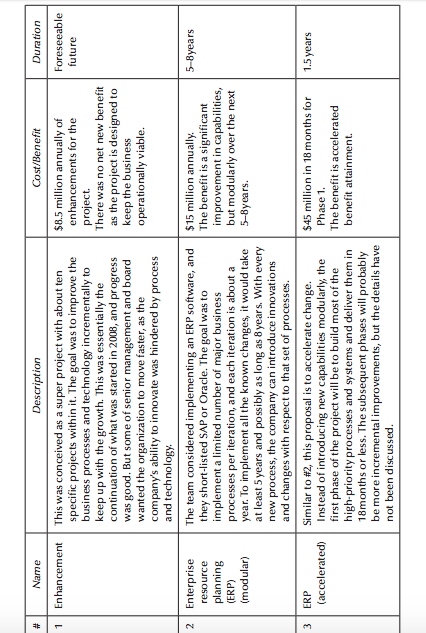
Since the company was aggressively growing and had not experienced any major failures, the board and senior management made the bold choice of approving #3. But this was not without controversy. Two executives, the chief operating officer and chief information officer both recommended either #2 (COO) or #1 (CIO). But they were overruled by the chief executive officer, chief marketing officer, chief innovation officer, and eventually the Board. Two executives, head of human resources (HR) and head of business strategy, abstained. Now in hindsight, Mr. Zhang thought whether there should be more evaluation of the other proposals and discussion to better understand the other executives concerns. To Mr. Zhang, there were two major puzzles after approving #3.
1. The business case was clearly wrong underestimating cost and ease of implementation. At the same time, the benefit of better reporting and analytics was overstated. The COO raised this concern at the time, but since there was no clear counter solution, it was rejected.
2. Everything took longer to accomplish. For example, overstating benefits underestimated the implementation schedule. For example, the business requirements were allocated 3 months to complete. But by month 6, the team was still struggling with getting executive buy-ins. The cost outpaced the plan by nearly 50% by the fifth month. CIO and head of HR raised the concern of the implementation schedule, but it was rejected by the general enthusiasm of Mr. Zhang and the Board.
IV. Initiation Phase
In addition to evaluating the events during the Ideation phase, Mr. Zhang also recalled the early days of the project. After the executives approved the project in early 2010, Mr. Zhang appointed a senior project manager to lead the project. But in the rush to start the project and believing the key project parameters were clear, Mr. Zhang and others pushed the project team to make tangible progress quickly and skip some key project management deliverables including the project charter.
V. Preparation Phase
Continuing from the earlier case, assume that Mr. Zhang and the senior executives accepted your recommendations to develop the project charter and other project initiation deliverables from Section IV. Even with a considerable project management effort during the Initiation Phase, the problem of getting started or the fuzzy front end was still considerable. Thankfully because of the planning and the executive support, there were no major obstacles as your team exited the Initiation Phase. After recovering from the small battle scars from the Initiation Phase and energized by the support and moment of the relative success of completing the Initiation Phase, you as the project manager understand that the Preparation Phase will be critical for project success.
VI. Implementation Phase
As Mr. Zhang reflected on the past experiences, even though he readily agreed that there was insufficient planning and organizing at the Ideation, Initiation, and Preparation Phases from March through June 2010, the problem really started in the Implementation Phase. Perhaps, it was a lack of adequate project management preparation that led to all the problems, but he still shuddered remembering the many missed deadlines and complications. For example, he vividly recalled a management meeting with his senior staff when the initial testing results failed to meet expectation. The Quality Assurance team reported a passing rate of 90% across the 2,000 test scripts, most of which was automated. What was detrimental was that of the 200 failed scripts, nearly 25% of them were in high severity categories meaning that that the system would stop functioning and manual workaround must be found. The team recommended an additional round of system testing to improve the testing before moving into the next phase of testing with users. But it would also slip the schedule by nearly a month. Mr. Zhang, eager to push ahead, urged the team to reject the extra testing and head into the next phase of testing. Mr. Zhang thought that any additional errors could be found and addressed there. With great hesitancy, the other executives followed his lead. To his great relief, the next phase of testing with the users proceeded better than the expected. But shortly after the launch, the problems discovered earlier came back to haunt the new ERP system. In hindsight, the user testing was probably inadequate and failed to capture some key problems. At the worst moment, which occurred in week 4 after launch in October 2011, the incident management system was registered over 100 incidents per hour, completely overwhelming the teams ability to even review them. After 3 months of constant fires, resulting in some major errors on customer orders and departure of several high-performing employees, Mr. Zhang eventually ordered to restart the old processes and systems.
VII. Closure Phase
According to the original project, after the launch of the project on September 30, 2011, the project team would work closely with the newly formed Support Team for a period of 3 months of intense hypercare. This would ensure that incidents could be addressed quickly and also provide the Support Team with a period of learning of the new system. The project team could then formally close the project by year end and move on to the next project. Sadly, the project did not proceed as planned. By February 2012, even the Board was involved as the situation deteriorated. This eventually led to the creation of a new position, the CPO, with the responsibility of fixing the situation. The time was February 2011, 5 months after go live. The situation was getting worse in all areas:
- More customers errors, which is now happening regularly. An estimate shows about 2% of the errors contained mistakes, mainly in the invoices (price and quantity), shipping address (which led to a number of high-profile mistakes), and wrong customers. Worse, there was no clear pattern of errors; they seemed to come from everywhere.
- New system problems were still being found, even though the back log of defects was trending lower. Analysis shows that some errors were fixed, then broken by subsequent repairs, and so on. In a few cases, the cycle of repetitive breaking and fixing became a routine.
- Nearly everyone involved lost confidence in the new system. For high-profile customers, customer representatives were double and triple invoices and records manually, causing a significant jump in overtime pay, especially for January and February, which traditionally are the low seasons.
# Name Cost/Benefit Duration 1 Enhancement Foreseeable future $8.5 million annually of enhancements for the project There was no net new benefit as the project is designed to keep the business operationally viable. 5-Byears 2 Enterprise resource planning (ERP) (modular) Description This was conceived as a super project with about ten specific projects within it. The goal was to improve the business processes and technology incrementally to keep up with the growth. This was essentially the continuation of what was started in 2008, and progress was good. But some of senior management and board wanted the organization to move faster, as the company's ability to innovate was hindered by process and technology The team considered implementing an ERP software, and they short-listed SAP or Oracle. The goal was to implement a limited number of major business processes per iteration, and each iteration is about a year. To implement all the known changes, it would take at least 5 years and possibly as long as 8 years. With every new process, the company can introduce innovations and changes with respect to that set of processes. Similar to #2, this proposal is to accelerate change. Instead of introducing new capabilities modularly, the first phase of the project will be to build most of the high-priority processes and systems and deliver them in 18months or less. The subsequent phases will probably be more incremental improvements, but the details have not been discussed. $15 million annually. The benefit is a significant improvement in capabilities, but modularly over the next 5-Byears. 3 ERP (accelerated) 1.5 years $45 million in 18 months for Phase 1. The benefit is accelerated benefit attainmentStep by Step Solution
There are 3 Steps involved in it

Get step-by-step solutions from verified subject matter experts
 Study Help