







Question: Questions Please note that we do not expect you to write a program or an actual database to answer these questions. What we are seeking
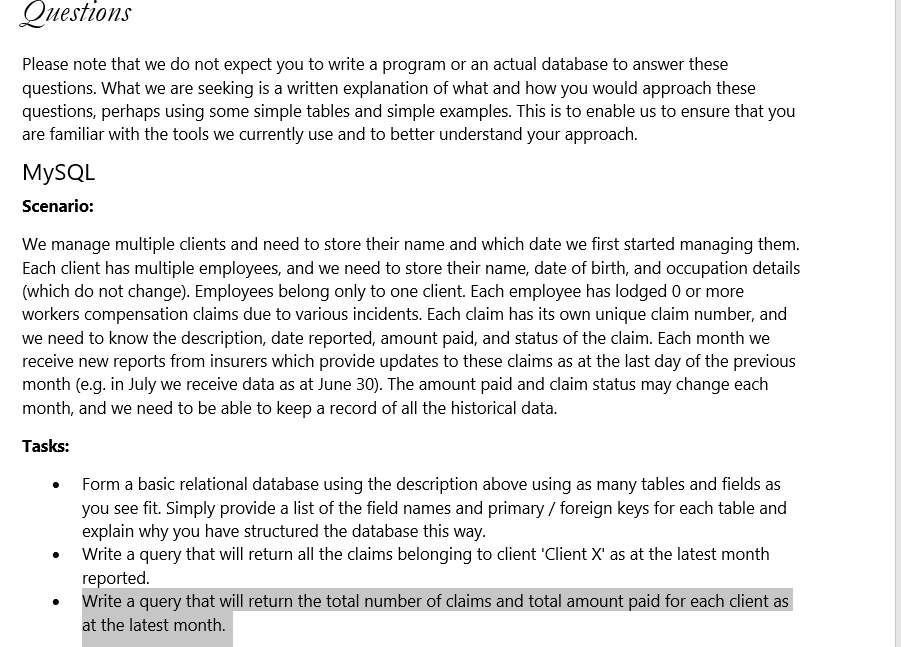
Questions Please note that we do not expect you to write a program or an actual database to answer these questions. What we are seeking is a written explanation of what and how you would approach these questions, perhaps using some simple tables and simple examples. This is to enable us to ensure that you are familiar with the tools we currently use and to better understand your approach. MySQL Scenario: We manage multiple clients and need to store their name and which date we first started managing them. Each client has multiple employees, and we need to store their name, date of birth, and occupation details (which do not change). Employees belong only to one client. Each employee has lodged 0 or more workers compensation claims due to various incidents. Each claim has its own unique claim number, and we need to know the description, date reported, amount paid, and status of the claim. Each month we receive new reports from insurers which provide updates to these claims as at the last day of the previous month (e.g. in July we receive data as at June 30). The amount paid and claim status may change each month, and we need to be able to keep a record of all the historical data. Tasks: Form a basic relational database using the description above using as many tables and fields as you see fit. Simply provide a list of the field names and primary / foreign keys for each table and explain why you have structured the database this way. Write a query that will return all the claims belonging to client "Client X' as at the latest month reported. Write a query that will return the total number of claims and total amount paid for each client as at the latest month
Step by Step Solution
There are 3 Steps involved in it

Get step-by-step solutions from verified subject matter experts
 Study Help