



Question: R130: Risk Financing Assignment 1 Case Study Summary Argot Foods is a large food distributor headquartered in eastern Canada. The company purchases a wide variety
R130: Risk Financing
Assignment 1
Case Study
Summary
Argot Foods is a large food distributor headquartered in eastern Canada. The company purchases a wide variety of fresh whole foods from local producers (including fruits, vegetables, fish, seafood, poultry, and meats) and distributes these items to restaurants and grocers in the region. On average, the business to restaurants represents 45 percent of sales, with the remaining 55 percent going to grocers.
Overview of Operations
To pick up goods, Argot's employees typically go directly to the fresh whole food producers, all of whom are located within a 400-kilometer radius of Argot's office headquarters and warehouse complex. To maintain the quality and freshness of all food products, Argot uses a large fleet of cargo vehicles equipped with refrigeration. After the items are picked up, they are brought to Argot's complex for storage and future distribution. The products are unloaded by warehouse employees who take an inventory count of all items and upload this information into the company's distribution database. Next, everything is stored in large, climate-controlled, walk-in food coolers. While in storage, food items are randomly reviewed for quality assurance purposes. Finally, when the goods are ready to be delivered to Argot's customers, the pickup process is reversed: Warehouse employees remove the items from the walk-in coolers, update the database as the products are loaded into delivery vehicles, and then load the items into their delivery vehicles. The items are then transported by the drivers to their final recipients.
Argot Foods currently has about 125 employees, which includes 80 warehouse staff, 25 drivers, and 20 office staff.
Most of the labour involved in the warehouse is considered moderately arduous. Some of the warehouse functions include the following:
Lifting loads from the delivery vehicles onto pallets using manual and electric-powered forklifts
Moving the products to the walk-in food coolers
Lifting the products from the pallets onto shelves in the coolers
Reversing this process when loading the trucks for distribution to the customers
The drivers have designated routes, arranged daily, for picking up food from the producers and delivering it to customers. The drivers are trained on all vehicles they use and are always given a set schedule. Their routes to the food producers involve municipal roads, major highways, and rural secondary routes. The routes for delivery to customers are primarily municipal roads and highways.
The company is currently in great financial shape. Over the past few years, net profits have exceeded projections and as such, the company has a healthy reserve fund.
Meeting the CEO of Argot Foods
Recently, Argot's risk manager met with the company's CEO. There were three main topics to discuss:
1. Risk financing priorities: The CEO informed the risk manager that her main risk financing priorities are to pay for negative financial consequences of an event and to manage uncertainty.
2. Estimate future liability costs: The CEO wants to know how much Argot should expect to pay in liability costs next year.
3. Insurance coverage: The CEO is interested in the ways insurance can best protect the company against its hazard risks. What types of coverage would be best suited to its needs? Currently, while Argot's insurance program includes primary liability coverages, it does not include excess liability coverage. Additionally, what cost savings might be available on Argot's insurance policy?
Questions
Please answer the questions below. Your written responses should be full sentences (not bullet points) and organized into appropriate paragraphs.
Lesson 1
1. What risks could pose a significant threat to Argot's financial goals? (Reference above: Meeting the CEO of Argot Foods) Reflect carefully on Argot's operations and come up with THREE (3) risks that the risk manager should identify as potentially impacting the company's chosen financial goals. For each risk: a. Provide a brief description of the risk and explain why the risk would have a significant impact on one or more of the financial goals (5 points x 3)
b. Classify each risk according to its potential loss frequency and loss severity using the Prouty approach and include a justification for these choices (4 points x 3)
c. Recommend an appropriate risk financing technique from your Prouty approach identification. Be sure to reference how each one helps Argot meet its risks financing goals (3 points x 3)
Lesson 2
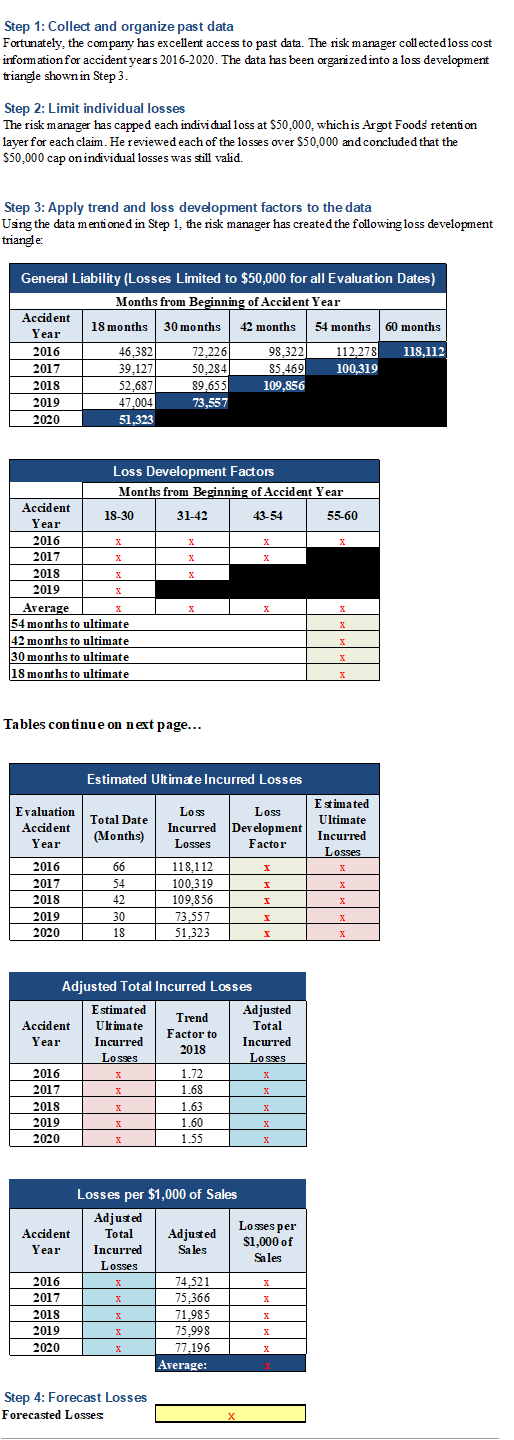
Argot's liability loss data for the past four years is available in the Excel spreadsheet found on the course website. The risk manager will take four steps to estimate Argot's expected general liability loss costs for the next year:
Step 1: Collect and organize past data
Step 2: Limit individual losses
Step 3: Apply trend and loss development factors to the data
Step 4: Forecast losses
2. Download the Excel spreadsheet from the course website. Complete all work for question 2 within the Excel spreadsheet and submit this file along with your written answers. Your spreadsheet should include the formulas you used, not just your final numbers. a. Refer to the Loss Development Factors table. Calculate the loss development factors and enter the correct numbers into the empty cells in the spreadsheet (every cell with an x should be replaced with a value). (9 points: 0.5 points for each correct calculation)
b. Refer to the Estimated Ultimate Incurred Losses table. Using your answers from the Loss Development Factors table, calculate the estimated ultimate incurred losses. (5 points: 1 point for each correct calculation)
c. Refer to the Adjusted Total Incurred Losses table. Using your answers from the Estimated Ultimate Incurred Losses table, calculate the adjusted total incurred losses. (5 points: 1 point for each correct calculation)
d. Refer to the Losses per $1,000 of Sales table. Using your answers from the Adjusted Total Incurred Losses table, calculate the losses per $1,000 of sales and its average. (6 points: 1 point for each correct calculation)
e. Finally, suppose the projected exposure (sales for year 2021) is $80,000. Calculate the forecasted losses for 2021. (1 point)
Step by Step Solution
There are 3 Steps involved in it

Get step-by-step solutions from verified subject matter experts