







Question: racket language problem #lang racket (provide (all-defined-out)) ;; for us to test (require racket/trace) ii in case you want to use tracing (require PTS.rkt) ;
racket language problem
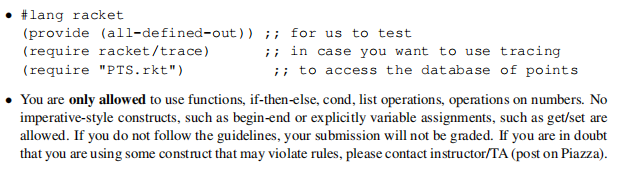
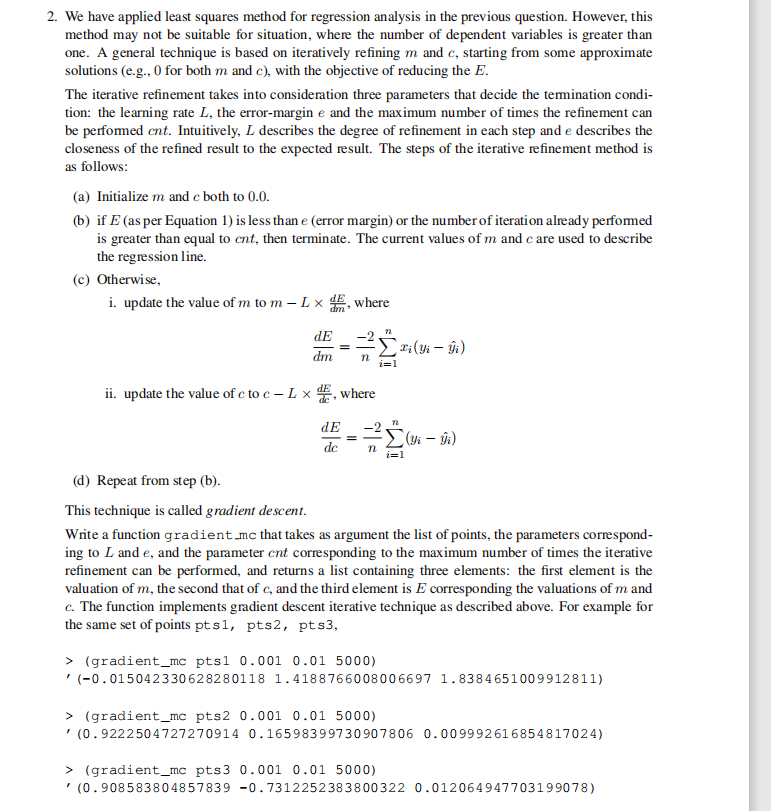
#lang racket (provide (all-defined-out)) ;; for us to test (require racket/trace) ii in case you want to use tracing (require "PTS.rkt") ; to access the database of points You are only allowed to use functions, if-then-else, cond, list operations, operations on numbers. No imperative-style constructs, such as begin-end or explicitly variable assignments, such as get/set are allowed. If you do not follow the guidelines, your submission will not be graded. If you are in doubt that you are using some construct that may violate rules, please contact instructor/TA (post on Piazza). 2. We have applied least squares method for regression analysis in the previous question. However, this method may not be suitable for situation, where the number of dependent variables is greater than one. A general technique is based on iteratively refining m and c, starting from some approximate solutions (e.g., 0 for both m and c), with the objective of reducing the E. The iterative refinement takes into consideration three parameters that decide the termination condi- tion: the learning rate L, the error-margine and the maximum number of times the refinement can be performed cnt. Intuitively, L describes the degree of refinement in each step and e describes the closeness of the refined result to the expected result. The steps of the iterative refinement method is as follows: (a) Initialize m and c both to 0.0. (b) if E (as per Equation 1) is less than e (error margin) or the number of iteration already performed is greater than equal to cnt, then terminate. The current values of m and care used to describe the regression line. (c) Otherwise, i. update the value of m to m-L x , where de 3 i 4 ) ii. update the value of c to c-L x , where -2 = n (gi - 9) (d) Repeat from step (b). This technique is called gradient descent. Write a function gradient_mc that takes as argument the list of points, the parameters correspond- ing to L and e, and the parameter cnt corresponding to the maximum number of times the iterative refinement can be performed, and returns a list containing three elements: the first element is the valuation of m, the second that of c, and the third element is corresponding the valuations of m and c. The function implements gradient descent iterative technique as described above. For example for the same set of points pt sl, pts2, pts3, > (gradient_mc pts1 0.001 0.01 5000) (-0.01504233062 8280118 1.4188766008006697 1.8384651009912811) > (gradient_mc pts2 0.001 0.01 5000) (0.9222504727270914 0.16598399730907806 0.009992616854817024) > (gradient_mc pts3 0.001 0.01 5000) (0.908583804857839 -0.7312252383800322 0.012064947703199078) #lang racket (provide (all-defined-out)) ;; for us to test (require racket/trace) ii in case you want to use tracing (require "PTS.rkt") ; to access the database of points You are only allowed to use functions, if-then-else, cond, list operations, operations on numbers. No imperative-style constructs, such as begin-end or explicitly variable assignments, such as get/set are allowed. If you do not follow the guidelines, your submission will not be graded. If you are in doubt that you are using some construct that may violate rules, please contact instructor/TA (post on Piazza). 2. We have applied least squares method for regression analysis in the previous question. However, this method may not be suitable for situation, where the number of dependent variables is greater than one. A general technique is based on iteratively refining m and c, starting from some approximate solutions (e.g., 0 for both m and c), with the objective of reducing the E. The iterative refinement takes into consideration three parameters that decide the termination condi- tion: the learning rate L, the error-margine and the maximum number of times the refinement can be performed cnt. Intuitively, L describes the degree of refinement in each step and e describes the closeness of the refined result to the expected result. The steps of the iterative refinement method is as follows: (a) Initialize m and c both to 0.0. (b) if E (as per Equation 1) is less than e (error margin) or the number of iteration already performed is greater than equal to cnt, then terminate. The current values of m and care used to describe the regression line. (c) Otherwise, i. update the value of m to m-L x , where de 3 i 4 ) ii. update the value of c to c-L x , where -2 = n (gi - 9) (d) Repeat from step (b). This technique is called gradient descent. Write a function gradient_mc that takes as argument the list of points, the parameters correspond- ing to L and e, and the parameter cnt corresponding to the maximum number of times the iterative refinement can be performed, and returns a list containing three elements: the first element is the valuation of m, the second that of c, and the third element is corresponding the valuations of m and c. The function implements gradient descent iterative technique as described above. For example for the same set of points pt sl, pts2, pts3, > (gradient_mc pts1 0.001 0.01 5000) (-0.01504233062 8280118 1.4188766008006697 1.8384651009912811) > (gradient_mc pts2 0.001 0.01 5000) (0.9222504727270914 0.16598399730907806 0.009992616854817024) > (gradient_mc pts3 0.001 0.01 5000) (0.908583804857839 -0.7312252383800322 0.012064947703199078)
Step by Step Solution
There are 3 Steps involved in it

Get step-by-step solutions from verified subject matter experts
 Study Help