







Question: Radioactive decay is a simple exponential (first-order) process and the following equation is very useful: AN=.dN (the-sign indicates that the number of radioactive atoms decreases
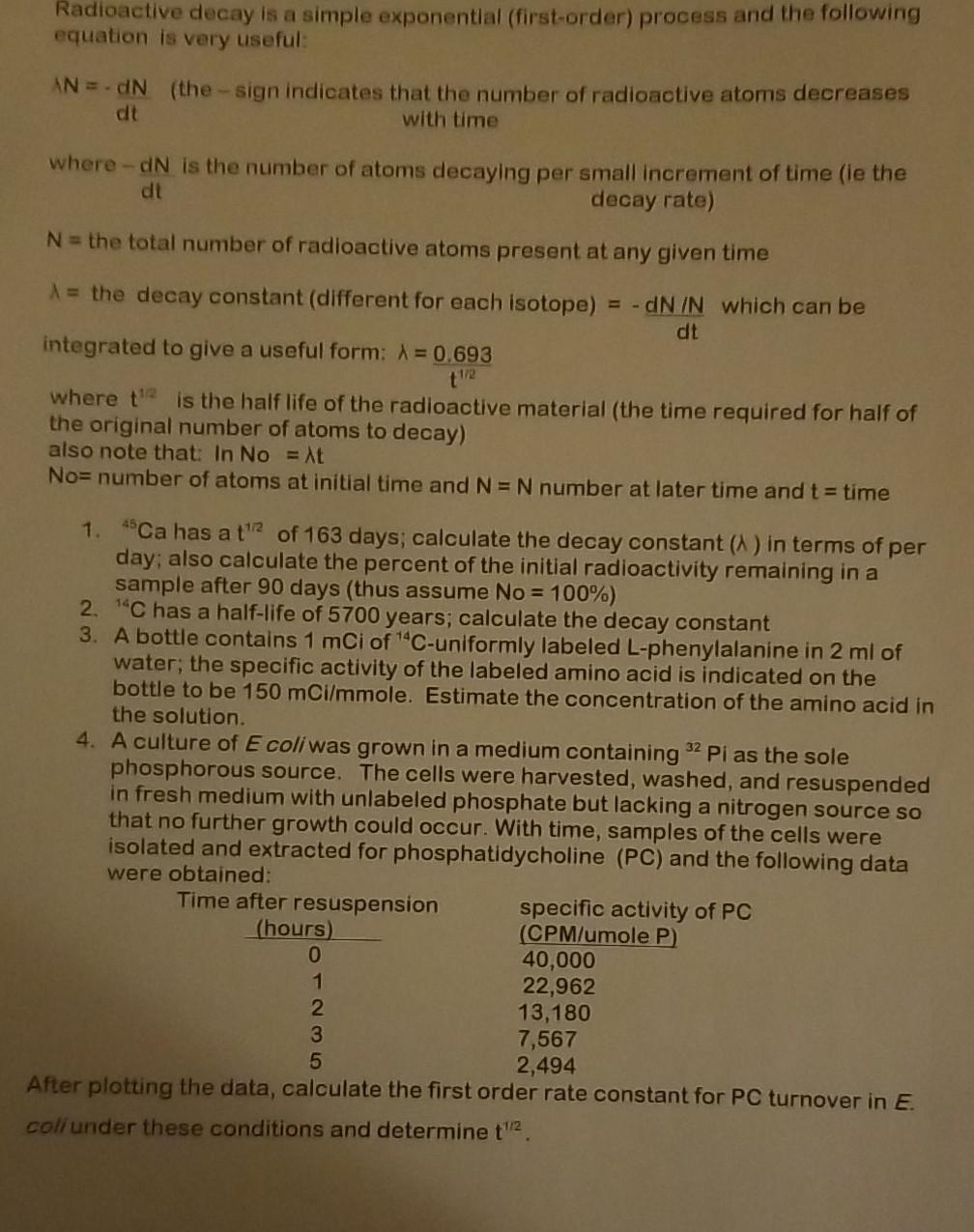
Radioactive decay is a simple exponential (first-order) process and the following equation is very useful: AN=.dN (the-sign indicates that the number of radioactive atoms decreases with time where -ON is the number of atoms decaying per small increment of time (ie the dt decay rate) N = the total number of radioactive atoms present at any given time A = the decay constant (different for each isotope) = -dN/N which can be dt integrated to give a useful form: 1 = 0.693 where this the half life of the radioactive material (the time required for half of the original number of atoms to decay) also note that: In No = it No= number of atoms at initial time and N= N number at later time and t = time 1. Ca has a tha of 163 days; calculate the decay constant (/) in terms of per day; also calculate the percent of the initial radioactivity remaining in a sample after 90 days (thus assume No = 100%) 2. C has a half-life of 5700 years; calculate the decay constant 3. A bottle contains 1 mCi of "C-uniformly labeled L-phenylalanine in 2 ml of water; the specific activity of the labeled amino acid is indicated on the bottle to be 150 mCi/mmole. Estimate the concentration of the amino acid in the solution. 4. A culture of Ecoli was grown in a medium containing Pi as the sole phosphorous source. The cells were harvested, washed, and resuspended in fresh medium with unlabeled phosphate but lacking a nitrogen source so that no further growth could occur. With time, samples of the cells were isolated and extracted for phosphatidycholine (PC) and the following data were obtained: Time after resuspension specific activity of PC (hours) (CPM/umole P) 0 40,000 1 22,962 2 13,180 3 7,567 5 2,494 After plotting the data, calculate the first order rate constant for PC turnover in E. coli under these conditions and determine t
Step by Step Solution
There are 3 Steps involved in it

Get step-by-step solutions from verified subject matter experts
 Study Help