







Question: Reaction Material Balance Practice Steps for documentation - REQUIRED 1. Draw picture. 2. Label streams, knowns. unknowns. 3. Define equations 4. Solve equations 5. Ammonia
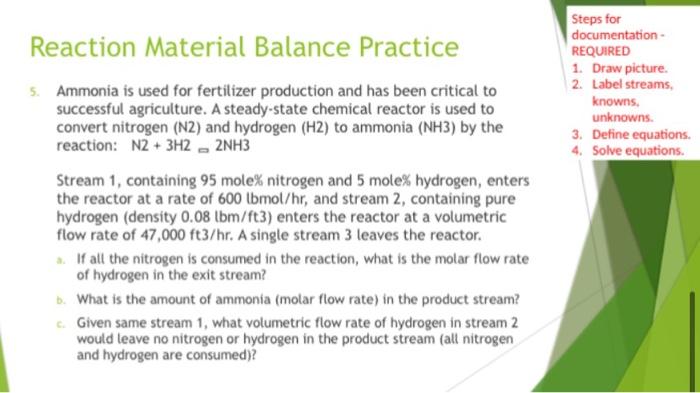
Reaction Material Balance Practice Steps for documentation - REQUIRED 1. Draw picture. 2. Label streams, knowns. unknowns. 3. Define equations 4. Solve equations 5. Ammonia is used for fertilizer production and has been critical to successful agriculture. A steady-state chemical reactor is used to convert nitrogen (N2) and hydrogen (H2) to ammonia (NH3) by the reaction: N2 + 3H2 2NH3 Stream 1, containing 95 mole% nitrogen and 5 mole% hydrogen, enters the reactor at a rate of 600 lbmol/hr, and stream 2, containing pure hydrogen (density 0.08 (bm/ft3) enters the reactor at a volumetric flow rate of 47,000 ft3/hr. A single stream 3 leaves the reactor. If all the nitrogen is consumed in the reaction, what is the molar flow rate of hydrogen in the exit stream? b. What is the amount of ammonia (molar flow rate) in the product stream? c. Given same stream 1, what volumetric flow rate of hydrogen in stream 2 would leave no nitrogen or hydrogen in the product stream (all nitrogen and hydrogen are consumed)
Step by Step Solution
There are 3 Steps involved in it

Get step-by-step solutions from verified subject matter experts
 Study Help