



Question: Read and answer the following questions, no plagiarism please. Using radio frequency identification (RFID) technology, ClearScan manufactures inventory management and tracking systems. Used in any
Read and answer the following questions, no plagiarism please. 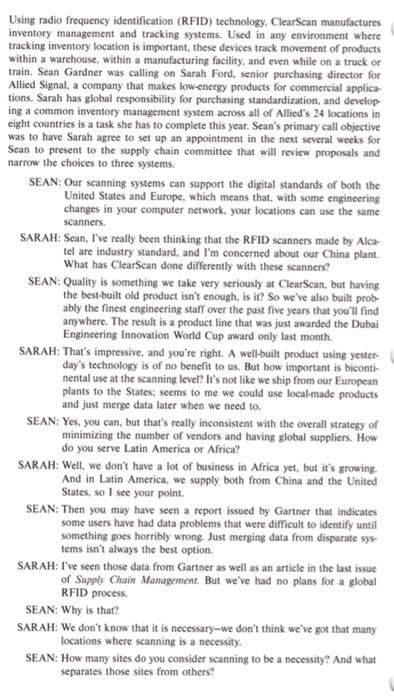
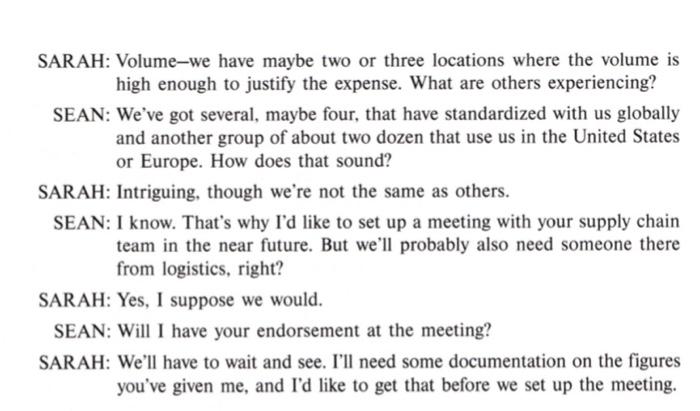
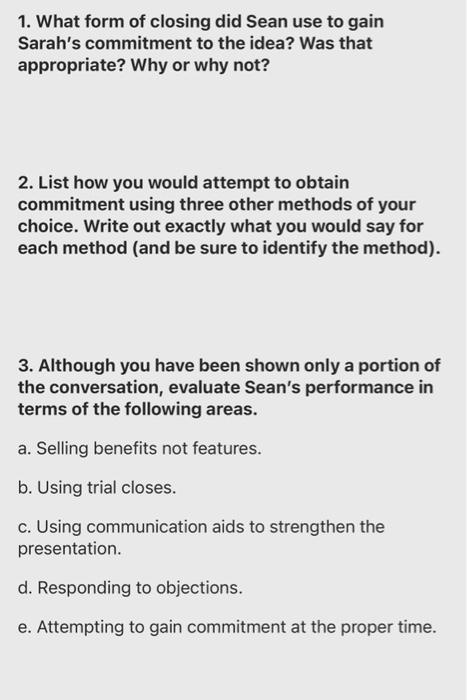
Using radio frequency identification (RFID) technology, ClearScan manufactures inventory management and tracking systems. Used in any environment where tracking inventory location is important, these devices track movement of products within a warehouse, within a manufacturing facility, and even while on a truck or train. Sean Gardner was calling on Sarah Ford, senior purchasing director for Allied Signal, a company that makes low-energy products for commercial applica- tions. Sarah has global responsibility for purchasing standardization, and develop ing a common inventory management system across all of Allied's 24 locations in eight countries is a task she has to complete this year. Sean's primary call objective was to have Sarah agree to set up an appointment in the next several weeks for Scan to present to the supply chain committee that will review proposals and narrow the choices to three systems SEAN: Our scanning systems can support the digital standards of both the United States and Europe, which means that with some engineering changes in your computer network, your locations can use the same scanners. SARAH: Scan, I've really been thinking that the RFID scanners made by Alca- tel are industry standard, and I'm concerned about our China plant What has ClearScan done differently with these scanners? SEAN: Quality is something we take very seriously at ClearScan, but having the best-built old product isn't enough, is it? So we've also built prob ably the finest engineering staff over the past five years that you'll find anywhere. The result is a product line that was just awarded the Dubai Engineering Innovation World Cup award only last month. SARAH: That's impressive, and you're right. A well-built product using yester day's technology is of no benefit to us. But how important is biconti nental use at the scanning level? It's not like we ship from our European plants to the States; seems to me we could use local-made products and just merge data later when we need to. SEAN: Yes, you can, but that's really inconsistent with the overall strategy of minimizing the number of vendors and having global suppliers. How do you serve Latin America or Africa? SARAH: Well, we don't have a lot of business in Africa yet, but it's growing, And in Latin America, we supply both from China and the United States, so I see your point. SEAN: Then you may have seen a report issued by Gartner that indicates some users have had data problems that were difficult to identify until something goes horribly wrong. Just merging data from disparate sys. tems isn't always the best option. SARAH: I've seen those data from Gartner as well as an article in the last issue of Supply Chain Management. But we've had no plans for a global RFID process. SEAN: Why is that? SARAH: We don't know that it is necessary-we don't think we've got that many locations where scanning is a necessity. SEAN: How many sites do you consider scanning to be a necessity? And what separates those sites from others! SARAH: Volume-we have maybe two or three locations where the volume is high enough to justify the expense. What are others experiencing? SEAN: We've got several, maybe four, that have standardized with us globally and another group of about two dozen that use us in the United States or Europe. How does that sound? SARAH: Intriguing, though we're not the same as others. SEAN: I know. That's why I'd like to set up a meeting with your supply chain team in the near future. But we'll probably also need someone there from logistics, right? SARAH: Yes, I suppose we would. SEAN: Will I have your endorsement at the meeting? SARAH: We'll have to wait and see. I'll need some documentation on the figures you've given me, and I'd like to get that before we set up the meeting. 1. What form of closing did Sean use to gain Sarah's commitment to the idea? Was that appropriate? Why or why not? 2. List how you would attempt to obtain commitment using three other methods of your choice. Write out exactly what you would say for each method (and be sure to identify the method). 3. Although you have been shown only a portion of the conversation, evaluate Sean's performance in terms of the following areas. a. Selling benefits not features. b. Using trial closes. c. Using communication aids to strengthen the presentation. d. Responding to objections. e. Attempting to gain commitment at the proper time Step by Step Solution
There are 3 Steps involved in it
1 Expert Approved Answer
Step: 1 Unlock

Question Has Been Solved by an Expert!
Get step-by-step solutions from verified subject matter experts
Step: 2 Unlock
Step: 3 Unlock