Question: Read article answer questions: 1. Why is it essential for SoundCloud and Spotify to export their product? Could the companies survive without international expansion? 2.
Read article answer questions:
1. Why is it essential for SoundCloud and Spotify to export their product? Could the companies survive without international expansion?
2. Why are service exports likely to be central to the growth of developed economies in the future?
3. What are the implications of this trend for national trade policy?
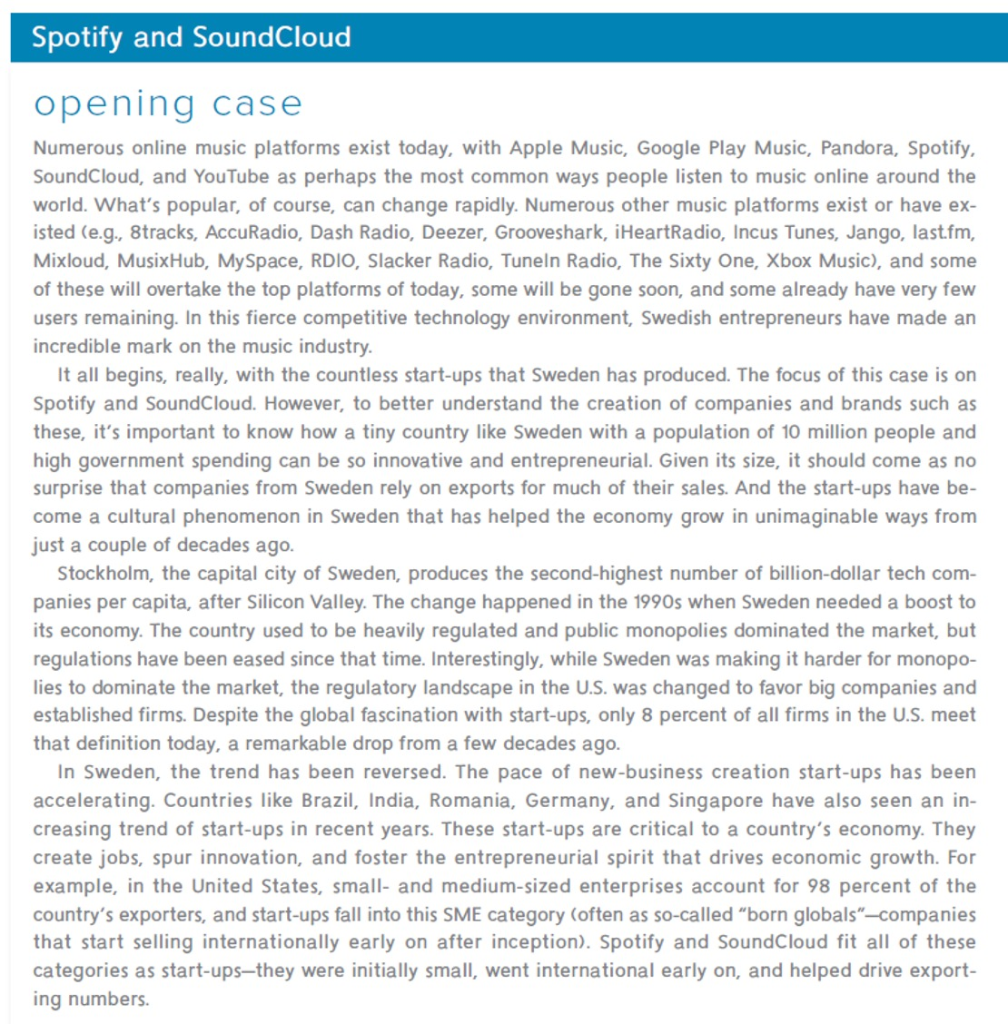
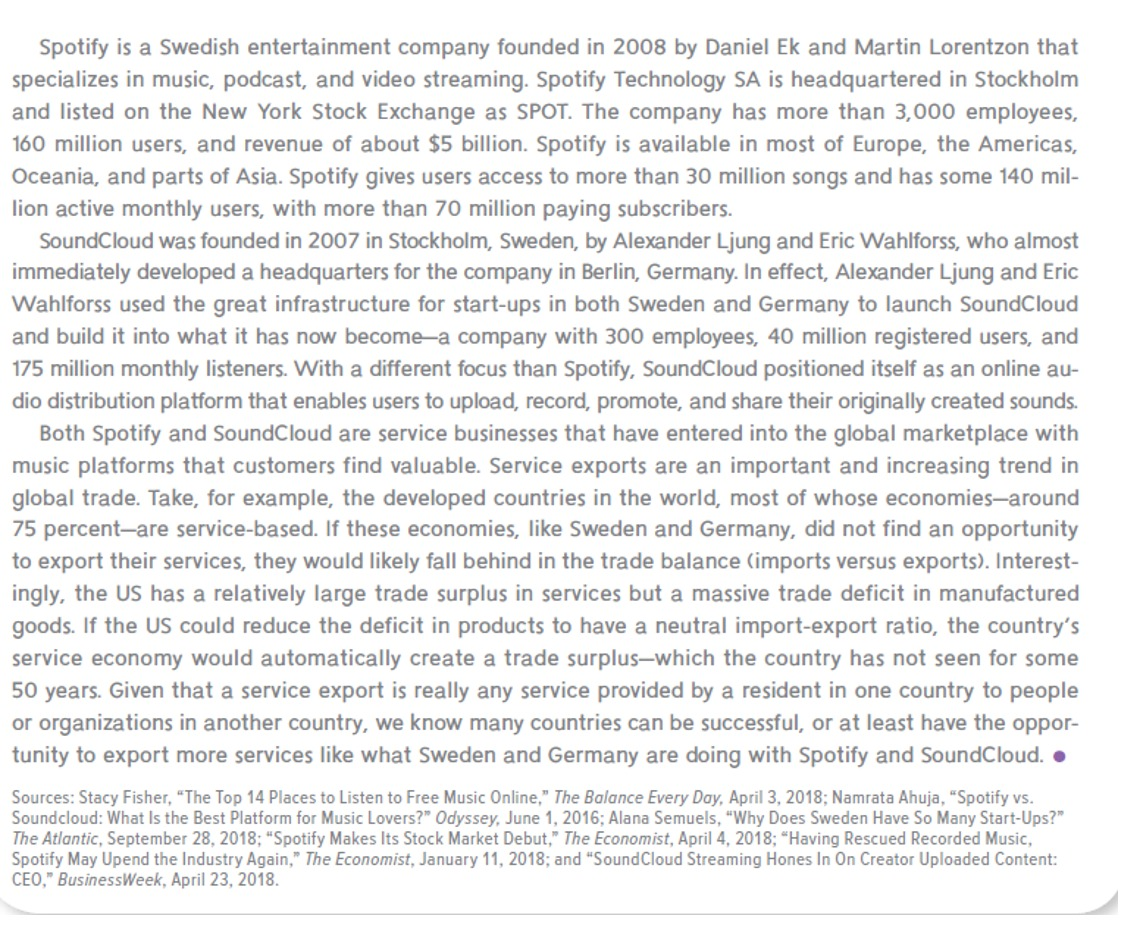
Spotify and SoundCloud opening case Numerous online music platforms exist today, with Apple Music, Google Play Music, Pandora, Spotify, SoundCloud, and YouTube as perhaps the most common ways people listen to music online around the world. What's popular, of course, can change rapidly. Numerous other music platforms exist or have ex- isted (e.g., 8tracks, AccuRadio, Dash Radio, Deezer, Grooveshark, iHeartRadio, Incus Tunes, Jango, last.fm, Mixloud, MusixHub, MySpace, RDIO, Slacker Radio, TuneIn Radio, The Sixty One, Xbox Music), and some of these will overtake the top platforms of today, some will be gone soon, and some already have very few users remaining. In this fierce competitive technology environment, Swedish entrepreneurs have made an incredible mark on the music industry. It all begins, really, with the countless start-ups that Sweden has produced. The focus of this case is on Spotify and SoundCloud. However, to better understand the creation of companies and brands such as these, it's important to know how a tiny country like Sweden with a population of 10 million people and high government spending can be so innovative and entrepreneurial. Given its size, it should come as no surprise that companies from Sweden rely on exports for much of their sales. And the start-ups have be- come a cultural phenomenon in Sweden that has helped the economy grow in unimaginable ways from just a couple of decades ago. Stockholm, the capital city of Sweden, produces the second-highest number of billion-dollar tech com- panies per capita, after Silicon Valley. The change happened in the 1990s when Sweden needed a boost to its economy. The country used to be heavily regulated and public monopolies dominated the market, but regulations have been eased since that time. Interestingly, while Sweden was making it harder for monopo- lies to dominate the market, the regulatory landscape in the U.S. was changed to favor big companies and established firms. Despite the global fascination with start-ups, only 8 percent of all firms in the U.S. meet that definition today, a remarkable drop from a few decades ago. In Sweden, the trend has been reversed. The pace of new business creation start-ups has been accelerating. Countries like Brazil, India, Romania, Germany, and Singapore have also seen an in- creasing trend of start-ups in recent years. These start-ups are critical to a country's economy. They create jobs, spur innovation, and foster the entrepreneurial spirit that drives economic growth. For example, in the United States, small- and medium-sized enterprises account for 98 percent of the country's exporters, and start-ups fall into this SME category (often as so-called "born globals"-companies that start selling internationally early on after inception). Spotify and SoundCloud fit all of these categories as start-ups-they were initially small, went international early on, and helped drive export- ing numbers. Spotify is a Swedish entertainment company founded in 2008 by Daniel Ek and Martin Lorentzon that specializes in music, podcast, and video streaming. Spotify Technology SA is headquartered in Stockholm and listed on the New York Stock Exchange as SPOT. The company has more than 3,000 employees, 160 million users, and revenue of about $5 billion. Spotify is available in most of Europe, the Americas, Oceania, and parts of Asia. Spotify gives users access to more than 30 million songs and has some 140 mil- lion active monthly users, with more than 70 million paying subscribers. SoundCloud was founded in 2007 in Stockholm, Sweden, by Alexander Ljung and Eric Wahlforss, who almost immediately developed a headquarters for the company in Berlin, Germany. In effect, Alexander Ljung and Eric Wahlforss used the great infrastructure for start-ups in both Sweden and Germany to launch SoundCloud and build it into what it has now become-a company with 300 employees, 40 million registered users, and 175 million monthly listeners. With a different focus than Spotify, SoundCloud positioned itself as an online au- dio distribution platform that enables users to upload, record, promote, and share their originally created sounds. Both Spotify and SoundCloud are service businesses that have entered into the global marketplace with music platforms that customers find valuable. Service exports are an important and increasing trend in global trade. Take, for example, the developed countries in the world, most of whose economies-around 75 percent-are service-based. If these economies, like Sweden and Germany, did not find an opportunity to export their services, they would likely fall behind in the trade balance (imports versus exports). Interest- ingly, the US has a relatively large trade surplus in services but a massive trade deficit in manufactured goods. If the US could reduce the deficit in products to have a neutral import-export ratio, the country's service economy would automatically create a trade surpluswhich the country has not seen for some 50 years. Given that a service export is really any service provided by a resident in one country to people or organizations in another country, we know many countries can be successful, or at least have the oppor- tunity to export more services like what Sweden and Germany are doing with Spotify and SoundCloud. . Sources: Stacy Fisher, "The Top 14 Places to Listen to Free Music Online," The Balance Every Day, April 3, 2018; Namrata Ahuja, "Spotify vs. Soundcloud: What is the Best Platform for Music Lovers?" Odyssey, June 1, 2016; Alana Semuels, "Why Does Sweden Have So Many Start-Ups?" The Atlantic, September 28, 2018; "Spotify Makes Its Stock Market Debut," The Economist, April 4, 2018; Having Rescued Recorded Music, Spotify May Upend the Industry Again," The Economist, January 11, 2018; and "SoundCloud Streaming Hones In On Creator Uploaded Content: CEO," BusinessWeek, April 23, 2018









 Study Help