







Question: Read Case 6.9 and answer the questions below in at least 100 words: Q) What responsibilities do companies have in preventing violations of the FCPA?
Read Case 6.9 and answer the questions below in at least 100 words:
Q) What responsibilities do companies have in preventing violations of the FCPA?
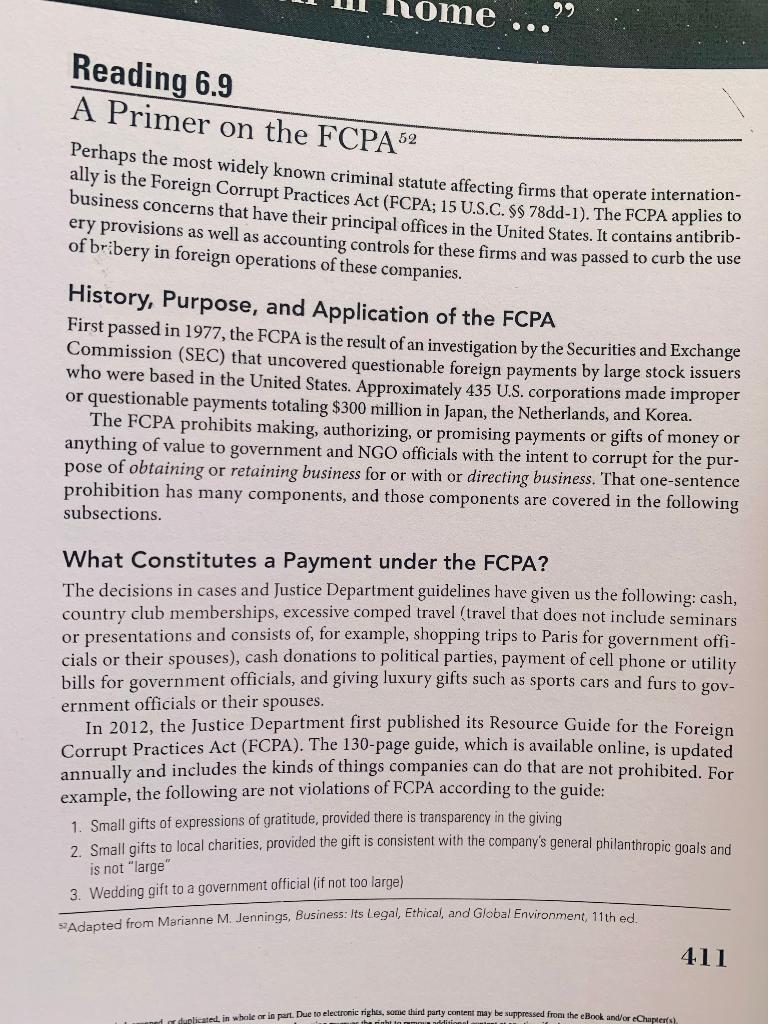
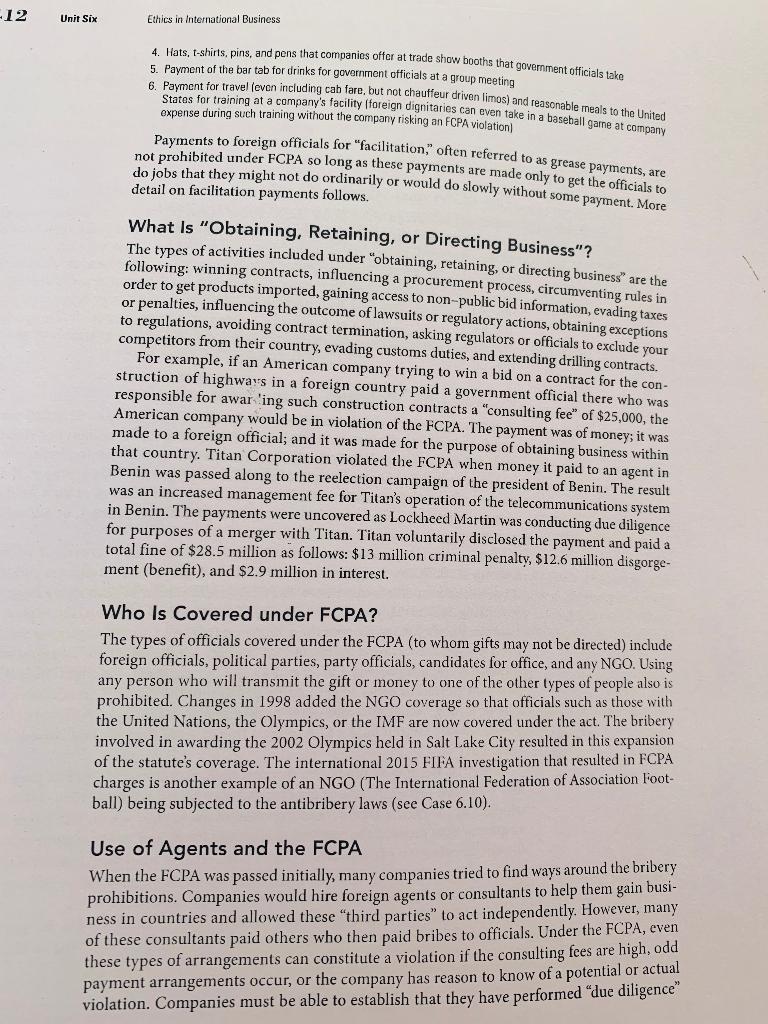
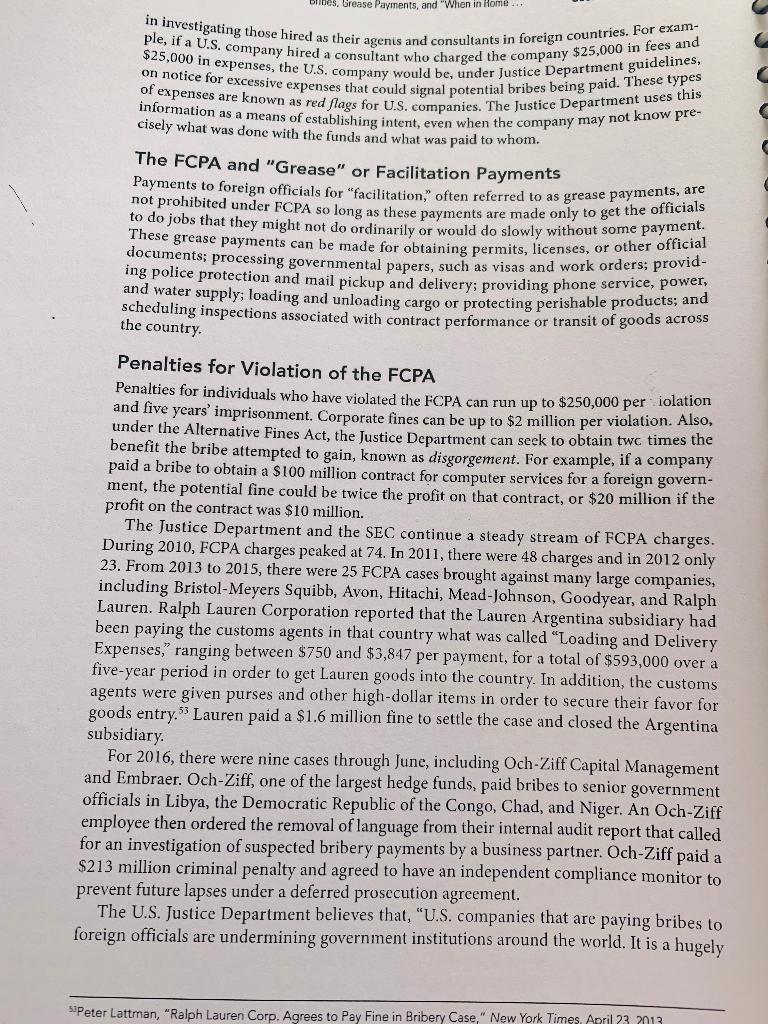
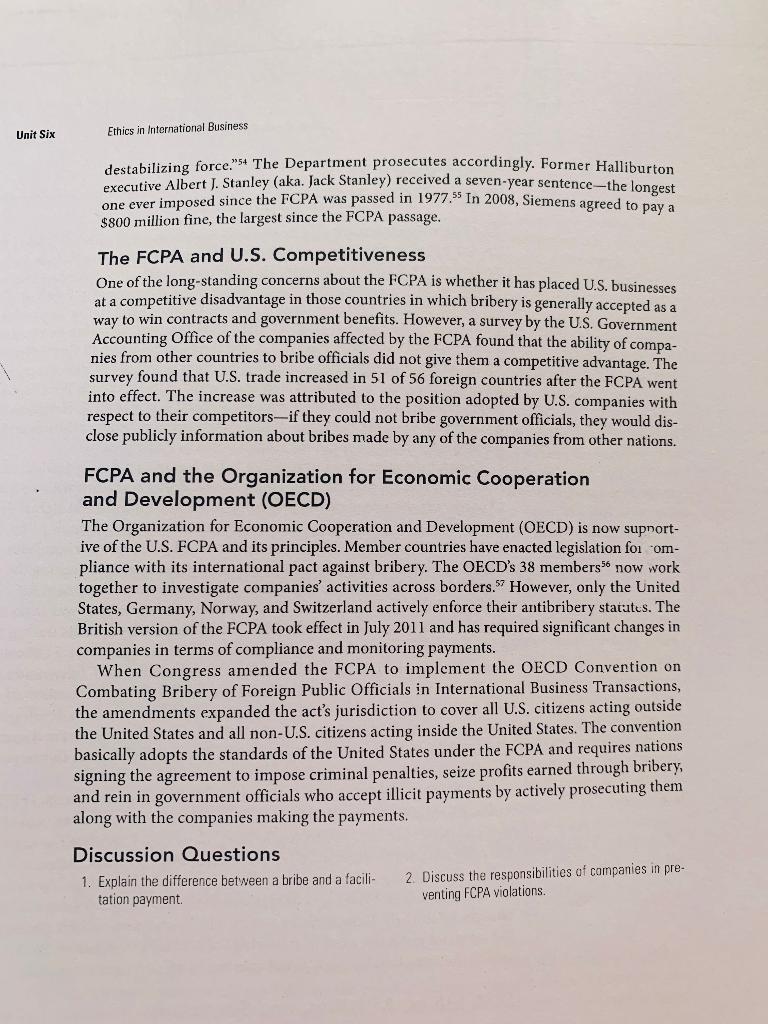
Nome 99 ... Reading 6.9 A Primer on the FCPA 52 Perhaps the most widely known criminal statute affecting firms that operate internation- ally is the Foreign Corrupt Practices Act (FCPA; 15 U.S.C. $$ 78dd-1). The FCPA applies to business concerns that have their principal offices in the United States. It contains antibrib- ery provisions as well as accounting controls for these firms and was passed to curb the use of bribery in foreign operations of these companies. History, Purpose, and Application of the FCPA First passed in 1977, the FCPA is the result of an investigation by the Securities and Exchange Commission (SEC) that uncovered questionable foreign payments by large stock issuers who were based in the United States. Approximately 435 U.S. corporations made improper or questionable payments totaling $300 million in Japan, the Netherlands, and Korea. The FCPA prohibits making, authorizing, or promising payments or gifts of money or anything of value to government and NGO officials with the intent to corrupt for the pur- pose of obtaining or retaining business for or with or directing business. That one-sentence prohibition has many components, and those components are covered in the following subsections. What Constitutes a Payment under the FCPA? The decisions in cases and Justice Department guidelines have given us the following: cash, country club memberships, excessive comped travel travel that does not include seminars or presentations and consists of, for example, shopping trips to Paris for government offi- cials or their spouses), cash donations to political parties, payment of cell phone or utility bills for government officials, and giving luxury gifts such as sports cars and furs to gov- ernment officials or their spouses. In 2012, the Justice Department first published its Resource Guide for the Foreign Corrupt Practices Act (FCPA). The 130-page guide, which is available online, is updated annually and includes the kinds of things companies can do that are not prohibited. For example, the following are not violations of FCPA according to the guide: 1. Small gifts of expressions of gratitude, provided there is transparency in the giving 2. Small gifts to local charities, provided the gift is consistent with the company's general philanthropic goals and is not "large" 3. Wedding gift to a government official (if not too large) sAdapted from Marianne M. Jennings, Business: Its Legal, Ethical, and Global Environment, 11th ed 411 Er duplicated in whole or in part. Due to electronic rights, some third party content may be suppressed from the Book and/or chapters) the right to additional -12 Unit Six Ethics in International Business 4. Hats, t-shirts, pins, and pens that companies offer at trade show booths that government officials take 5. Payment of the bar tab for drinks for government officials at a group meeting 6. Payment for travel (even including cab fare, but not chauffeur driven limos) and reasonable meals to the United States for training at a company's facility foreign dignitaries can even take in a baseball garne at company expense during such training without the company risking an FCPA violation Payments to foreign officials for "facilitation" often referred to as grease payments, are not prohibited under FCPA so long as these payments are made only to get the officials to do jobs that they might not do ordinarily or would do slowly without some payment. More detail on facilitation payments follows. What Is "Obtaining, Retaining, or Directing Business"? The types of activities included under obtaining, retaining, or directing business" are the following: winning contracts, influencing a procurement process, circumventing rules in order to get products imported, gaining access to non-public bid information, evading taxes or penalties, influencing the outcome of lawsuits or regulatory actions, obtaining exceptions to regulations, avoiding contract termination, asking regulators or officials to exclude your competitors from their country, evading customs duties, and extending drilling contracts. For example, if an American company trying to win a bid on a contract for the con- struction of highways in a foreign country paid a government official there who was responsible for awar 'ing such construction contracts a "consulting fee" of $25,000, the American company would be in violation of the FCPA. The payment was of money; it was made to a foreign official; and it was made for the purpose of obtaining business within that country. Titan Corporation violated the FCPA when money it paid to an agent in Benin was passed along to the reelection campaign of the president of Benin. The result was an increased management fee for Titan's operation of the telecommunications system in Benin. The payments were uncovered as Lockheed Martin was conducting due diligence for purposes of a merger with Titan. Titan voluntarily disclosed the payment and paid a total fine of $28.5 million as follows: $13 million criminal penalty, $12.6 million disgorge- ment (benefit), and $2.9 million in interest. Who Is Covered under FCPA? The types of officials covered under the FCPA (to whom gifts may not be directed) include foreign officials, political parties, party officials, candidates for office, and any NGO. Using any person who will transmit the gift or money to one of the other types of people also is prohibited. Changes in 1998 added the NGO coverage so that officials such as those with the United Nations, the Olympics, or the IMF are now covered under the act. The bribery involved in awarding the 2002 Olympics held in Salt Lake City resulted in this expansion of the statute's coverage. The international 2015 FIFA investigation that resulted in FCPA charges is another example of an NGO (The International Federation of Association Foot- ball) being subjected to the antibribery laws (see Case 6.10). Use of Agents and the FCPA When the FCPA was passed initially, many companies tried to find ways around the bribery prohibitions. Companies would hire foreign agents or consultants to help them gain busi- ness in countries and allowed these "third parties" to act independently. However, many of these consultants paid others who then paid bribes to officials. Under the FCPA, even these types of arrangements can constitute a violation if the consulting fees are high, odd payment arrangements occur, or the company has reason to know of a potential or actual violation. Companies must be able to establish that they have performed "due diligence" bhines. Grease Payments, and "When in Home ple, if a U.S. company hired a consultant who charged the company $25,000 in fees and in investigating those hired as their agents and consultants in foreign countries. For exam- $25,000 in expenses, the U.S. company would be, under Justice Department guidelines, of expenses are known as red flags for U.S. companies. The Justice Department uses this on notice for excessive expenses that could signal potential bribes being paid. These types information as a means of establishing intent, even when the company may not know pre- cisely what was done with the funds and what was paid to whom. The FCPA and "Grease" or Facilitation Payments Payments to foreign officials for "facilitation often referred to as grease payments, are not prohibited under FCPA so long as these payments are made only to get the officials These grease payments can be made for obtaining permits , licenses, or other official documents, processing governmental papers, such as visas and work orders; provid- ing police protection and mail pickup and delivery, providing phone service, power, and water supply; loading and unloading cargo or protecting perishable products; and scheduling inspections associated with contract performance or transit of goods across the country. Penalties for Violation of the FCPA Penalties for individuals who have violated the FCPA can run up to $250,000 per iolation and five years' imprisonment. Corporate fines can be up to $2 million per violation. Also, under the Alternative Fines Act, the Justice Department can seek to obtain twc times the benefit the bribe attempted to gain, known as disgorgement. For example, if a company paid a bribe to obtain a $100 million contract for computer services for a foreign govern- ment, the potential fine could be twice the profit on that contract, or $20 million if the profit on the contract was $10 million. The Justice Department and the SEC continue a steady stream of FCPA charges. During 2010, FCPA charges peaked at 74. In 2011, there were 48 charges and in 2012 only 23. From 2013 to 2015, there were 25 FCPA cases brought against many large companies, including Bristol-Meyers Squibb, Avon, Hitachi, Mead-Johnson, Goodyear, and Ralph Lauren Ralph Lauren Corporation reported that the Lauren Argentina subsidiary had been paying the customs agents in that country what was called "Loading and Delivery Expenses," ranging between $750 and $3,847 per payment, for a total of $593,000 over a five-year period in order to get Lauren goods into the country. In addition, the customs agents were given purses and other high-dollar items in order to secure their favor for goods entry." Lauren paid a $1.6 million fine to settle the case and closed the Argentina subsidiary. For 2016, there were nine cases through June, including Och-Ziff Capital Management and Embraer. Och-Ziff, one of the largest hedge funds, paid bribes to senior government officials in Libya, the Democratic Republic of the Congo, Chad, and Niger. An Och-Ziff employee then ordered the removal of language from their internal audit report that called for an investigation of suspected bribery payments by a business partner. Och-Ziff paid a $213 million criminal penalty and agreed to have an independent compliance monitor to prevent future lapses under a deferred prosecution agreement. The U.S. Justice Department believes that, U.S. companies that are paying bribes to foreign officials are undermining government institutions around the world. It is a hugely SiPeter Lattman, "Ralph Lauren Corp. Agrees to Pay Fine in Bribery Case," New York Times. April 23, 2013 Unit Six Ethics in International Business 1 destabilizing force."* The Department prosecutes accordingly. Former Halliburton executive Albert J. Stanley (aka. Jack Stanley) received a seven-year sentence-the longest one ever imposed since the FCPA was passed in 1977.95 In 2008, Siemens agreed to pay a $800 million fine, the largest since the FCPA passage. The FCPA and U.S. Competitiveness One of the long-standing concerns about the FCPA is whether it has placed U.S. businesses at a competitive disadvantage in those countries in which bribery is generally accepted as a way to win contracts and government benefits. However, a survey by the US Government Accounting Office of the companies affected by the FCPA found that the ability of compa- nies from other countries to bribe officials did not give them a competitive advantage. The survey found that U.S. trade increased in 51 of 56 foreign countries after the FCPA went into effect. The increase was attributed to the position adopted by U.S. companies with respect to their competitors--if they could not bribe government officials, they would dis- close publicly information about bribes made by any of the companies from other nations. FCPA and the Organization for Economic Cooperation and Development (OECD) The Organization for Economic Cooperation and Development (OECD) is now support- ive of the U.S. FCPA and its principles. Member countries have enacted legislation foi om- pliance with its international pact against bribery. The OECD's 38 members56 now work together to investigate companies' activities across borders. However, only the United States, Germany, Norway, and Switzerland actively enforce their antibribery statutes. The British version of the FCPA took effect in July 2011 and has required significant changes in companies in terms of compliance and monitoring payments. When Congress amended the FCPA to implement the OECD Convention on Combating Bribery of Foreign Public Officials in International Business Transactions, the amendments expanded the act's jurisdiction to cover all U.S. citizens acting outside the United States and all non-U.S. citizens acting inside the United States. The convention basically adopts the standards of the United States under the FCPA and requires nations signing the agreement to impose criminal penalties, seize profits earned through bribery, and rein in government officials who accept illicit payments by actively prosecuting them along with the companies making the payments. Discussion Questions 1. Explain the difference between a bribe and a facili- tation payment. 2. Discuss the responsibilities of companies in pre- venting FCPA violationsStep by Step Solution
There are 3 Steps involved in it
1 Expert Approved Answer
Step: 1 Unlock

Question Has Been Solved by an Expert!
Get step-by-step solutions from verified subject matter experts
Step: 2 Unlock
Step: 3 Unlock
 Study Help