



Question: Read Case for Critical Analysis 7.2 pg259260 textbookanswer the following question. QUESTION : Identify what costs Rio Tinto has been forced to bear as a
Read Case for Critical Analysis 7.2 pg259260 textbookanswer the following question.
QUESTION: Identify what costs Rio Tinto has been forced to bear as a result of the destruction of these ancient rock sites? To what extent do you feel these costs are sufficient? Why or why not?
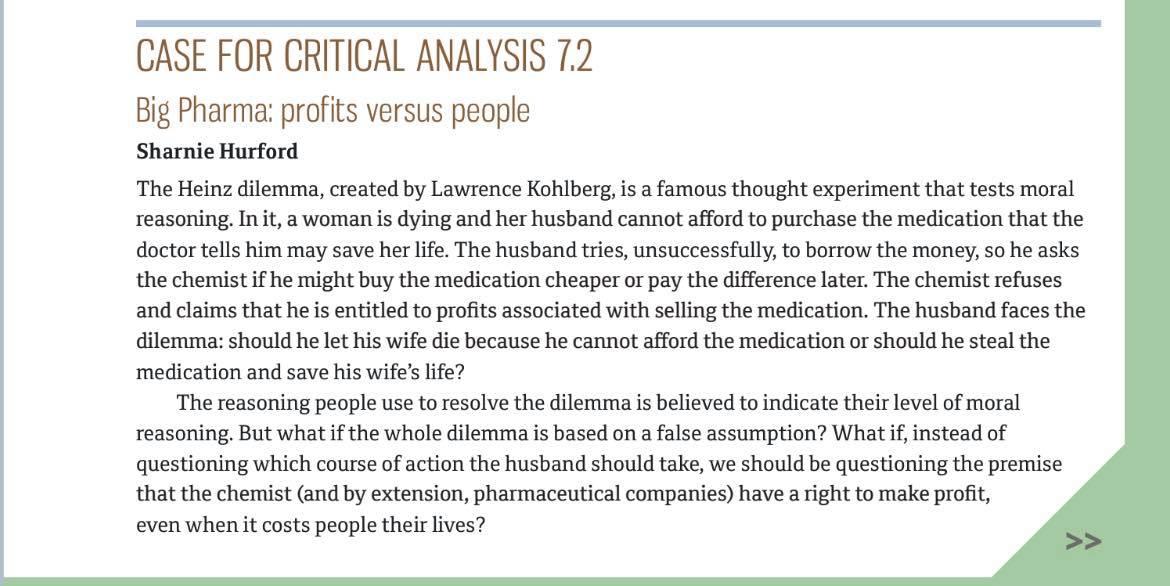
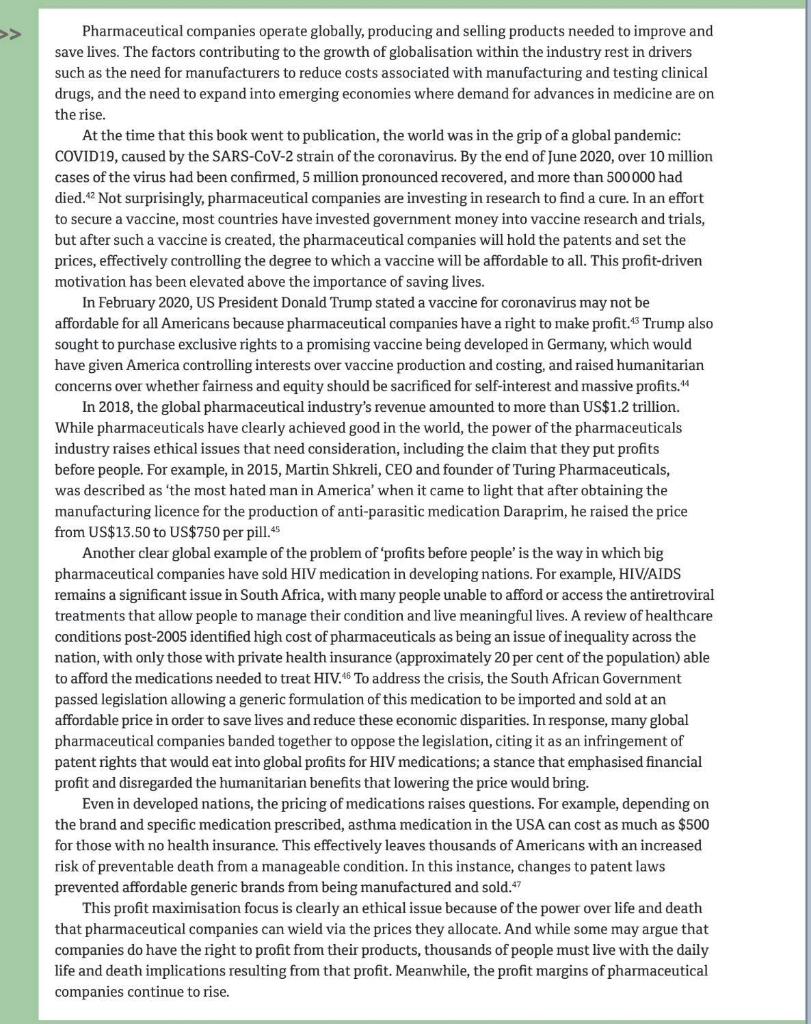
CASE FOR CRITICAL ANALYSIS 7.2 Big Pharma: profits versus people Sharnie Hurford The Heinz dilemma, created by Lawrence Kohlberg, is a famous thought experiment that tests moral reasoning. In it, a woman is dying and her husband cannot afford to purchase the medication that the doctor tells him may save her life. The husband tries, unsuccessfully, to borrow the money, so he asks the chemist if he might buy the medication cheaper or pay the difference later. The chemist refuses and claims that he is entitled to profits associated with selling the medication. The husband faces the dilemma: should he let his wife die because he cannot afford the medication or should he steal the medication and save his wife's life? The reasoning people use to resolve the dilemma is believed to indicate their level of moral reasoning. But what if the whole dilemma is based on a false assumption? What if, instead of questioning which course of action the husband should take, we should be questioning the premise that the chemist (and by extension, pharmaceutical companies) have a right to make profit, even when it costs people their lives? Pharmaceutical companies operate globally, producing and selling products needed to improve and save lives. The factors contributing to the growth of globalisation within the industry rest in drivers such as the need for manufacturers to reduce costs associated with manufacturing and testing clinical drugs, and the need to expand into emerging economies where demand for advances in medicine are on the rise. At the time that this book went to publication, the world was in the grip of a global pandemic: COVID19, caused by the SARS-CoV-2 strain of the coronavirus. By the end of June 2020, over 10 million cases of the virus had been confirmed, 5 million pronounced recovered, and more than 500 000 had died. Not surprisingly, pharmaceutical companies are investing in research to find a cure. In an effort to secure a vaccine, most countries have invested government money into vaccine research and trials, but after such a vaccine is created, the pharmaceutical companies will hold the patents and set the prices, effectively controlling the degree to which a vaccine will be affordable to all. This profit-driven motivation has been elevated above the importance of saving lives. In February 2020, US President Donald Trump stated a vaccine for coronavirus may not be affordable for all Americans because pharmaceutical companies have a right to make profit. 43 Trump also sought to purchase exclusive rights to a promising vaccine being developed in Germany, which would have given America controlling interests over vaccine production and costing, and raised humanitarian concerns over whether fairness and equity should be sacrificed for self-interest and massive profits. In 2018, the global pharmaceutical industry's revenue amounted to more than US$1.2 trillion. While pharmaceuticals have clearly achieved good in the world, the power of the pharmaceuticals industry raises ethical issues that need consideration, including the claim that they put profits before people. For example, in 2015, Martin Shkreli, CEO and founder of Turing Pharmaceuticals, was described as 'the most hated man in America' when it came to light that after obtaining the manufacturing licence for the production of anti-parasitic medication Daraprim, he raised the price from US$13.50 to US$750 per pill.45 Another clear global example of the problem of profits before people' is the way in which big pharmaceutical companies have sold HIV medication in developing nations. For example, HIV/AIDS remains a significant issue in South Africa, with many people unable to afford or access the antiretroviral treatments that allow people to manage their condition and live meaningful lives. A review of healthcare conditions post-2005 identified high cost of pharmaceuticals as being an issue of inequality across the nation, with only those with private health insurance (approximately 20 per cent of the population) able to afford the medications needed to treat HIV.4 To address the crisis, the South African Government passed legislation allowing a generic formulation of this medication to be imported and sold at an affordable price in order to save lives and reduce these economic disparities. In response, many global pharmaceutical companies banded together to oppose the legislation, citing it as an infringement of patent rights that would eat into global profits for HIV medications; a stance that emphasised financial profit and disregarded the humanitarian benefits that lowering the price would bring. Even in developed nations, the pricing of medications raises questions. For example, depending on the brand and specific medication prescribed, asthma medication in the USA can cost as much as $500 for those with no health insurance. This effectively leaves thousands of Americans with an increased risk of preventable death from a manageable condition. In this instance, changes to patent laws prevented affordable generic brands from being manufactured and sold.47 This profit maximisation focus is clearly an ethical issue because of the power over life and death that pharmaceutical companies can wield via the prices they allocate. And while some may argue that companies do have the right to profit from their products, thousands of people must live with the daily life and death implications resulting from that profit. Meanwhile, the profit margins of pharmaceutical companies continue to riseStep by Step Solution
There are 3 Steps involved in it
1 Expert Approved Answer
Step: 1 Unlock

Question Has Been Solved by an Expert!
Get step-by-step solutions from verified subject matter experts
Step: 2 Unlock
Step: 3 Unlock