







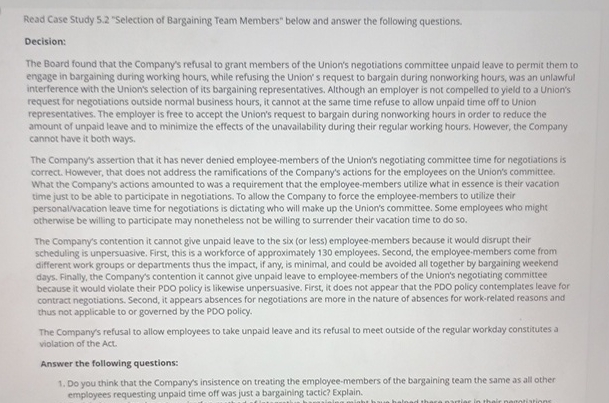
Question: Read Case Study 5 . 2 Selection of Bargaining Team Members below and answer the following questions. Decision: The Board found that the Company's refusal
Read Case Study "Selection of Bargaining Team Members" below and answer the following questions.
Decision:
The Board found that the Company's refusal to grant members of the Union's negotiations committee unpaid leave to permit them to engage in bargaining during working hours, while refusing the Union's request to bargain during nonworking hours, was an unlawful interference with the Unlon's selectlon of its bargaining representatlves. Atthough an employer is not compelled to yietd to a Union's request for negotiations outside normal business hours, it cannot at the same time refuse to allow unpaid time off to Union representatives. The employer is free to accept the Union's request to bargain during nonworking hours in order to reduce the amount of unpaid leave and to minimize the effects of the unavailability during their regular working hours. However, the Company cannot have it both ways.
The Company's assertion that it has never denied employeemembers of the Union's negotiating committee time for negotiations is correct. However, that does not address the ramifications of the Company's actions for the employees on the Union's committee. What the Company's actions amounted to was a requirement that the employeemembers utilize what in essence is their vacation time just to be able to participate in negotiations. To allow the Company to force the employeemembers to utilize their personalvacation leave time for negotiations is dictating who will make up the Union's committee. Some employees who might otherwise be willing to participate may nonetheless not be willing to surrender their vacation time to do so
The Company's contention it cannot give unpaid leave to the six or less employeemembers because it would disrupt their scheduling is unpersuasive. First, this is a workforce of approximately employees. Second, the employeemembers come from different work groups or departments thus the impact, if any, is minimal, and could be avoided all together by bargaining weekend days. Finally, the Company's contention it cannot give unpald leave to employeemembers of the Union's negotiating committee because it would violate their PDO policy is likewise unpersuasive. First, it does not appear that the PDO policy contemplates leave for contract negotiations. Second, it appears absences for negotiations are more in the nature of absences for workrelated reasons and thus not applicable to or governed by the PDO policy.
The Companys refusal to allow employees to take unpaid leave and its refusal to meet outside of the regular workday constitutes a violation of the Act.
Answer the following questions:
Do you think that the Companys insistence on treating the employeemembers of the bargaining team the same as all other employees requesting unpaid time off was just a bargaining tactic? Explain.
Step by Step Solution
There are 3 Steps involved in it
1 Expert Approved Answer
Step: 1 Unlock

Question Has Been Solved by an Expert!
Get step-by-step solutions from verified subject matter experts
Step: 2 Unlock
Step: 3 Unlock
 Study Help