Question: Read Debate Issue. Take a Stand: The FTC versus POM Wonderful. Post a 300- to the 350-word discussion taking a stand on the issue, then
Read Debate Issue. Take a Stand: The FTC versus POM Wonderful. Post a 300- to the 350-word discussion taking a stand on the issue, then find a post opposite your stance and discuss why you disagree with it.
https://danielsethics.mgt.unm.edu/pdf/pom-wonderful-di.pdf
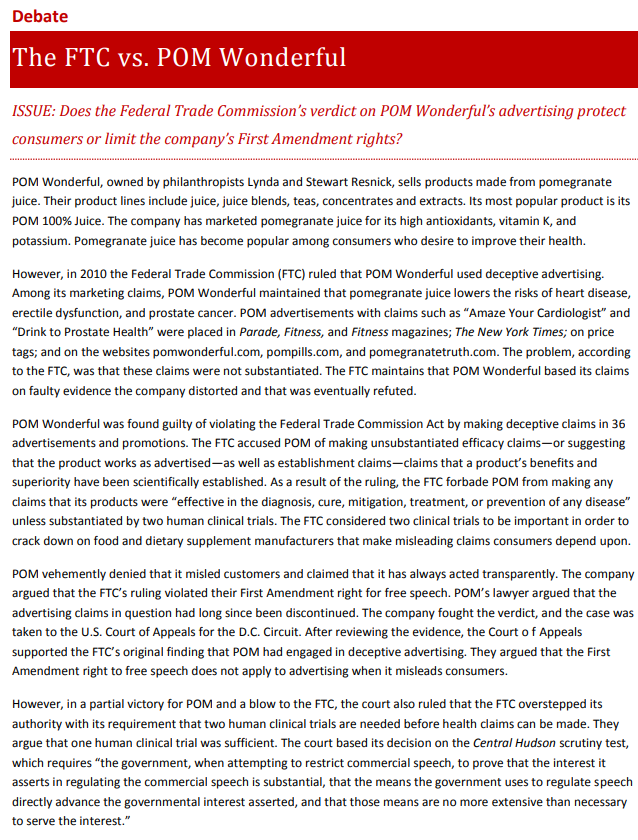
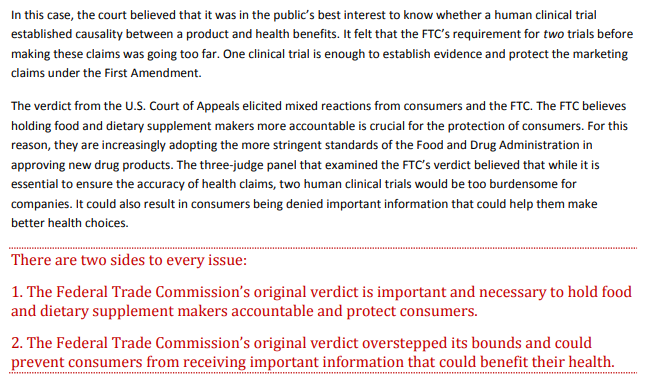
Debate The FTC vs. POM Wonderful ISSUE: Does the Federal Trade Commission's verdict on POM Wonderful's advertising protect consumers or limit the company's First Amendment rights? POM Wonderful, owned by philanthropists Lynda and Stewart Resnick, sells products made from pomegranate juice. Their product lines include juice, juice blends, teas, concentrates and extracts. Its most popular product is its POM 100% Juice. The company has marketed pomegranate juice for its high antioxidants, vitamin K, and potassium. Pomegranate juice has become popular among consumers who desire to improve their health. However, in 2010 the Federal Trade Commission (FTC) ruled that POM Wonderful used deceptive advertising. Among its marketing claims, POM Wonderful maintained that pomegranate juice lowers the risks of heart disease, erectile dysfunction, and prostate cancer. POM advertisements with claims such as Amaze Your Cardiologist" and "Drink to Prostate Health" were placed in Parade, Fitness, and Fitness magazines; The New York Times; on price tags; and on the websites pomwonderful.com, pompills.com, and pomegranatetruth.com. The problem, according to the FTC, was that these claims were not substantiated. The FTC maintains that POM Wonderful based its claims on faulty evidence the company distorted and that was eventually refuted. POM Wonderful was found guilty of violating the Federal Trade Commission Act by making deceptive claims in 36 advertisements and promotions. The FTC accused POM of making unsubstantiated efficacy claims or suggesting that the product works as advertisedas well as establishment claims-claims that a product's benefits and superiority have been scientifically established. As a result of the ruling, the FTC forbade POM from making any claims that its products were "effective in the diagnosis, cure, mitigation, treatment, or prevention of any disease" unless substantiated by two human clinical trials. The FTC considered two clinical trials to be important in order to crack down on food and dietary supplement manufacturers that make misleading claims consumers depend upon. POM vehemently denied that it misled customers and claimed that it has always acted transparently. The company argued that the FTC's ruling violated their first Amendment right for free speech. POM's lawyer argued that the advertising claims in question had long since been discontinued. The company fought the verdict, and the case was taken to the U.S. Court of Appeals for the D.C. Circuit. After reviewing the evidence, the Court of Appeals supported the FTC's original finding that POM had engaged in deceptive advertising. They argued that the First Amendment right to free speech does not apply to advertising when it misleads consumers. However, in a partial victory for POM and a blow to the FTC, the court also ruled that the FTC overstepped its authority with its requirement that two human clinical trials are needed before health claims can be made. They argue that one human clinical trial was sufficient. The court based its decision on the Central Hudson scrutiny test, which requires "the government, when attempting to restrict commercial speech, to prove that the interest it asserts in regulating the commercial speech is substantial, that the means the government uses to regulate speech directly advance the governmental interest asserted, and that those means are no more extensive than necessary to serve the interest." In this case, the court believed that it was in the public's best interest to know whether a human clinical trial established causality between a product and health benefits. It felt that the FTC's requirement for two trials before making these claims was going too far. One clinical trial is enough to establish evidence and protect the marketing claims under the First Amendment. The verdict from the U.S. Court of Appeals elicited mixed reactions from consumers and the FTC. The FTC believes holding food and dietary supplement makers more accountable is crucial for the protection of consumers. For this reason, they are increasingly adopting the more stringent standards of the Food and Drug Administration in approving new drug products. The three-judge panel that examined the FTC's verdict believed that while it is essential to ensure the accuracy of health claims, two human clinical trials would be too burdensome for companies. It could also result in consumers being denied important information that could help them make better health choices. There are two sides to every issue: 1. The Federal Trade Commission's original verdict is important and necessary to hold food and dietary supplement makers accountable and protect consumers. 2. The Federal Trade Commission's original verdict overstepped its bounds and could prevent consumers from receiving important information that could benefit their health









 Study Help