







Question: Read die passage gre below and write a PRECIS. Give a vuitable title For exemple, consider your blood pressure. When it dips 100 low your

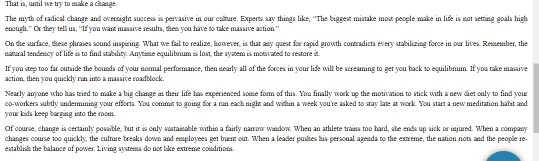
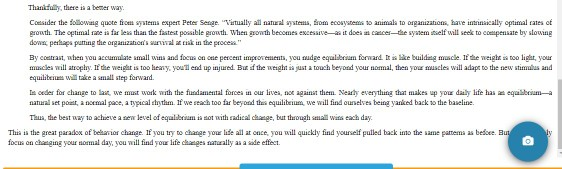
Read die passage gre below and write a PRECIS. Give a vuitable title For exemple, consider your blood pressure. When it dips 100 low your heart rate speeds up and edges your blood pressure back into a healthy age. When it is too high, your kidneys reduce the cost of fluid in the body by flushing out wine. All the while your blood vessels help maintain die balmace by contracting or expanding as seeded The bus body employs trandreds of feedback loops to keep your blood pressure, body temperature, glucose levels, calcium level, and many other processes as a stable equiliteia. That is, until we try to make a cage The myth of radical change and oversight success is pervasive in our culture. Experts say things like, 'The biggest mistake most people make in life is not setting goala high enougla" Or they tell us, "If you want massive results, des you have to take massive action" On the surface, these plurais sound inspiring What we fail to realize however, is that may quest for raped growth contradicts every stabilizing force in our lives. Remember, the satural tendency of life is to find stability. Anytime equilibrium is lost the system is moved to restore If you step too far outside the bounds of your normal perficemance, then stearly all of the forces in your life will be screaming to get you back to equilibrium If you take massive action, then you quickly ran into a massive coadblock. Nearly anyone who has tried to make a big change in their life has experienced some form of this. You finally work up the motivation to stick with a new det only to find your co-workera subtly undermining your efforts. You commit to going for a run each night and within a week you're asked to stay late at work you start a new meditation habit and your ids keep bring into the sol of course, change in certainly pourable, but it is only stable within a fairly narcon window. When an athlete traits too hard, she ends up sick or injured. When a company changes course 100 quickly, the culture break down and employees get best out. When a leader puses las personal agenda to the extreme, the nation not and the people re- establish the balance of power. Living systems do not like extreme conditions Thankfully, there is a better way Consider the following quote from systems expert Peter Senge. "Virtually all natural systems, from ecosystems to animals to organizations have intrinsically optimal rates of growth. The optimal sate in far less than the fastest possible growth. When growth becomes excessive as it does in cances-the system itself will seek to compensate by slowing dows perlaps putting de organization's walk in the process." By contrast, when you accumulate small wims and focus on che percent improvements, you sudge equilibrium forward. I like building muscle. If the weight is too light, your muscles will atrophy. If the weight is too hey, you'll end up injured. But if the weight as just a touch beyond your timmal, then your muscles will adapt to the new stimulus and equilibrium will take a small step forward In order for change to last, we must work with the fundamental forces in our lives, next against them. Nearly everything that makes up your daily life has e equilibrioma natural set post, a normal pace, a typically them. If we reach too far beyond thesequilibrium, we will find ourselves being yanked back to the baseline. Thus, the best way to achieve a ser level of egalabriam ia not with radical change, but through small wets each day. This is the great paradox of beltavior change. If you try to change your lide all at once you will quickly find yourself pulled back into the same pattema as before. But ly focus on changing your normal day, you will find your life changes naturally as a side effect Read die passage gre below and write a PRECIS. Give a vuitable title For exemple, consider your blood pressure. When it dips 100 low your heart rate speeds up and edges your blood pressure back into a healthy age. When it is too high, your kidneys reduce the cost of fluid in the body by flushing out wine. All the while your blood vessels help maintain die balmace by contracting or expanding as seeded The bus body employs trandreds of feedback loops to keep your blood pressure, body temperature, glucose levels, calcium level, and many other processes as a stable equiliteia. That is, until we try to make a cage The myth of radical change and oversight success is pervasive in our culture. Experts say things like, 'The biggest mistake most people make in life is not setting goala high enougla" Or they tell us, "If you want massive results, des you have to take massive action" On the surface, these plurais sound inspiring What we fail to realize however, is that may quest for raped growth contradicts every stabilizing force in our lives. Remember, the satural tendency of life is to find stability. Anytime equilibrium is lost the system is moved to restore If you step too far outside the bounds of your normal perficemance, then stearly all of the forces in your life will be screaming to get you back to equilibrium If you take massive action, then you quickly ran into a massive coadblock. Nearly anyone who has tried to make a big change in their life has experienced some form of this. You finally work up the motivation to stick with a new det only to find your co-workera subtly undermining your efforts. You commit to going for a run each night and within a week you're asked to stay late at work you start a new meditation habit and your ids keep bring into the sol of course, change in certainly pourable, but it is only stable within a fairly narcon window. When an athlete traits too hard, she ends up sick or injured. When a company changes course 100 quickly, the culture break down and employees get best out. When a leader puses las personal agenda to the extreme, the nation not and the people re- establish the balance of power. Living systems do not like extreme conditions Thankfully, there is a better way Consider the following quote from systems expert Peter Senge. "Virtually all natural systems, from ecosystems to animals to organizations have intrinsically optimal rates of growth. The optimal sate in far less than the fastest possible growth. When growth becomes excessive as it does in cances-the system itself will seek to compensate by slowing dows perlaps putting de organization's walk in the process." By contrast, when you accumulate small wims and focus on che percent improvements, you sudge equilibrium forward. I like building muscle. If the weight is too light, your muscles will atrophy. If the weight is too hey, you'll end up injured. But if the weight as just a touch beyond your timmal, then your muscles will adapt to the new stimulus and equilibrium will take a small step forward In order for change to last, we must work with the fundamental forces in our lives, next against them. Nearly everything that makes up your daily life has e equilibrioma natural set post, a normal pace, a typically them. If we reach too far beyond thesequilibrium, we will find ourselves being yanked back to the baseline. Thus, the best way to achieve a ser level of egalabriam ia not with radical change, but through small wets each day. This is the great paradox of beltavior change. If you try to change your lide all at once you will quickly find yourself pulled back into the same pattema as before. But ly focus on changing your normal day, you will find your life changes naturally as a side effect
Step by Step Solution
There are 3 Steps involved in it
1 Expert Approved Answer
Step: 1 Unlock

Question Has Been Solved by an Expert!
Get step-by-step solutions from verified subject matter experts
Step: 2 Unlock
Step: 3 Unlock
 Study Help