







Question: Read example 22.10 in the link above. It considers the case of two recurrent classes, where one of the recurrent classes is ergodic, and the

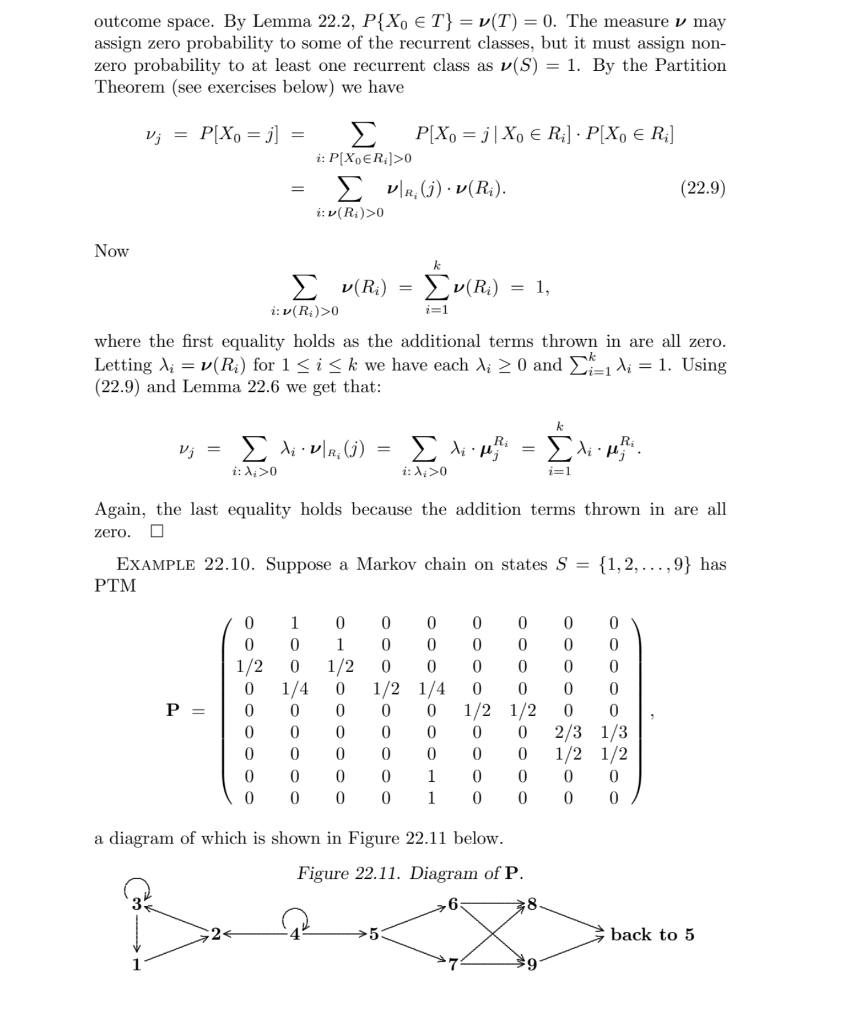
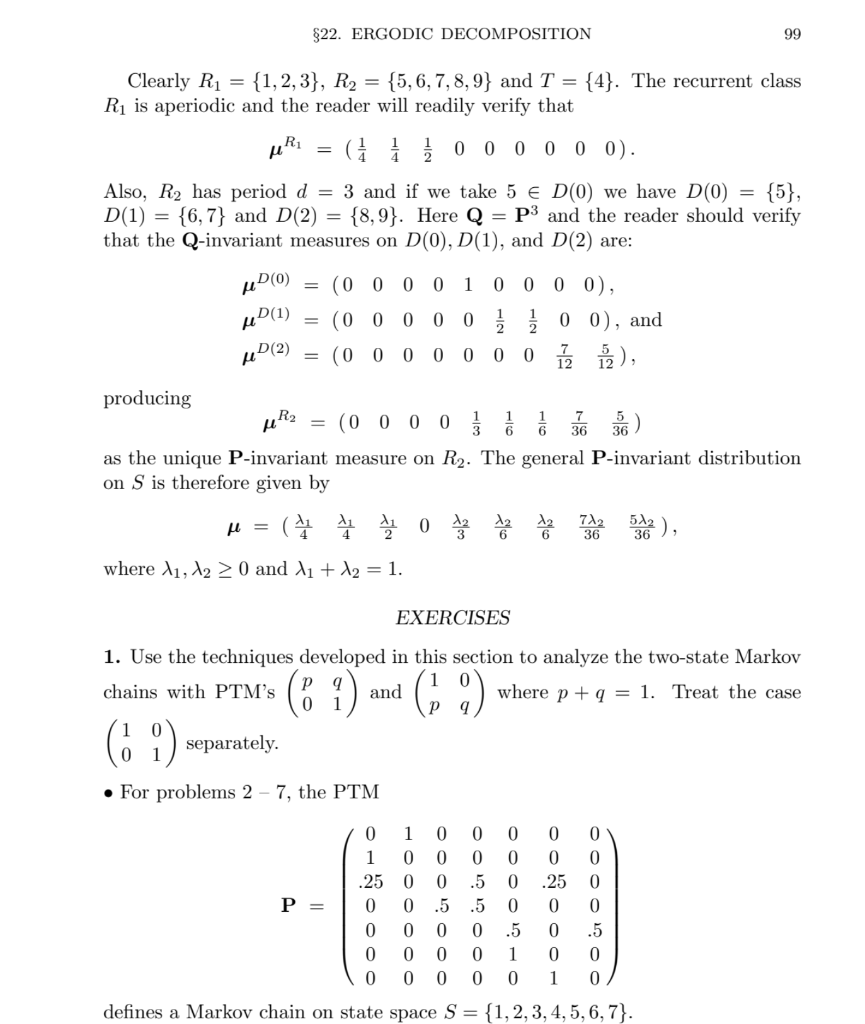
Read example 22.10 in the link above. It considers the case of two recurrent classes, where one of the recurrent classes is ergodic, and the other is periodic. Find lim v P. p3 where v 0 = (000100000). Find the answer theoretically (using a mathematical computation) AND confirm it using a simulation. Submit both your 0 code/output as well as mathematical work. 100 It can be used to replace one homework grade (for both parts done entirely and correctly) OR up to 4 points on a midterm. outcome space. By Lemma 22.2, P{X, ET} = v(T) = 0. The measure v may assign zero probability to some of the recurrent classes, but it must assign non- zero probability to at least one recurrent class as v(S) = 1. By the Partition Theorem (see exercises below) we have Vj = P(X) = j) = P[X, = j|X, e Ri] P(X, E Ri] i: P[X, ER:]>0 vr;(j) v(R;). i: v(R)>0 == (22.9) Now v(R) (R.) = 1, i: v(R)>0 i=1 where the first equality holds as the additional terms thrown in are all zero. Letting li = v(Ri) for 1 0 and Xiai li = 1. Using (22.9) and Lemma 22.6 we get that: k Vj = ti:v|r; (j) I like i: >0 i:li>0 i=1 Again, the last equality holds because the addition terms thrown in are all zero. EXAMPLE 22.10. Suppose a Markov chain on states S = {1, 2, ...,9} has PTM 0 0 1/2 0 0 0 0 P = 1 0 0 1/4 0 0 0 0 0 0 1 1/2 0 0 0 0 0 0 0 0 0 0 0 0 1/2 1/4 0 0 0 0 0 0 0 1 0 1 0 0 0 0 0 0 0 0 1/2 1/2 0 0 0 0 0 0 0 0 0 0 0 0 0 0 0 0 0 0 2/3 1/3 1/2 1/2 0 0 0 0 0 0 a diagram of which is shown in Figure 22.11 below. Figure 22.11. Diagram of P. 2 5 back to 5 $22. ERGODIC DECOMPOSITION 99 - = Clearly R1 {1,2,3}, R2 = {5, 6, 7, 8, 9} and T = {4}. The recurrent class R is aperiodic and the reader will readily verify that UR ( 0 0 0 0 0 0). Also, R2 has period d = 3 and if we take 5 D(0) we have D(0) {5}, D(1) = {6,7} and D(2) {8,9}. Here Q = P3 and the reader should verify that the Q-invariant measures on D(0), D(1), and D(2) are: D(0) = (00 0 0 1 0 0 00), (0 0 0 0 0 00), and D(2) (0 0 0 0 0 0 0 ), producing 4R2 = (0 0 0 0 36 36) as the unique P-invariant measure on R2. The general P-invariant distribution on S is therefore given by ( 0 ), 5 where 11, 12 > 0 and 11 + 12 = 1. MD(1) 0 7X2 36 36 EXERCISES 1. Use the techniques developed in this section to analyze the two-state Markov chains with PTM's and where p + q = 1. Treat the case 0 1 (9 (69) separately. For problems 2 7, the PTM 0 1 0 1 0 0 .250 0.5 0 0.5 .5 0 0 0 0 0 0 0 0 0 P = 0 0 0 0 .5 1 0 0 0 .25 0 0 0 0 0 .5 0 0 0 0 1 defines a Markov chain on state space S = {1,2,3,4,5,6,7}. Read example 22.10 in the link above. It considers the case of two recurrent classes, where one of the recurrent classes is ergodic, and the other is periodic. Find lim v P. p3 where v 0 = (000100000). Find the answer theoretically (using a mathematical computation) AND confirm it using a simulation. Submit both your 0 code/output as well as mathematical work. 100 It can be used to replace one homework grade (for both parts done entirely and correctly) OR up to 4 points on a midterm. outcome space. By Lemma 22.2, P{X, ET} = v(T) = 0. The measure v may assign zero probability to some of the recurrent classes, but it must assign non- zero probability to at least one recurrent class as v(S) = 1. By the Partition Theorem (see exercises below) we have Vj = P(X) = j) = P[X, = j|X, e Ri] P(X, E Ri] i: P[X, ER:]>0 vr;(j) v(R;). i: v(R)>0 == (22.9) Now v(R) (R.) = 1, i: v(R)>0 i=1 where the first equality holds as the additional terms thrown in are all zero. Letting li = v(Ri) for 1 0 and Xiai li = 1. Using (22.9) and Lemma 22.6 we get that: k Vj = ti:v|r; (j) I like i: >0 i:li>0 i=1 Again, the last equality holds because the addition terms thrown in are all zero. EXAMPLE 22.10. Suppose a Markov chain on states S = {1, 2, ...,9} has PTM 0 0 1/2 0 0 0 0 P = 1 0 0 1/4 0 0 0 0 0 0 1 1/2 0 0 0 0 0 0 0 0 0 0 0 0 1/2 1/4 0 0 0 0 0 0 0 1 0 1 0 0 0 0 0 0 0 0 1/2 1/2 0 0 0 0 0 0 0 0 0 0 0 0 0 0 0 0 0 0 2/3 1/3 1/2 1/2 0 0 0 0 0 0 a diagram of which is shown in Figure 22.11 below. Figure 22.11. Diagram of P. 2 5 back to 5 $22. ERGODIC DECOMPOSITION 99 - = Clearly R1 {1,2,3}, R2 = {5, 6, 7, 8, 9} and T = {4}. The recurrent class R is aperiodic and the reader will readily verify that UR ( 0 0 0 0 0 0). Also, R2 has period d = 3 and if we take 5 D(0) we have D(0) {5}, D(1) = {6,7} and D(2) {8,9}. Here Q = P3 and the reader should verify that the Q-invariant measures on D(0), D(1), and D(2) are: D(0) = (00 0 0 1 0 0 00), (0 0 0 0 0 00), and D(2) (0 0 0 0 0 0 0 ), producing 4R2 = (0 0 0 0 36 36) as the unique P-invariant measure on R2. The general P-invariant distribution on S is therefore given by ( 0 ), 5 where 11, 12 > 0 and 11 + 12 = 1. MD(1) 0 7X2 36 36 EXERCISES 1. Use the techniques developed in this section to analyze the two-state Markov chains with PTM's and where p + q = 1. Treat the case 0 1 (9 (69) separately. For problems 2 7, the PTM 0 1 0 1 0 0 .250 0.5 0 0.5 .5 0 0 0 0 0 0 0 0 0 P = 0 0 0 0 .5 1 0 0 0 .25 0 0 0 0 0 .5 0 0 0 0 1 defines a Markov chain on state space S = {1,2,3,4,5,6,7}
Step by Step Solution
There are 3 Steps involved in it

Get step-by-step solutions from verified subject matter experts
 Study Help