- Read Fords Global Platform Strategy. Answer the following:
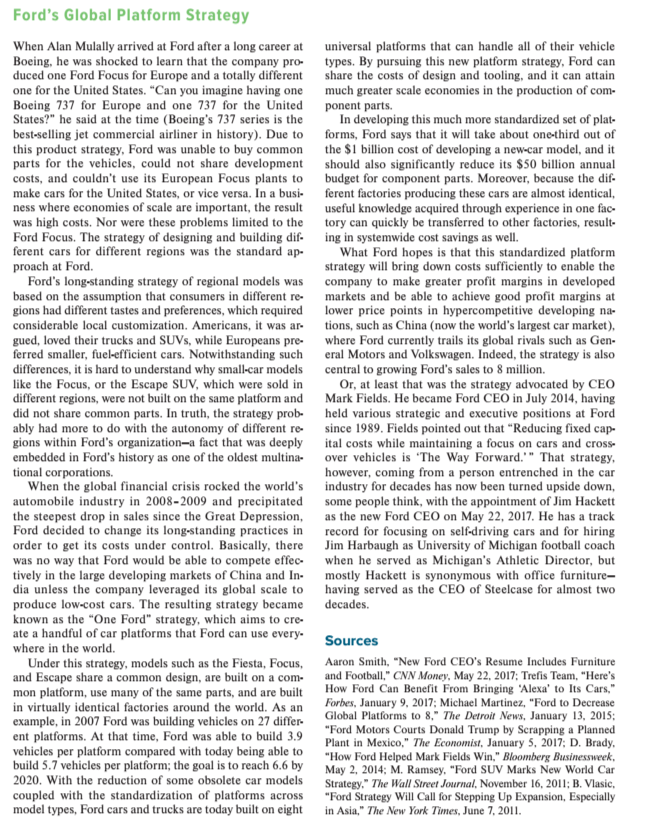
- How would you characterize the strategy for competing internationally that Ford was pursuing prior to the arrival of Alan Mulally? What are the benefits of the more standardized platform strategy? Can you see any drawbacks?
- What would you recommend that Ford undertakes in terms of continuing or possibly changing the global strategy that Mulally put in place? Clearly Fields long-term employment with Ford did not result in a benefit to making Ford globally competitive (Fords stock price dropped 40 percent with Fields in charge).
- Car manufacturers are some of the most secretive companies in the world. Should more car competitors share building platforms to standardize their operations like other industries (e.g., music, electronics)? In this spirit, can Ford become more competitive and more innovative with a non-car person such as Jim Hackett in charge?
Ford's Global Platform Strategy universal platforms that can handle all of their vehicle types. By pursuing this new platform strategy, Ford can When Alan Mulally arrived at Ford after a long career at Boeing, he was shocked to learn that the company pro duced one Ford Focus for Europe and a totally different one for the United States. "Can you imagine having one Boeing 737 for Europe and one 737 for the United States?" he said at the time (Boeing's 737 series is the best-selling jet commercial airliner in history). Due to this product strategy, Ford was unable to buy common parts for the vehicles, could not share development costs, and couldn't use its European Focus plants to make cars for the United States, or vice versa. In a busi- ness where economies of scale are important, the result was high costs. Nor were these problems limited to the Ford Focus. The strategy of designing and building dif. ferent cars for different regions was the standard ap- proach at Ford. Ford's long-standing strategy of regional models was based on the assumption that consumers in different re- gions had different tastes and preferences, which required considerable local customization. Americans, it was ar gued, loved their trucks and SUVs, while Europeans pre. ferred smaller, fuel-efficient cars. Notwithstanding such differences, it is hard to understand why small-car models like the Focus, or the Escape SUV, which were sold in different regions, were not built on the same platform and did not share common parts. In truth, the strategy prob- ably had more to do with the autonomy of different re gions within Ford's organization-a fact that was deeply embedded in Ford's history as one of the oldest multina tional corporations. When the global financial crisis rocked the world's automobile industry in 2008-2009 and precipitated the steepest drop in sales since the Great Depression, Ford decided to change its long-standing practices in order to get its costs under control. Basically, there was no way that Ford would be able to compete effec ely in the large developing markets of China and In- dia unless the company leveraged its global scale to produce low-cost cars. The resulting strategy became known as the "One Ford" strategy, which aims to cre- ate a handful of car platforms that Ford can use every. where in the world. Under this strategy, models such as the Fiesta, Focus, and Escape share a common design, are built on a com- mon platform, use many of the same parts, and are built in virtually identical factories around the world. As an example, in 2007 Ford was building vehicles on 27 differ ent platforms. At that time, Ford was able to build 3.9 vehicles per platform compared with today being able to build 5.7 vehicles per platform; the goal is to reach 6.6 by 2020. With the reduction of some obsolete car models coupled with the standardization of platforms across model types, Ford cars and trucks are today built on eight much greater scale economies in the production of com- ponent parts. In developing this much more standardized set of plat- forms, Ford says that it will take about one-third out of the $1 billion cost of developing a new-car model, and it should also significantly reduce its $50 billion annual budget for component parts. Moreover, because the dif- ferent factories producing these cars are almost identical, useful knowledge acquired through experience in one face tory can quickly be transferred to other factories, result- ing in systemwide cost savings as well. What Ford hopes is that this standardized platform strategy will bring down costs sufficiently to enable the company to make greater profit margins in developed markets and be able to achieve good profit margins at lower price points in hypercompetitive developing na- tions, such as China (now the world's largest car market), where Ford currently trails its global rivals such as Gen- eral Motors and Volkswagen. Indeed, the strategy is also central to growing Ford's sales to 8 million. Or, at least that was the strategy advocated by CEO Mark Fields. He became Ford CEO in July 2014, having held various strategic and executive positions at Ford since 1989. Fields pointed out that "Reducing fixed cap. ital costs while maintaining a focus on cars and cross- over vehicles is "The Way Forward."" That strategy, however, coming from a person entrenched in the car industry for decades has now been turned upside down, some people think, with the appointment of Jim Hackett as the new Ford CEO on May 22, 2017. He has a track record for focusing on self-driving cars and for hiring Jim Harbaugh as University of Michigan football coach when he served as Michigan's Athletic Director, but mostly Hackett is synonymous with office furniture- having served as the CEO of Steelcase for almost two decades. Sources Aaron Smith, "New Ford CEO's Resume Includes Furniture and Football," CNN Money, May 22, 2017: Trefis Team, "Here's How Ford Can Benefit From Bringing 'Alexa' to Its Cars," Forbes, January 9, 2017: Michael Martinez, "Ford to Decrease Global Platforms to 8." The Detroit News, January 13, 2015; "Ford Motors Courts Donald Trump by Scrapping a Planned Plant in Mexico," The Economist, January 5, 2017; D. Brady, "How Ford Helped Mark Fields Win," Bloomberg Businessweek, May 2, 2014; M. Ramsey. "Ford SUV Marks New World Car Strategy." The Wall Street Journal, November 16, 2011: B. Vlasic, "Ford Strategy Will Call for Stepping Up Expansion, Especially in Asia." The New York Times, June 7, 2011




