







Question: Read journal below to answer the question below. When P&G was evaluating this investment opportunity what type of investment project do you think they considered
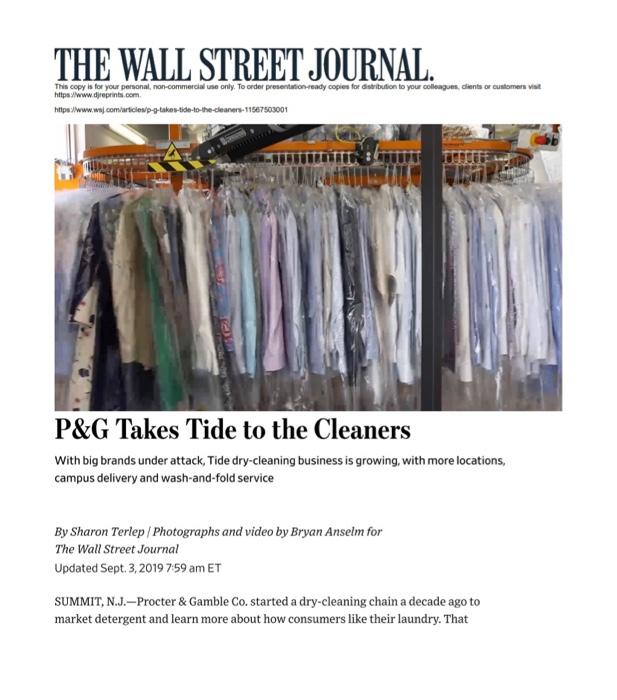
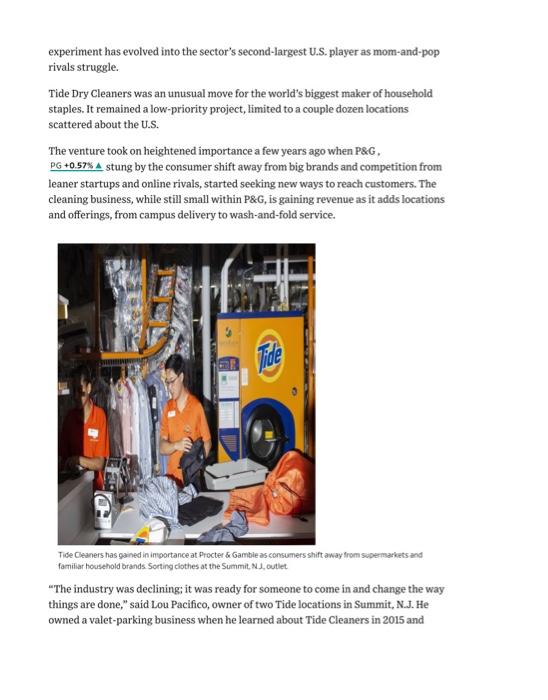
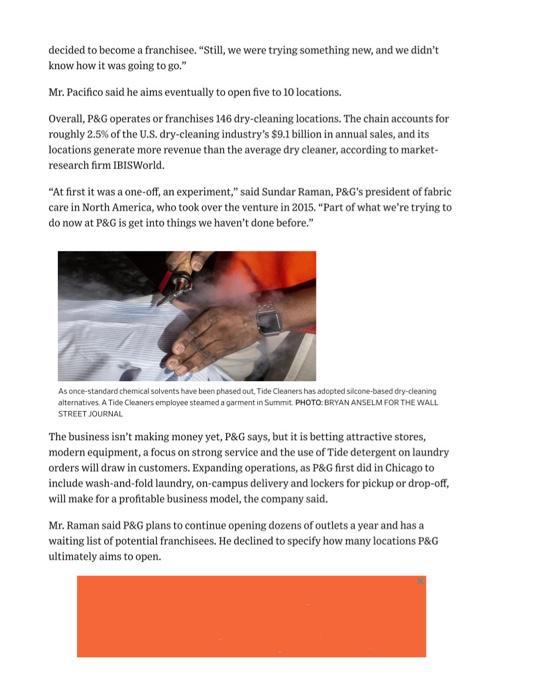
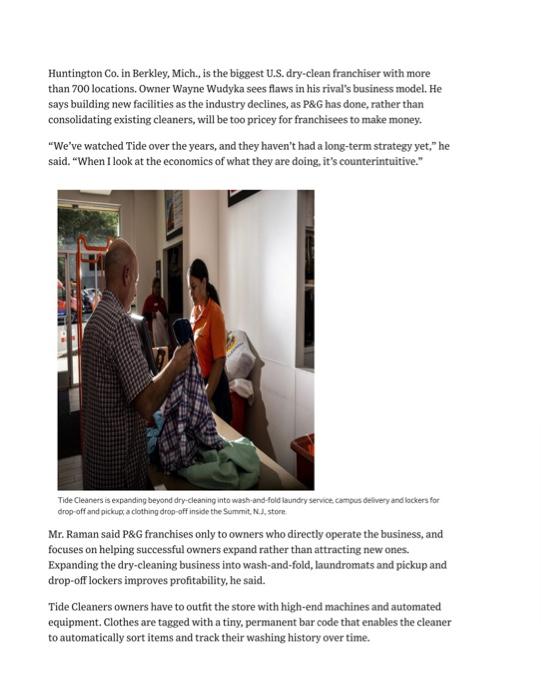
THE WAIL STREE' JOURNAL. This copy is for your personal, non-commercial use only. To onder presentefion-ready copien for distrituifion to your colleagues, dienta or customen vist htips:liww d) htipeslWww. waj comiarticles/p-4-takes-tide-to-the-cleaners-11Stisoso01 P\&G Takes Tide to the Cleaners With big brands under attack, Tide dry-cleaning business is growing, with more locations, campus delivery and wash-and-fold service By Sharon Terlep / Photographs and video by Bryan Anselm for The Wall Street Journal Updated Sept. 3, 2019 7:59 am ET SUMMIT, N.J.-Procter \& Gamble Co. started a dry-cleaning chain a decade ago to market detergent and learn more about how consumers like their laundry. That experiment has evolved into the sector's second-largest U.S. player as mom-and-pop rivals struggle. Tide Dry Cleaners was an unusual move for the world's biggest maker of household staples. It remained a low-priority project, limited to a couple dozen locations scattered about the U.S. The venture took on heightened importance a few years ago when P\&G , PG+0.57%_stung by the consumer shift away from big brands and competition from leaner startups and online rivals, started seeking new ways to reach customers. The cleaning business, while still small within P\&G, is gaining revenue as it adds locations and offerings, from campus delivery to wash-and-fold service. Tide Cleaners has ganed in importance at Procter 6 Gamble as consumers shift away Irom supermarkets and famiilar household brands Sorting clothes at the Summit. N., outlet. "The industry was declining; it was ready for someone to come in and change the way things are done," said Lou Pacifico, owner of two Tide locations in Summit, N.J. He owned a valet-parking business when he learned about Tide Cleaners in 2015 and decided to become a franchisee. "Still, we were trying something new, and we didn't know how it was going to go." Mr. Pacifico said he aims eventually to open five to 10 locations. Overall, P\&G operates or franchises 146 dry-cleaning locations. The chain accounts for roughly 2.5% of the U.S. dry-cleaning industry's $9.1 billion in annual sales, and its locations generate more revenue than the average dry cleaner, according to marketresearch firm IBISWorld. "At first it was a one-off, an experiment," said Sundar Raman, P\&G's president of fabric care in North America, who took over the venture in 2015, "Part of what we're trying to do now at P\&G is get into things we haven't done before," As once-standard chemical solvents have been phased out, Tide Cleaners has adopted sicone-based dry-cleaning alternatives A Tide Cleaners empioyee steamed a garment in Summit. PHOTO- BRYAN ANSELM FOR THE WALL. STREET SOURWAL The business isn't making money yet, P\&G says, but it is betting attractive stores, modern equipment, a focus on strong service and the use of Tide detergent on laundry orders will draw in customers. Expanding operations, as P\&G first did in Chicago to include wash-and-fold laundry, on-campus delivery and lockers for pickup or drop-off, will make for a profitable business model, the company said. Mr. Raman said P\&G plans to continue opening dozens of outlets a year and has a waiting list of potential franchisees. He declined to specify how many locations P\&G ultimately aims to open. Huntington Co. in Berkley, Mich., is the biggest U.S. dry-clean franchiser with more than 700 locations. Owner Wayne Wudyka sees flaws in his rival's business model. He says building new facilities as the industry declines, as P\&G has done, rather than consolidating existing cleaners, will be too pricey for franchisees to make money. "We"ve watched Tide over the years, and they haven't had a long-term strategy yet," he said. "When I look at the economics of what they are doing, it's counterintuitive." Tide Cleaners is expanding beyond dry-cleaning into wash-and-fold isundry service cambus defivery and hackers for drop-off and pichup s clothing drop-off inside the Summit. N.J, store Mr. Raman said P\&G franchises only to owners who directly operate the business, and focuses on helping successful owners expand rather than attracting new ones. Expanding the dry-cleaning business into wash-and-fold, laundromats and pickup and drop-off lockers improves profitability, he said. Tide Cleaners owners have to outfit the store with high-end machines and automated equipment. Clothes are tagged with a tiny, permanent bar code that enables the cleaner to automatically sort items and track their washing history over time. P\&G requires franchisees to pay a $20,000 fee and invest between $660,000 and $1.6 million for their initial store, which must include machinery to dry-clean on site. With dry cleaning, P\&G picked an industry in decline. Overall, there are nearly 33,000 dry-cleaning locations in the U.S., down from close to 40,000 in 2010. Americans increasingly prefer casual clothes and, even with more formal items, apparel makers are using more fabrics that don't require dry cleaning. Meanwhile, operators face regulatory mandates to swap out machines that use chemicals common to the dry-cleaning process in favor of safer solvents. Perchloroethylene, known as perc or PCE, has long been the most commonly used drycleaning solvent. In 2012, the U.S. Environmental Protection Agency classified the substance as a "likely human carcinogen," and state and federal regulators have pushed to phase out the substance, requiring dry cleaners to make costly updates to equipment. Tide Dry Cleaners, like many in the industry, uses a silicone-based alternative chemical dubbed Green Earth that is used in many cosmetics. Alan Spielvogel, director of technical services for the National Dry Cleaners Association trade group, has watched the Tide chain grow. Its offerings, he said, are packaged differently but are basically similar to services offered by a typical dry cleaner. "They are relying on brand recognition," he said, "but they're really not processing the garment any differently than anyone else is," SHARE YOUR THOUGHTS What has been your experience with Tide cleaning products? Join the conversation below. Write to Sharon Terlep at sharon.terlep@wsj.com Corrections \& Amplifications Sundar Raman is P\&G's president of fabric care in North America. An earlier version of this article incorrectly spelled his last name as Ramen. (Sept. 3, 2019) Coppright 02019 Dow sones 8 Compart inc. Al Rogts Reserved THE WAIL STREE' JOURNAL. This copy is for your personal, non-commercial use only. To onder presentefion-ready copien for distrituifion to your colleagues, dienta or customen vist htips:liww d) htipeslWww. waj comiarticles/p-4-takes-tide-to-the-cleaners-11Stisoso01 P\&G Takes Tide to the Cleaners With big brands under attack, Tide dry-cleaning business is growing, with more locations, campus delivery and wash-and-fold service By Sharon Terlep / Photographs and video by Bryan Anselm for The Wall Street Journal Updated Sept. 3, 2019 7:59 am ET SUMMIT, N.J.-Procter \& Gamble Co. started a dry-cleaning chain a decade ago to market detergent and learn more about how consumers like their laundry. That experiment has evolved into the sector's second-largest U.S. player as mom-and-pop rivals struggle. Tide Dry Cleaners was an unusual move for the world's biggest maker of household staples. It remained a low-priority project, limited to a couple dozen locations scattered about the U.S. The venture took on heightened importance a few years ago when P\&G , PG+0.57%_stung by the consumer shift away from big brands and competition from leaner startups and online rivals, started seeking new ways to reach customers. The cleaning business, while still small within P\&G, is gaining revenue as it adds locations and offerings, from campus delivery to wash-and-fold service. Tide Cleaners has ganed in importance at Procter 6 Gamble as consumers shift away Irom supermarkets and famiilar household brands Sorting clothes at the Summit. N., outlet. "The industry was declining; it was ready for someone to come in and change the way things are done," said Lou Pacifico, owner of two Tide locations in Summit, N.J. He owned a valet-parking business when he learned about Tide Cleaners in 2015 and decided to become a franchisee. "Still, we were trying something new, and we didn't know how it was going to go." Mr. Pacifico said he aims eventually to open five to 10 locations. Overall, P\&G operates or franchises 146 dry-cleaning locations. The chain accounts for roughly 2.5% of the U.S. dry-cleaning industry's $9.1 billion in annual sales, and its locations generate more revenue than the average dry cleaner, according to marketresearch firm IBISWorld. "At first it was a one-off, an experiment," said Sundar Raman, P\&G's president of fabric care in North America, who took over the venture in 2015, "Part of what we're trying to do now at P\&G is get into things we haven't done before," As once-standard chemical solvents have been phased out, Tide Cleaners has adopted sicone-based dry-cleaning alternatives A Tide Cleaners empioyee steamed a garment in Summit. PHOTO- BRYAN ANSELM FOR THE WALL. STREET SOURWAL The business isn't making money yet, P\&G says, but it is betting attractive stores, modern equipment, a focus on strong service and the use of Tide detergent on laundry orders will draw in customers. Expanding operations, as P\&G first did in Chicago to include wash-and-fold laundry, on-campus delivery and lockers for pickup or drop-off, will make for a profitable business model, the company said. Mr. Raman said P\&G plans to continue opening dozens of outlets a year and has a waiting list of potential franchisees. He declined to specify how many locations P\&G ultimately aims to open. Huntington Co. in Berkley, Mich., is the biggest U.S. dry-clean franchiser with more than 700 locations. Owner Wayne Wudyka sees flaws in his rival's business model. He says building new facilities as the industry declines, as P\&G has done, rather than consolidating existing cleaners, will be too pricey for franchisees to make money. "We"ve watched Tide over the years, and they haven't had a long-term strategy yet," he said. "When I look at the economics of what they are doing, it's counterintuitive." Tide Cleaners is expanding beyond dry-cleaning into wash-and-fold isundry service cambus defivery and hackers for drop-off and pichup s clothing drop-off inside the Summit. N.J, store Mr. Raman said P\&G franchises only to owners who directly operate the business, and focuses on helping successful owners expand rather than attracting new ones. Expanding the dry-cleaning business into wash-and-fold, laundromats and pickup and drop-off lockers improves profitability, he said. Tide Cleaners owners have to outfit the store with high-end machines and automated equipment. Clothes are tagged with a tiny, permanent bar code that enables the cleaner to automatically sort items and track their washing history over time. P\&G requires franchisees to pay a $20,000 fee and invest between $660,000 and $1.6 million for their initial store, which must include machinery to dry-clean on site. With dry cleaning, P\&G picked an industry in decline. Overall, there are nearly 33,000 dry-cleaning locations in the U.S., down from close to 40,000 in 2010. Americans increasingly prefer casual clothes and, even with more formal items, apparel makers are using more fabrics that don't require dry cleaning. Meanwhile, operators face regulatory mandates to swap out machines that use chemicals common to the dry-cleaning process in favor of safer solvents. Perchloroethylene, known as perc or PCE, has long been the most commonly used drycleaning solvent. In 2012, the U.S. Environmental Protection Agency classified the substance as a "likely human carcinogen," and state and federal regulators have pushed to phase out the substance, requiring dry cleaners to make costly updates to equipment. Tide Dry Cleaners, like many in the industry, uses a silicone-based alternative chemical dubbed Green Earth that is used in many cosmetics. Alan Spielvogel, director of technical services for the National Dry Cleaners Association trade group, has watched the Tide chain grow. Its offerings, he said, are packaged differently but are basically similar to services offered by a typical dry cleaner. "They are relying on brand recognition," he said, "but they're really not processing the garment any differently than anyone else is," SHARE YOUR THOUGHTS What has been your experience with Tide cleaning products? Join the conversation below. Write to Sharon Terlep at sharon.terlep@wsj.com Corrections \& Amplifications Sundar Raman is P\&G's president of fabric care in North America. An earlier version of this article incorrectly spelled his last name as Ramen. (Sept. 3, 2019) Coppright 02019 Dow sones 8 Compart inc. Al Rogts Reserved
Step by Step Solution
There are 3 Steps involved in it

Get step-by-step solutions from verified subject matter experts
 Study Help