







Question: Read Mini Case : Working Smarter at Continental Furniture International (pages 328-332) Discussion Question 3: 3. Develop a plan for Joel and his team to
Read Mini Case: Working Smarter at Continental Furniture International (pages 328-332)
- Discussion Question 3: 3. Develop a plan for Joel and his team to get the Energy Telematics project unsuspended. The plan will need details of who, what, when, where and why. (Case attached):
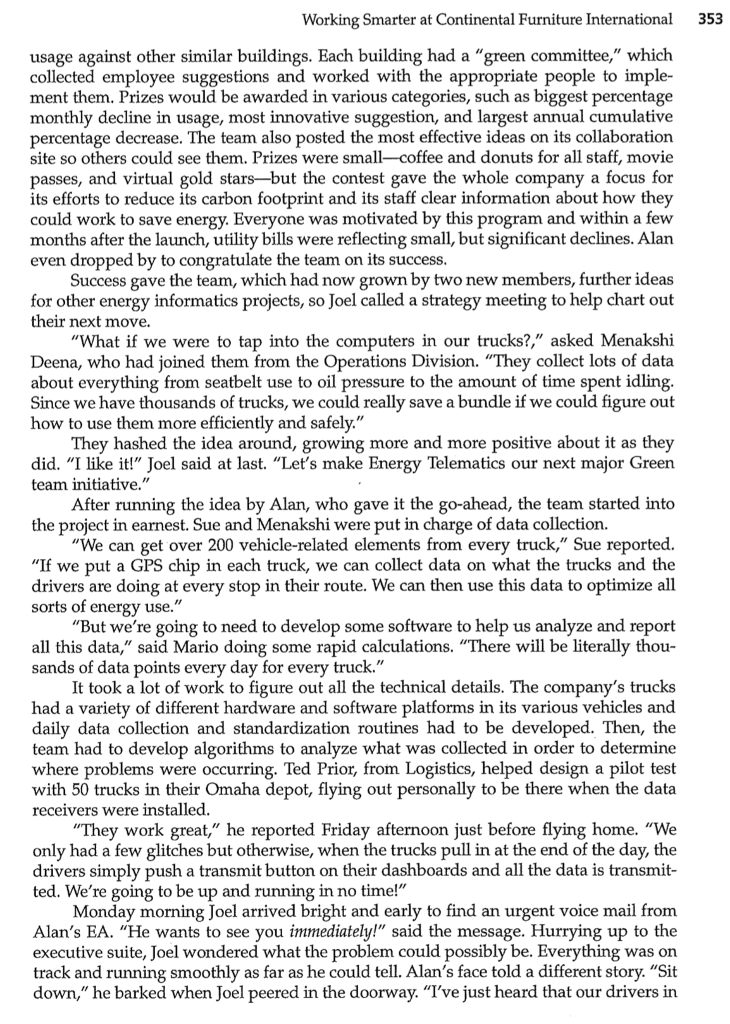
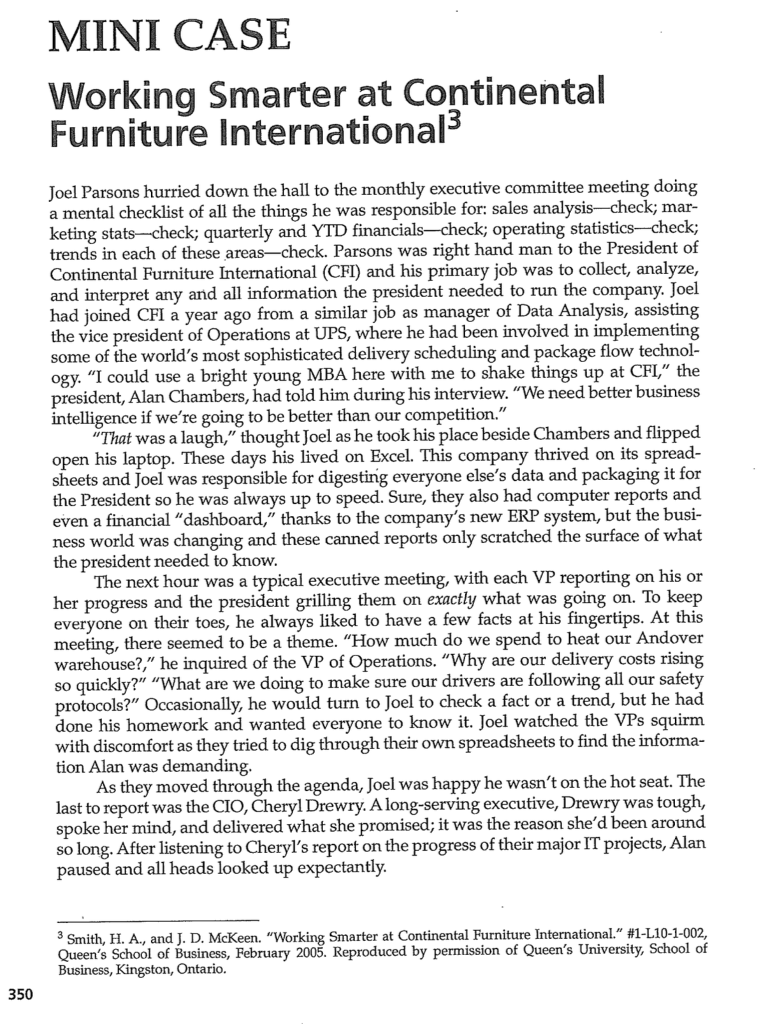
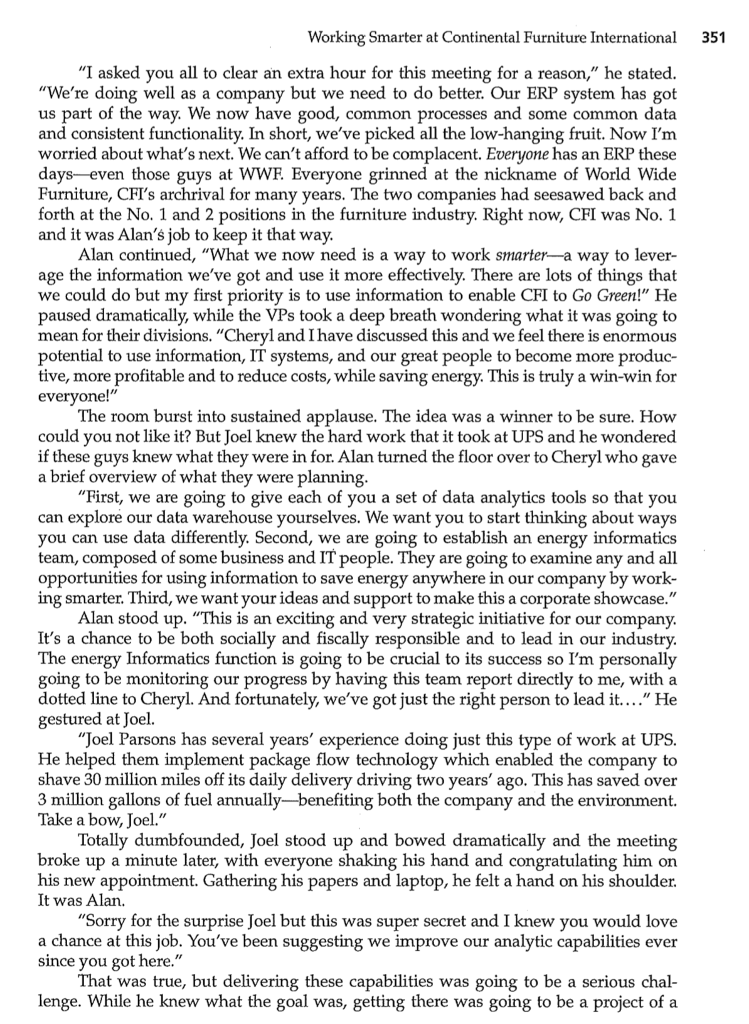
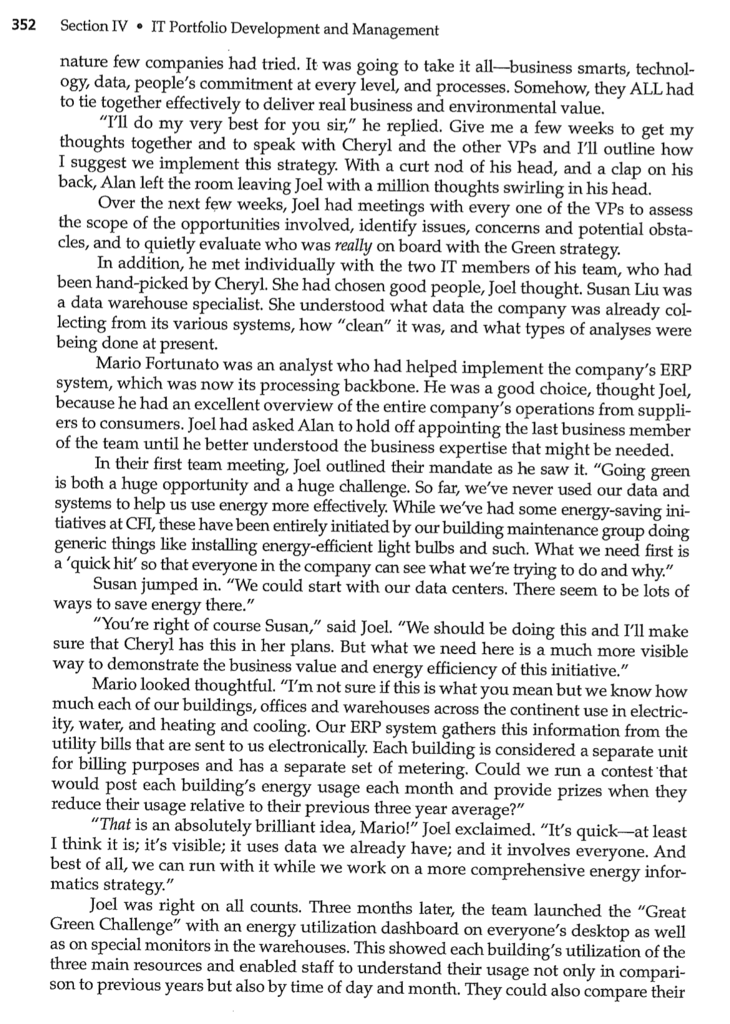
\"Finally, IT is getting a lot of pressure from the executive office,\" reported Sandy. \"These guys have seen what's going on in other companies, and they want to see Genex move into the twenty-first century. Staff at Genex cover vast territory and must work from home, from local facilities, or on the road. Not only does Genex need to provide a virtual working environment for these workers, but it also needs to consider how they can work together as a team without having physical colocation for communication.\" \"Well, | guess we have it all,\" said Devlin. \"Integration problems, outdated hardware and software, inconsistent data, expensive workarounds, pressure to modernize, and substantial budget limitations.\" Turning to Yee and Sandy, he smiled. "\"Now what are we going to do about it? Where do we start?\" Discussion Questions 1. What evidence 1s the CEO using to suggest that Genex 1s not using technology competitively? 2. D1d Devlin need to hire Sandy, a \"high-priced technology consultant,\" to tell him that technology at Genex was a mess? 3. Devise a strategy to successfully implement enterprisewide systems (such as SAP) at Genex. Mini Case Managing Technology at Genex Fuels * Smith, H. A., and J. D. McKeen. \"Managing Technology at Genex Fuels.\" #9-L05-1-004, Queen's School of Business, February 2005. Reproduced by permission of Queen's University, School of Business, Kingston, Ontario. \"You have got yourselves into a terrible predicament,\" said V. R. \"Sandy\" Sandhuramen, his soft Indian accent belying the gravity of his words. \"You are incredibly lucky you have managed to do business as well as you have, but this situation cannot be allowed to carry on.\" Sandy, a high-priced technology consultant, had been hired by Genex Fuel's new CIO, Nick Devlin, to review the company's technology portfolio and help him and his newly appointed IT architect, Chuck Yee, get a handle on the firm's technology needs. Genex, a major producer of crude oil and natural gas, is the largest marketer of petroleum and petroleum products in the region. It is structured into three distinct business divisions, each comprising a number of functional segments. Until recently, IT had been decentralized into the three divisions, each with its own director of IT who reported to the divisional executive vice presidents (EVPs). Devlin, formerly the director of the corporate division, had been appointed CIO and given the specific mandate to bring in SAP as the primary technology platform for all the divisions. \"We have to start behaving like we're one business,\" said the CEO when he appointed Devlin. \"I want a much more agile and responsive IT organization than we've had in the past. It seems to me that every time | ask IT to look into something I've heard or read about, they always come up with a thousand and one reasons why it won 't work. We need to be able to use technology competitively, and that won't happen unless you can get ahead of the curve.\" Devlin's excitement about his new mandate had lasted just about a week, until the true scope of the challenge became clear. He had asked each divisional IT director for an inventory of hardware and software currently in place and to briefly outline the work that was in their plans for the coming year. \"We must have one of every piece of hardware and software ever produced,\" Devlin marveled as he scanned their reports. On the one hand, there was a new customer management system called COMC, which had been implemented to improve real-time information exchange between the company's 135 bulk fuel sites and Genex headquarters. On the other hand, IT was still running an archaic DOS-based marketing system called MAAS to provide customer service and reports. \"And they want to bring in SAP!" he groaned. \"We need a plan, and we need it soon.\" That was when Devlin had engaged Sandy to work with Yee. \"First, | want a no-holds- barred assessment of our current situation,\" he had said, and now they were in his office, outlining the \"terrible predicament.\" \"The biggest problem you face at present,\" said Sandy, \"is the fact that you have absolutely no standards and no integration, as you discovered for yourself, Nick." There was a lot of technology out thereboth old and newand it was a political hot potato. Almost every system had its group of advocates, some very senior in the company. All the EVPs had invested their individual technology budgets in the hardware and software that they felt could best support their work. The problem was that maintaining this mishmash was now costing an arm and a leg. And it was highly doubtful that the company was getting true value for its technology investment. \"We should be able to leverage our existing investments so we can invest in new technology,\" said Yee. \"Instead, almost all our budget is taken up with holding these systems together with toothpicks and tape.\" \"One of the most challenging situations,\" Sandy went on, \"is Price One." Obsolete but absolutely essential, Price One is the fuel-pricing system that stores the pricing algorithms for all fuels marketing functions, including aviation, marine, retail, branded associates, and industrial and wholesale. Although pricing is an integral part of marketing, Price One cannot communicate with COMC and is not easily adaptable to changes in the business environment. Price One perfectly reflected the business and technology that existed ten years ago, but this has now become a real drawback. To get around these limitations while continuing to use Price One, staff manually feed information from pricing requests in COMC to Price One to get approval because both systems use different terminology in coding products for different pricing methods. Price One also lacks the ability to link information from different systems to ensure data integrity. As a result, Price One has accumulated some irrelevant data groups under pricing for products, and such corrupted data can be detected only by an experienced individual who has been dealing with that product group for decades and who would know at a glance the validity of the data. One of Price One's critical flaws is its inability to link with other systems, such as COMC, and to pick up competitive market information in order to approve price. Previous plans to rewrite this system have been resisted strenuously by management because of the expense. Now the system is on its last legs. \"And like most oil and gas companies,\" Sandy observed, \"you have automated very few of your information assets as other types of organizations have done.\" Typically for the industry, Genex had grown by acquiring other, smaller firms and had inherited an enormous amount of physical data. It now has more than two million items of paper and microfilm. It has one hundred twenty thousand tapes of data. Some items date back to the 1940s and came from numerous sources. The company's seismic assets, on which it bases many of its decisions and which has a replacement cost estimated at more than two billion dollars, are stored on a wide variety of media from analog tapes, magnetic reels, and cartridges to optical discs to paper, film, and microfilm. They are spread out across five conventional physical warehouses. This system of data management is problematic for two main reasons. First, with land sales occurring every two weeks, it is extremely difficult to make timely decisions based on all known information about a property. Clearly, the more seismic information a company can bring to bear on its decisions, the better it can decide where it wants to do further work. Second, the company's data assets, on which its future depends, are extremely vulnerable. There is no backup. When needed, the only copy of the information requested is physically transported to Genex's offices. The tapes on which the data reside deteriorate further with each reading. Furthermore, much information resides on obsolete forms of media and is getting increasingly difficult to access. Working Smarter at Continental Furniture International usage against other similar buildings. Each building had a \"green committee,\" which collected employee suggestions and worked with the appropriate people to imple- ment them. Prizes would be awarded in various categories, such as biggest percentage monthly decline in usage, most innovative suggestion, and largest annual cumulative percentage decrease. The team also posted the most effective ideas on its collaboration site so others could see them. Prizes were smallcoffee and donuts for all staff, movie passes, and virtual gold starsbut the contest gave the whole company a focus for its efforts to reduce its carbon footprint and its staff clear information about how they could work to save energy. Everyone was motivated by this program and within a few months after the launch, utility bills were reflecting small, but significant declines. Alan even dropped by to congratulate the team on its success. Success gave the team, which had now grown by two new members, further ideas for other energy informatics projects, so Joel called a strategy meeting to help chart out their next move. \"What if we were to tap into the computers in our trucks?,\" asked Menakshi Deena, who had joined them from the Operations Division. \"They collect lots of data about everything from seatbelt use to oil pressure to the amount of time spent idling. Since we have thousands of trucks, we could really save a bundle if we could figure out how to use them more efficiently and safely.\" They hashed the idea around, growing more and more positive about it as they did. \"I like it!\" Joel said at last. \"Let's make Energy Telematics our next major Green team initiative.\" : After running the idea by Alan, who gave it the go-ahead, the team started into the project in earnest. Sue and Menakshi were put in charge of data collection. \"We can get over 200 vehicle-related elements from every truck,\" Sue reported. \"If we put a GPS chip in each truck, we can collect data on what the trucks and the drivers are doing at every stop in their route. We can then use this data to optimize all sorts of energy use.\" \"But we're going to need to develop some software to help us analyze and report all this data,\" said Mario doing some rapid calculations. \"There will be literally thou- sands of data points every day for every truck.\" It took a lot of work to figure out all the technical details. The company's trucks had a variety of different hardware and software platforms in its various vehicles and daily data collection and standardization routines had to be developed. Then, the team had to develop algorithms to analyze what was collected in order to determine where problems were occurring. Ted Prior, from Logistics, helped design a pilot test with 50 trucks in their Omaha depot, flying out personally to be there when the data receivers were installed. \"They work great,\" he reported Friday afternoon just before flying home. \"We only had a few glitches but otherwise, when the trucks pull in at the end of the day, the drivers simply push a transmit button on their dashboards and all the data is transmit- ted. We're going to be up and running in no time!\" Monday morning Joel arrived bright and early to find an urgent voice mail from Alan's EA. \"He wants to see you immediately!\" said the message. Hurrying up to the executive suite, Joel wondered what the problem could possibly be. Everything was on track and running smoothly as far as he could tell. Alan's face told a different story. \"Sit down,\" he barked when Joel peered in the doorway. \"I've just heard that our drivers in 353 350 MINI CASE Working Smarter at Continental Furniture International' Joel Parsons hurried down the hall to the monthly executive committee meeting doing a mental checklist of all the things he was responsible for: sales analysischeck; mar- keting statscheck; quarterly and YTD financialscheck; operating statisticscheck; trends in each of these areascheck. Parsons was right hand man to the President of Continental Furniture International (CFI) and his primary job was to collect, analyze, and interpret any and all information the president needed to run the company. Joel had joined CFI a year ago from a similar job as manager of Data Analysis, assisting the vice president of Operations at UPS, where he had been involved in implementing some of the world's most sophisticated delivery scheduling and package flow technol- ogy. \"I could use a bright young MBA here with me to shake things up at CFL" the president, Alan Chambers, had told him during his interview. \"We need better business intelligence if we're going to be better than our competition.\" \"That was a laugh,\" thought Joel as he took his place beside Chambers and flipped open his laptop. These days his lived on Excel. This company thrived on its spread- sheets and Joel was responsible for digesting everyone else's data and packaging it for the President so he was always up to speed. Sure, they also had computer reports and even a financial \"dashboard,\" thanks to the company's new ERP system, but the busi- ness world was changing and these canned reports only scratched the surface of what the president needed to know. The next hour was a typical executive meeting, with each VP reporting on his or her progress and the president grilling them on exactly what was going on. To keep everyone on their toes, he always liked to have a few facts at his fingertips. At this meeting, there seemed to be a theme. \"How much do we spend to heat our Andover warehouse?,\" he inquired of the VP of Operations. \"Why are our delivery costs rising so quickly?\" \"What are we doing to make sure our drivers are following all our safety protocols?\" Occasionally, he would turn to Joel to check a fact or a trend, but he had done his homework and wanted everyone to know it. Joel watched the VPs squirm with discomfort as they tried to dig through their own spreadsheets to find the informa- tion Alan was demanding. As they moved through the agenda, Joel was happy he wasn't on the hot seat. The last to report was the CIO, Cheryl Drewry. A long-serving executive, Drewry was tough, spoke her mind, and delivered what she promised; it was the reason she'd been around so long. After listening to Cheryl's report on the progress of their major IT projects, Alan paused and all heads looked up expectantly. 3 gmith, H. A., and J. D. McKeen. \"Working Smarter at Continental Furniture International.\" #1-L10-1-002, Queen's School of Business, February 2005. Reproduced by permission of Queen's University, School of Business, Kingston, Ontario. Working Smarter at Continental Furniture International \"I asked you all to clear an extra hour for this meeting for a reason,\" he stated. \"We're doing well as a company but we need to do better. Our ERP system has got us part of the way. We now have good, common processes and some common data and consistent functionality. In short, we've picked all the low-hanging fruit. Now I'm worried about what's next. We can't afford to be complacent. Everyone has an ERP these dayseven those guys at WWE. Everyone grinned at the nickname of World Wide Furniture, CFI's archrival for many years. The two companies had seesawed back and forth at the No. 1 and 2 positions in the furniture industry. Right now, CFI was No. 1 and it was Alan's job to keep it that way. Alan continued, \"What we now need is a way to work smartera way to lever- age the information we've got and use it more effectively. There are lots of things that we could do but my first priority is to use information to enable CFI to Go Green!\" He paused dramatically, while the VPs took a deep breath wondering what it was going to mean for their divisions. \"Cheryl and I have discussed this and we feel there is enormous potential to use information, IT systems, and our great people to become more produc- tive, more profitable and to reduce costs, while saving energy. This is truly a win-win for everyone!\" The room burst into sustained applause. The idea was a winner to be sure. How could you not like it? But Joel knew the hard work that it took at UPS and he wondered if these guys knew what they were in for. Alan turned the floor over to Cheryl who gave a brief overview of what they were planning. \"First, we are going to give each of you a set of data analytics tools so that you can explore our data warehouse yourselves. We want you to start thinking about ways you can use data differently. Second, we are going to establish an energy informatics team, composed of some business and IT people. They are going to examine any and all opportunities for using information to save energy anywhere in our company by work- ing smarter. Third, we want your ideas and support to make this a corporate showcase.\" Alan stood up. \"This is an exciting and very strategic initiative for our company. It's a chance to be both socially and fiscally responsible and to lead in our industry. The energy Informatics function is going to be crucial to its success so I'm personally going to be monitoring our progress by having this team report directly to me, with a dotted line to Cheryl. And fortunately, weve got just the right person to lead it...."\" He gestured at Joel. \"Joel Parsons has several years' experience doing just this type of work at UPS. He helped them implement package flow technology which enabled the company to shave 30 million miles off its daily delivery driving two years' ago. This has saved over 3 million gallons of fuel annuallybenefiting both the company and the environment. Take a bow, Joel.\" Totally dumbfounded, Joel stood up and bowed dramatically and the meeting broke up a minute later, with everyone shaking his hand and congratulating him on his new appointment. Gathering his papers and laptop, he felt a hand on his shoulder. It was Alan, \"Sorry for the surprise Joel but this was super secret and I knew you would love a chance at this job. You've been suggesting we improve our analytic capabilities ever since you got here.\" That was true, but delivering these capabilities was going to be a serious chal- lenge. While he knew what the goal was, getting there was going to be a project of a 351 352 Section IV IT Portfolio Development and Management nature few companies had tried. It was going to take it allbusiness smarts, technol- ogy, data, people's commitment at every level, and processes. Somehow, they ALL had to tie together effectively to deliver real business and environmental value. \"I'll do my very best for you sir,\" he replied. Give me a few weeks to get my thoughts together and to speak with Cheryl and the other VPs and I'll outline how I suggest we implement this strategy. With a curt nod of his head, and a clap on his back, Alan left the room leaving Joel with a million thoughts swirling in his head. Over the next few weeks, Joel had meetings with every one of the VPs to assess the scope of the opportunities involved, identify issues, concerns and potential obsta- cles, and to quietly evaluate who was really on board with the Green strategy. In addition, he met individually with the two IT members of his team, who had been hand-picked by Cheryl. She had chosen good people, Joel thought. Susan Liu was a data warehouse specialist. She understood what data the company was already col- lecting from its various systems, how \"clean\" it was, and what types of analyses were being done at present. Mario Fortunato was an analyst who had helped implement the company's ERP system, which was now its processing backbone. He was a good choice, thought Joel, because he had an excellent overview of the entire company's operations from suppli- ers to consumers. Joel had asked Alan to hold off appointing the last business member of the team until he better understood the business expertise that might be needed. In their first team meeting, Joel outlined their mandate as he saw it. \"Going green is both a huge opportunity and a huge challenge. So far, we've never used our data and systems to help us use energy more effectively. While we've had some energy-saving ini- tiatives at CFl, these have been entirely initiated by our building maintenance group doing generic things like installing energy-efficient light bulbs and such. What we need first is a 'quick hit' so that everyone in the company can see what we're trying to do and why.\" Susan jumped in. \"We could start with our data centers. There seem to be lots of ways to save energy there.\" \"You're right of course Susan,\" said Joel. \"We should be doing this and I'll make sure that Cheryl has this in her plans. But what we need here is a much more visible way to demonstrate the business value and energy efficiency of this initiative.\" Mario looked thoughtful. \"I'm not sure if this is what you mean but we know how much each of our buildings, offices and warehouses across the continent use in electric- ity, water, and heating and cooling. Our ERP system gathers this information from the utility bills that are sent to us electronically. Each building is considered a separate unit for billing purposes and has a separate set of metering. Could we run a contest that would post each building's energy usage each month and provide prizes when they reduce their usage relative to their previous three year average?\" \"That is an absolutely brilliant idea, Mario!\" Joel exclaimed. \"It's quickat least I think it is; it's visible; it uses data we already have; and it involves everyone, And best of all, we can run with it while we work on a more comprehensive energy infor- matics strategy.\" Joel was right on all counts. Three months later, the team launched the \"Great Green Challenge\" with an energy utilization dashboard on everyone's desktop as well as on special monitors in the warehouses. This showed each building's utilization of the three main resources and enabled staff to understand their usage not only in compari- son to previous years but also by time of day and month. They could also compare their 354 Section IV e IT Portfolio Development and Management Omaha are threatening to strike,\" he said as Joel took his seat. \"They think you're going to use your system to monitor their behavior. What's going on?\" \"I have no idea sir,\" Joel stammered. \"We've just done a technical pilot.\" \"Well, I've told them out there that the pilot has been suspended indefinitely,\" Alan said. \"Clearly, you haven't been careful about the impressions you're giving so you'd better go back to the drawing board.\" Back in the team room, Joel called an urgent meeting to explain the situation. \"We've done a lot of work to collect this data and it could have a huge impact on our costs, energy efficiency and safety record,\" he noted. \"But we will not get a chance to prove this if we don't figure out how to get the drivers onside. We didn't need to \"sell' the Great Green project, but this hostile reaction suggests that we may have some sell- ing to do with other parts of the organization as well as our truck drivers. Anybody got any other ideas about what could go wrong?\" \"Well, our front-line operations managers are super busy,\" said Menakshi. \"We''d better be careful how we present this program to them or it could be seen as a lot of extra work.\" \"Our mechanics should be involved as well,\" said Ted. \"They seemed quite inter- ested in the information we could pull off the trucks. They could be quite helpful if we get them involved.\" \"We've got all this great data,\" said Sue, \"but how are we going to get the drivers to act on it? Just collecting this information isn't enough.\" \"We've also got to consider how to roll this project out across the company,\" said Mario. \"If the drivers can get this upset about a simple technical pilot, what are they going to do when they see the information we're planning to collect!\" The team fell silent and Joel turned all these thoughts over in his mind. He knew his future at CFI depended on what they did next. They'd barely started this project and it was already in trouble. \"Okay,\" he said. \"We've hit a snag so now we've got to find a way to get Energy Telematics back on track. I told Alan we'd work up a plan and, if he likes it, he'll unsus- pend the project. Who's got some ideas?\
Step by Step Solution
There are 3 Steps involved in it

Get step-by-step solutions from verified subject matter experts
 Study Help